
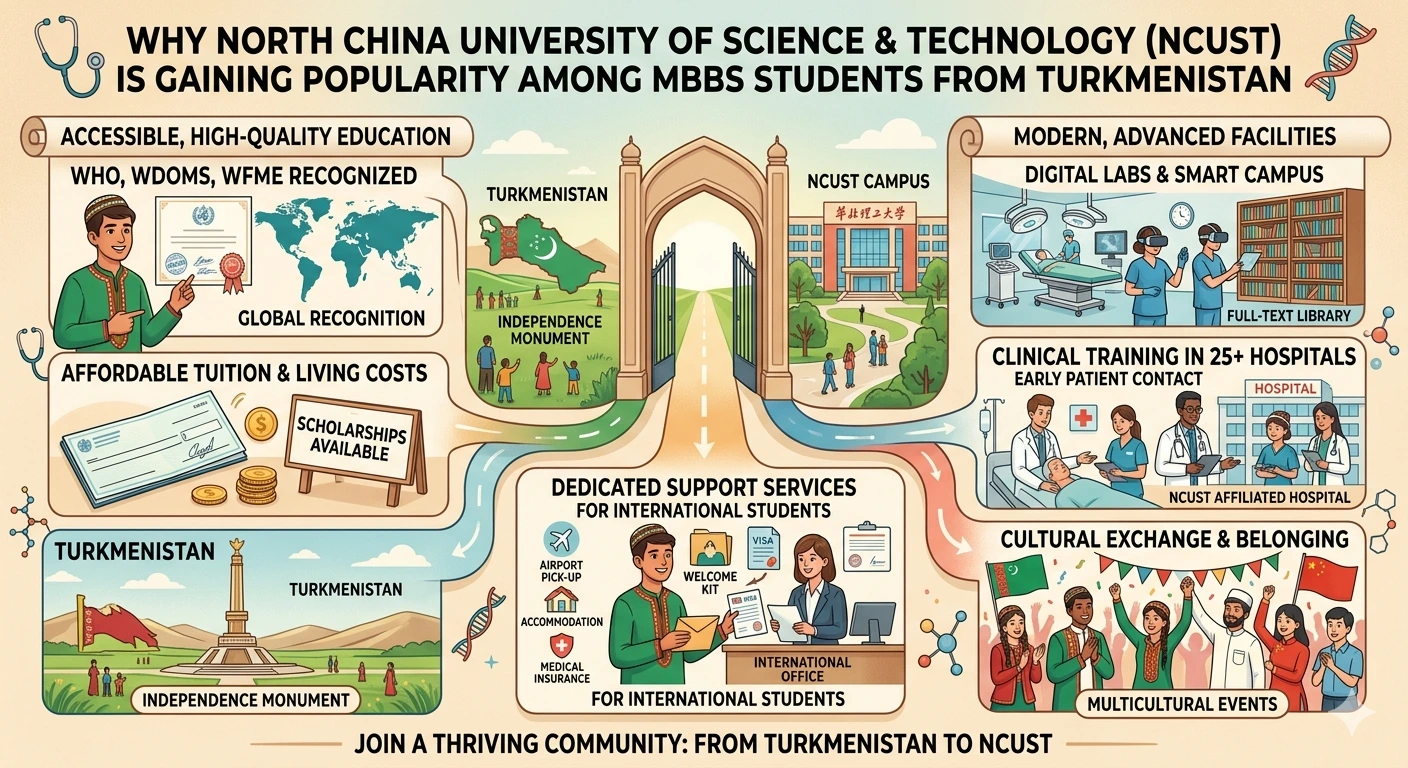
North China University of Science & Technology is gaining traction among MBBS students from Turkmenistan due to its structured clinical training model, English-medium instruction, and stable academic progression. The program aligns with international licensing pathways while minimizing transition challenges often faced by Central Asian students. Strong hospital affiliations and early exposure to clinical environments further strengthen its appeal.
Study sphere advisors has observed consistent application patterns where students prioritize universities that combine academic clarity with practical training. This article delivers a focused breakdown of why this institution is increasingly preferred, supported by structured comparisons, technical data, and decision-making insights.
Academic structure and clinical exposure advantages
North China University of Science & Technology integrates theoretical sciences with hospital-based clinical practice from early years. This reduces the common gap between classroom learning and real-world medical application.
Clinical integration model
Students enter supervised hospital environments earlier than many comparable institutions. This allows:
- Faster development of patient interaction skills
- Improved diagnostic reasoning through real case exposure
- Reduced adjustment pressure during final clinical years
Bonus Tip: Early clinical exposure benefits students from Turkmenistan who may face adaptation challenges in new healthcare systems. Starting early shortens the learning curve.
Why students from Turkmenistan prefer this university
Students from Turkmenistan typically seek stability, English-medium instruction, and globally aligned curricula. This university meets these requirements without unnecessary complexity.
Key preference factors
| Decision Factor | North China University of Science & Technology | Typical Alternative Universities |
|---|---|---|
| Medium of Instruction | Fully English for MBBS | Mixed or partially English |
| Clinical Exposure Start | Early-stage integration | Often delayed until later years |
| Curriculum Structure | Globally aligned and standardized | Varies significantly |
| Student Support Systems | Structured academic guidance | Inconsistent across institutions |
| Licensing Preparation | Integrated approach | Often requires external preparation |
According to UNESCO Institute for Statistics, outbound student mobility from Central Asia has steadily increased by over 15% in recent years, reflecting a shift toward internationally aligned medical programs.
Program structure and technical specifications
The MBBS program follows a standardized structure designed for international students. This ensures clarity in progression and predictable academic milestones.
Core academic framework and training structure
| Component | Details |
|---|---|
| Program Duration | 6 years (including internship) |
| Language of Instruction | English |
| Clinical Training | Integrated with affiliated hospitals |
| Internship Structure | Final year practical rotation |
| Degree Recognition | Aligns with international medical frameworks |
| Teaching Methodology | Lectures, lab work, clinical rotations |
| Assessment Style | Continuous + final evaluations |
World Health Organization (WHO) directories confirm that globally listed institutions with structured clinical programs improve licensing exam success rates.
Learning environment and regional adaptability
The university environment supports international students through organized campus systems and predictable academic schedules. For students from Turkmenistan, adaptability plays a key role.
Regional adjustment considerations
- Climate variation requires preparation for colder seasons
- Food and cultural differences are manageable within campus facilities
- Academic discipline is structured and timetable-driven
Bonus Tip: Students benefit from preparing for seasonal climate changes in advance, particularly winter adaptation, which can affect initial academic performance.
Practical decision factors before selecting a university
Choosing a medical university requires evaluating long-term academic and professional outcomes rather than short-term convenience.
Key evaluation criteria
- Accreditation and global recognition status
- Clinical exposure quality and hospital partnerships
- Language clarity throughout the program
- Licensing pathway compatibility
- Student support and academic consistency
Global education reports from OECD highlight that students choosing structured programs with early clinical integration show better long-term professional stability.
Study sphere advisors relevant support services
Study sphere advisors provides focused support aligned with international medical education pathways. The services listed below are directly relevant to students planning MBBS abroad.
- Student Visa Processing
Structured documentation handling to reduce rejection risks and delays. - Study Visa Guidance
Clear pathway mapping aligned with university admission requirements. - Business Visa Assistance
Supports guardians or representatives visiting institutions for verification. - Work Visa Consultation
Guidance for post-graduation opportunities and regulatory pathways.
This support framework ensures that administrative barriers do not disrupt academic planning.
Common pre-decision questions students ask
Is the program fully taught in English
Yes. The MBBS program is delivered in English, reducing language barriers for international students.
Does the university provide early clinical exposure
Yes. Clinical exposure begins earlier than many comparable institutions, improving practical learning.
Is the degree aligned with international licensing requirements
The curriculum is structured to support global licensing pathways, though individual country requirements must still be verified.
How structured is the academic progression
The program follows a fixed, predictable academic structure with defined milestones.
Answers to broader student concerns after enrollment
How can students adapt quickly to a new academic system
Following structured study schedules and engaging in early clinical practice improves adaptation speed.
What challenges do international students typically face
Climate adjustment, food preferences, and academic pacing are the most common initial challenges.
How important is clinical exposure during MBBS
Clinical exposure is critical for developing diagnostic and patient management skills.
Can students pursue licensing exams after graduation
Yes. Graduates typically proceed toward licensing exams based on their target country requirements.
How can students maintain consistent academic performance
Regular revision, participation in clinical sessions, and structured time management ensure stability.
Key takeaways
North China University of Science & Technology stands out due to its early clinical exposure, structured curriculum, and alignment with international medical pathways. These factors directly address the primary concerns of MBBS students from Turkmenistan.
Careful evaluation of clinical training quality, academic consistency, and long-term licensing compatibility remains essential before finalizing any decision.
Leave a Reply