
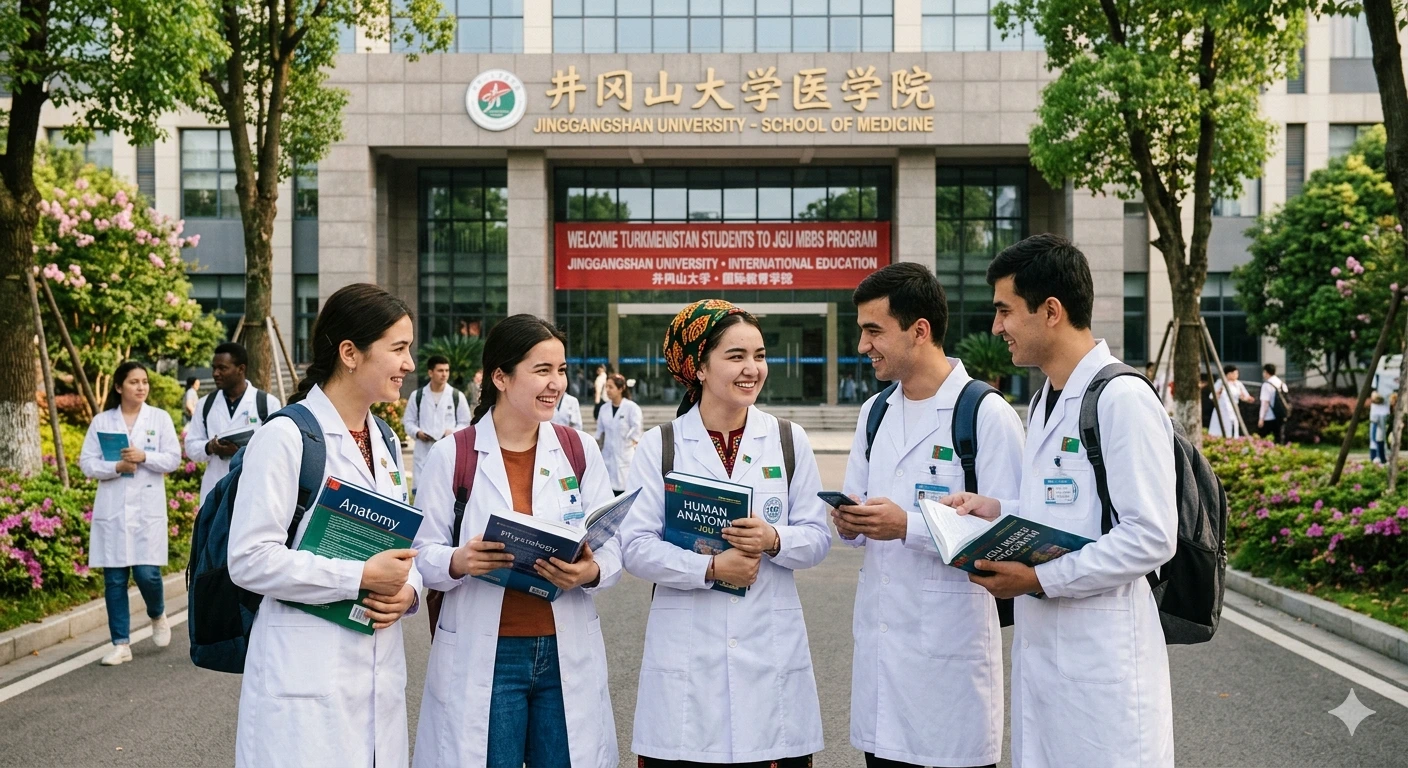
Jinggangshan University’s MBBS program appeals to medical aspirants from Turkmenistan because it offers structured English-medium education, early clinical exposure, and alignment with international licensing pathways. The program reduces transition challenges often faced by Central Asian students by combining foundational sciences with hospital-based training in a controlled academic environment.
Study sphere advisors has observed consistent decision patterns among applicants from Turkmenistan: preference is given to universities that provide stable academic delivery, multicultural adaptation support, and predictable clinical progression. This article breaks down the academic structure, technical specifications, and practical considerations that influence this choice.
Program Structure and Clinical Integration
Jinggangshan University follows a phased MBBS model that integrates theoretical knowledge with hands-on hospital training.
Academic and Clinical Flow
| Phase | Duration | Focus Area | Outcome |
|---|---|---|---|
| Pre-Clinical | 2 years | Basic sciences (Anatomy, Physiology, Biochemistry) | Strong foundational knowledge |
| Para-Clinical | 1 year | Pathology, Pharmacology, Microbiology | Disease understanding and diagnostics |
| Clinical | 2 years | Rotations in affiliated hospitals | Practical patient interaction |
| Internship | 1 year | Supervised hospital practice | Real-world clinical readiness |
This structured progression ensures that students do not face abrupt transitions when entering clinical environments.
Bonus Tip: Students from Turkmenistan benefit from early exposure to clinical terminology in English, reducing language barriers during hospital rotations.
Technical Specifications and Academic Framework
The program is designed to align with global medical education standards, ensuring compatibility with licensing exams in multiple countries.
Key Academic and Operational Details
| Specification | Details |
|---|---|
| Medium of Instruction | English |
| Duration | 6 years (including internship) |
| Recognition | Listed in international medical directories |
| Clinical Training | Conducted in affiliated teaching hospitals |
| Curriculum Standard | Aligned with global MBBS frameworks |
| Assessment Model | Semester-based evaluations with practical exams |
| Student Demographics | International cohort with Central Asian representation |
According to the World Directory of Medical Schools (WDOMS), internationally listed universities improve eligibility for licensing pathways across multiple countries. Additionally, data from UNESCO (2024) indicates that China remains one of the top destinations for international medical students due to structured education systems and clinical infrastructure.
Why Turkmenistan Students Prefer This Program
Several practical factors drive this preference beyond general academic appeal.
Adaptation and Learning Environment
- Climate similarity between parts of China and Central Asia reduces physical adjustment stress
- Availability of halal food and cultural communities supports lifestyle continuity
- English-medium teaching reduces dependency on local language during academics
Clinical Exposure Advantage
Students gain access to high patient volumes in teaching hospitals. This exposure enhances diagnostic confidence and procedural familiarity.
Bonus Tip: Choosing universities with high patient inflow significantly improves clinical competence compared to low-volume training setups.
Comparison with Other MBBS Destinations
Students from Turkmenistan often compare China with alternative destinations before making a decision.
Destination-Based Comparison
| Factor | China (Jinggangshan University) | Eastern Europe | Central Asia |
|---|---|---|---|
| Medium of Instruction | English | Mixed (English + Local) | Mostly local languages |
| Clinical Exposure | High patient volume | Moderate | Limited |
| Curriculum Structure | Standardized | Varies by country | Less standardized |
| International Recognition | Broad | Moderate | Limited |
| Cultural Adaptation | Moderate | Challenging | Easy |
This comparison highlights why structured programs in China often provide a balanced academic and clinical pathway.
Key Decision Factors Before Choosing This Path
Selecting an MBBS program requires careful evaluation beyond surface-level features.
What to Evaluate Before Enrollment
- Verify recognition in international medical directories
- Assess hospital affiliations for clinical training quality
- Confirm medium of instruction consistency throughout the program
- Understand licensing exam eligibility in the target country
- Evaluate student support systems for international adaptation
Study sphere advisors emphasizes that overlooking clinical training quality is one of the most common mistakes applicants make.
Bonus Tip: Always review internship structure separately, as it directly impacts licensing readiness.
Services Offered by Study sphere advisors
Study sphere advisors provides structured guidance aligned with medical education pathways:
- Student Visa Processing
Handles documentation and compliance for smooth international transitions - Study Visa Consultation
Aligns university selection with long-term licensing and career goals - Work Visa Guidance
Supports post-graduation pathways where applicable - Business Visa Assistance
Facilitates short-term academic visits and institutional coordination
Practical Questions Students Ask Before Applying
Is the program fully taught in English
Yes. The academic curriculum is delivered in English, though basic local language learning may be introduced for patient interaction.
How strong is the clinical exposure
Affiliated hospitals provide consistent patient interaction, which strengthens hands-on learning.
Does the degree support international licensing
Eligibility depends on country-specific regulations, but internationally listed universities generally improve access to licensing exams.
Is cultural adjustment difficult
Moderate adjustment is expected, but existing international student communities ease the transition.
Long Term Considerations After Enrollment
How can students maximize clinical training
Active participation in rotations and consistent patient interaction improve competency.
What challenges appear during internship
Communication with patients in local languages can require adaptation.
How to prepare for licensing exams early
Parallel preparation during clinical years improves success rates.
Does international exposure improve career mobility
Yes. Training in structured systems enhances adaptability across healthcare environments.
Final Takeaways for Medical Aspirants
Jinggangshan University’s MBBS program offers a structured, clinically integrated pathway that aligns with the expectations of students from Turkmenistan. Strong academic sequencing, reliable hospital exposure, and international compatibility form the core strengths of the program.
Careful evaluation of recognition, clinical infrastructure, and long-term licensing goals remains essential. A decision based on structured comparison and verified data leads to better academic and professional outcomes.
Leave a Reply