
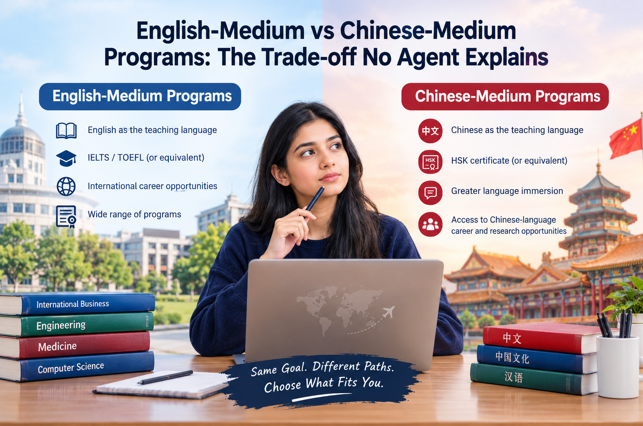
Choosing between English-medium and Chinese-medium programs in China is not simply a language decision. It affects admission eligibility, scholarship options, classroom performance, clinical or practical training, internship opportunities, and future employment. English-medium programs can suit international students who are not yet proficient in Chinese, while Chinese-medium programs can provide stronger day-to-day language immersion and access to a wider range of Chinese-language academic and professional environments. The right choice depends on the specific university, degree, language requirements, and career plans.
For Pakistani students, particularly those considering medicine, dentistry, engineering, business, or postgraduate research, the distinction deserves careful attention. A program advertised as English-taught may still involve Chinese-language communication during practical training or everyday activities. Conversely, enrolling in a Chinese-medium program without sufficient language preparation can create academic difficulties even for students with strong previous grades.
University selection and admission advisory experience highlights a common planning mistake: students sometimes compare universities by scholarship availability or program title before checking the actual teaching language, language-test requirements, and opportunities to use the language outside lectures. These details should be verified before accepting an offer or submitting a student visa application.
What Is the Difference Between English-Medium and Chinese-Medium Programs
| Factor | English-Medium Programs | Chinese-Medium Programs |
|---|---|---|
| Main teaching language | English | Chinese, usually Mandarin |
| Typical language evidence | IELTS, TOEFL, an accepted English-medium education certificate, or another university-approved document | HSK certificate or another form of Chinese proficiency accepted by the university |
| Classroom adjustment | Often easier for students educated in English | Requires sufficient Chinese comprehension, academic vocabulary, and listening skills |
| Everyday communication | Chinese is still useful for housing, transport, administration, and daily life | Language immersion may develop through both study and daily interaction |
| Academic preparation | Students must understand technical terminology in English | Students must understand lectures, textbooks, examinations, and technical terminology in Chinese |
| Career preparation | May support international or English-speaking career paths, depending on the degree | May support roles requiring Chinese communication, depending on the profession and employer |
| Main limitation | Less automatic exposure to academic Chinese | A language gap can affect grades, participation, and practical learning |
The teaching language alone does not determine the quality of a degree. Students should examine the curriculum, faculty, laboratories, teaching hospitals where relevant, accreditation, and the university’s support for international students.
Admission and Language Requirements You Should Check
Language requirements differ by institution, qualification level, and subject. Applicants should not assume that one certificate or score will be accepted by every Chinese university.
| Requirement | English-Medium Program | Chinese-Medium Program |
|---|---|---|
| Previous education | Required school certificate or degree for the chosen qualification | Required school certificate or degree for the chosen qualification |
| Language proof | IELTS, TOEFL, previous English-medium education, or another accepted option, as specified by the university | HSK score or other accepted proof of Chinese proficiency |
| Academic records | Transcripts and certificates | Transcripts and certificates |
| Additional documents | May include a personal statement, recommendation letters, portfolio, or research proposal | May include a personal statement, recommendation letters, portfolio, or research proposal |
| Entrance assessments | Required where specified by the institution or program | Required where specified by the institution or program |
| Medical and professional programs | Additional academic, clinical, or professional conditions may apply | Additional academic, clinical, or professional conditions may apply |
For example, Central South University’s published 2026 Silk Road Scholarship requirements for selected master’s and doctoral programs specify IELTS 6.0 or TOEFL 85 for English-taught study, and HSK Level 4 with a score of 260 or above for Chinese-taught study. Applicants with HSK Level 4 scores from 180 to below 260 may qualify for one year of Chinese-language preparation under that particular scheme. These are program-specific criteria, not universal Chinese university requirements. Source: Central South University scholarship notice.
Does Your Subject Change the Decision
Yes. Language requirements become particularly important when a degree involves patients, laboratories, fieldwork, internships, or direct interaction with local communities.
| Field | What Students Should Verify |
|---|---|
| Medicine and dentistry | Language used in lectures, patient interaction, clinical placements, internship arrangements, and professional licensing examinations |
| Engineering and technology | Language used in laboratory instructions, project supervision, safety training, and industry placements |
| Business and management | Language of case studies, presentations, internships, and local business communication |
| Computer science | Language used in lectures, technical projects, team activities, and potential internships |
| Chinese studies and language | Whether the program requires prior proficiency or offers structured language preparation |
| Research degrees | Language used for supervision, research publications, laboratory work, and thesis submission |
How Language Choice Affects Scholarships
Scholarship eligibility depends on the funding scheme, university, degree level, academic record, and language of instruction. Neither teaching medium guarantees funding, and an applicant should verify whether the exact degree is covered.
| Scholarship Route | Language Considerations | What to Verify |
|---|---|---|
| Chinese Government Scholarship through HEC | Requirements vary by degree and program; Chinese-taught postgraduate programs may require HSK | Current HEC notice, nomination criteria, university placement, and language conditions |
| Chinese Government Scholarship through a university or other eligible route | English- and Chinese-taught options may be available where the institution offers them | Whether the selected program accepts the application route and what language evidence is required |
| University scholarships | May be restricted to particular subjects, degree levels, or teaching languages | Scholarship coverage, academic conditions, renewal requirements, and application deadline |
| Language-preparation scholarships or pathways | May include Chinese-language study before the main degree | Whether preparatory study is compulsory, funded, and subject to a progression examination |
According to the Higher Education Commission of Pakistan’s published Chinese Government Scholarship guidance, undergraduate scholarship pathways may require preparatory Chinese-language study, while master’s and doctoral applicants may find both English- and Chinese-taught programs. The precise conditions depend on the applicable scholarship notice and university. Source: HEC program information.
Students should also understand the difference between a scholarship that covers tuition and one that includes accommodation, insurance, or a living allowance. The award letter and official scholarship conditions determine the actual coverage.
Student Visa Requirements and Language Compliance
The teaching language does not, by itself, determine which Chinese student visa applies. The intended duration of study and the documents issued for the course are central considerations.
| Visa Requirement | Description | Importance |
|---|---|---|
| X1 study visa | For study lasting more than 180 days | Commonly relevant to full-degree programs |
| X2 study visa | For study lasting 180 days or less | Relevant to eligible short-term study |
| University admission letter | Confirms admission to the Chinese institution | Must correspond to the student’s intended course |
| JW201 or JW202 study confirmation | Required according to the applicable study visa instructions | Details must match the student’s admission and study arrangements |
| Passport and application documents | Must meet the current Chinese visa application requirements | Incorrect, incomplete, or inconsistent information can delay processing |
| Additional supporting evidence | May include academic records, financial evidence, or other documents, depending on the applicable instructions | Applicants should check the current requirements before submission |
The Chinese Embassy in Pakistan’s visa guidance identifies the X1 category for study exceeding 180 days and the X2 category for study of up to 180 days. The embassy may request additional documents or an interview, so applicants should not rely on a general checklist alone. Source: Chinese Embassy in Pakistan, visa instructions.
English-medium students should not interpret admission as permission to undertake unrelated work. Any employment or internship must comply with the applicable immigration rules and university requirements. Students should confirm the legal conditions before accepting paid work or making plans around future employment.
Career Outcomes and the Value of Chinese Proficiency
An English-medium degree can help students build subject knowledge in English, but it does not automatically create access to international employment. Employers consider qualifications, practical experience, communication skills, and professional requirements.
Chinese proficiency may expand access to roles involving Chinese clients, local companies, research teams, or Chinese-speaking communities. However, language ability alone does not guarantee employment or a work permit.
| Career Goal | English-Medium Consideration | Chinese-Medium Consideration |
|---|---|---|
| International postgraduate study | Can support study in English-speaking academic environments | May require additional English preparation if the next institution teaches in English |
| Employment with multinational companies | English may be useful in international teams | Chinese may add value where the role involves China-based operations |
| Employment in China | Chinese communication may still be necessary for many roles | Academic language immersion may help, but professional communication must be developed |
| Medicine or dentistry | English-taught study does not automatically satisfy licensing requirements | Chinese proficiency may be important in patient-facing settings |
| Research and technical careers | Useful where publications, supervision, and collaboration operate in English | Useful where research teams, fieldwork, or industry partners communicate in Chinese |
For Pakistani students entering regulated professions, degree recognition and licensing must be assessed separately from teaching language. Medical and dental applicants should check the current Pakistan Medical and Dental Council requirements before committing to a university. Engineering students should similarly confirm the relevant Pakistan Engineering Council requirements where applicable.
Factors Students Should Assess Before Applying
Before selecting a program, compare the academic and practical implications rather than relying on the language label alone.
- Budget planning: Account for the possibility of an additional language-preparation period, related living arrangements, and any costs not covered by a scholarship. Do not assume a preparatory year is automatically funded.
- Academic fit: Review the actual curriculum, teaching methods, examination format, laboratory access, and faculty expertise.
- Language readiness: Assess whether current English or Chinese ability is sufficient for lectures, assessments, and practical activities.
- Visa compliance: Match the admission documents, study duration, and visa application details. Keep copies of official correspondence.
- Career goals: Identify the language and professional qualifications required for the intended job or postgraduate route.
- Post-study opportunities: Check the relevant work authorization rules rather than assuming graduation creates an automatic right to remain or work.
Practical Insights From the Application Process
Bonus Tip 1: Ask for evidence of the teaching language. Request the official program curriculum and confirmation from the university’s international admissions office. A translated brochure or agent’s description may not establish the language used in every module.
Bonus Tip 2: Work backward from scholarship deadlines. Language tests, document verification, recommendation letters, and pre-admission requirements can take time. Prepare these before the application window opens, and confirm whether separate university and scholarship applications are required.
Bonus Tip 3: Check practical training before accepting a medical offer. Ask how patient communication, clinical placements, and internship arrangements work for international students. A course taught in English may still require Chinese for meaningful clinical interaction.
How Study Sphere Advisors Supports Students
University Selection Guidance
Study Sphere Advisors helps students compare degree options by teaching language, subject suitability, university requirements, and intended career direction.
Admission Processing Support
Students can review the application checklist, academic documents, and university-specific language evidence required for their chosen program.
Scholarship Guidance
Support includes understanding published eligibility conditions, application routes, document requirements, and scholarship coverage before an application is submitted.
Visa Documentation Assistance
Students can organize admission-related documents and check them against the applicable Chinese study visa instructions. Final visa decisions remain with the relevant authorities.
Questions Students Usually Ask Before Applying
1. Should a student with no Chinese proficiency choose an English-medium degree?
It may be a practical starting point, provided the student meets the university’s English requirements and plans to develop enough Chinese for daily life and any required practical training.
2. Can a student change from English-medium to Chinese-medium study after admission?
Possibly, but approval depends on university policy, academic standing, language proficiency, program availability, and scholarship conditions. Obtain written confirmation before making plans.
3. Is an English-medium program automatically easier?
No. Students may find the language familiar, but technical subjects, examinations, research, and laboratory work can still be demanding.
4. Should students learn Chinese even if their degree is taught in English?
Yes, where practical. Chinese can support everyday communication, interaction with local communities, and certain internship or career opportunities, although the required level depends on the student’s goals.
Conclusion
The choice between English-medium and Chinese-medium study should reflect a student’s academic readiness, language ability, scholarship eligibility, and long-term plans. English-medium programs can reduce the initial language barrier, while Chinese-medium programs may offer deeper academic immersion in the language. Neither option guarantees stronger career outcomes or easier admission.
Before accepting an offer, verify the program’s actual teaching language, entry requirements, scholarship conditions, visa documentation, and professional recognition where applicable. A decision based on these factors is more reliable than choosing a course solely because it is advertised as English-taught or Chinese-taught.
Get Guidance on Your Study Options
Students comparing Chinese universities can seek help reviewing admission requirements, scholarship conditions, teaching languages, and study visa documentation. Study Sphere Advisors provides educational guidance to help students assess their options and prepare for the application process.
Contact: studysphereadvisor@gmail.com
Phone: 0301 6823658
Leave a Reply