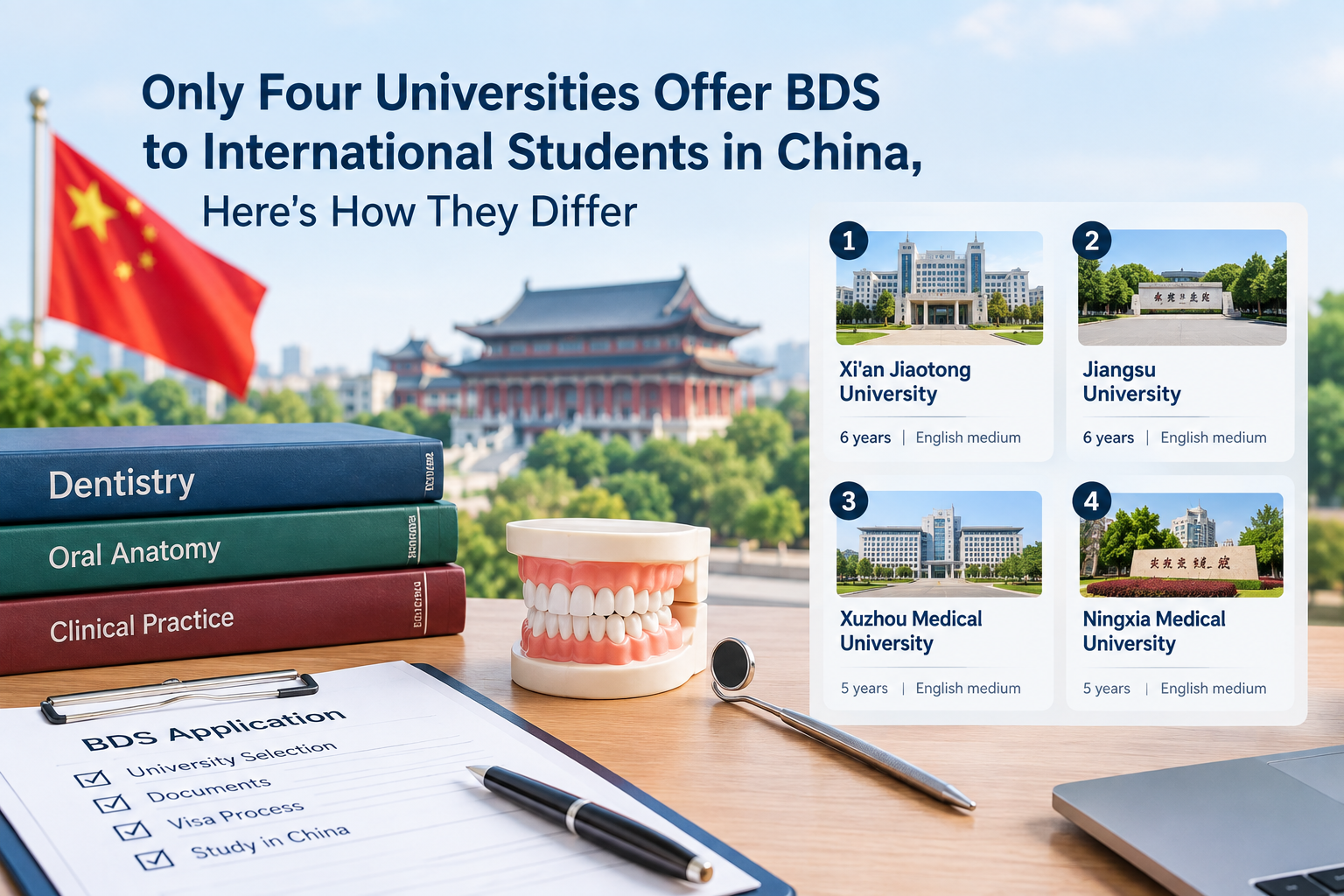
The idea that only four universities offer BDS to international students in China should be treated carefully. Current 2026 admission information shows that more institutions offer Bachelor of Dental Surgery programs to international applicants. The more useful question is which universities currently publish clear BDS pathways, what differs between their programs, and what an applicant should verify before applying.
For applicants comparing BDS in China, program duration, teaching language, clinical training, admission testing, Chinese-language requirements and the university’s current international-student admission notice matter more than a simple university count. Official university material also shows that BDS structures can differ significantly. Xi’an Jiaotong University describes a six-year English-medium BDS with a dedicated internship year, while Jiangsu University publishes a six-year English-medium BDS for its 2026 intake and Xuzhou Medical University publishes a five-year English-medium BDS.
Why the four university idea can be misleading
University availability changes by intake, teaching language and the specific program approved for international admission. Some universities may offer dentistry to international students in Chinese rather than English, while others may change their intake or admission conditions between academic years.
For that reason, an applicant should never treat an old university list as a permanent list of BDS options. Xuzhou Medical University, for example, has published a specific 2026 international BDS admission notice, demonstrating why current university-level admission information should be checked for every intake.
Four current examples worth examining
The following four universities illustrate how BDS programs can differ. They are examples for comparison rather than an exhaustive list of every Chinese university offering dentistry to international students.
| University | Current BDS evidence | Teaching language | Published duration | Important admission or academic feature |
|---|---|---|---|---|
| Xi’an Jiaotong University | BDS for international students | English | 6 years | Includes a one-year practical hospital internship |
| Jiangsu University | BDS for international students | English | 6 years | 2026 information includes CSCA and English-language requirements |
| Xuzhou Medical University | BDS for international students | English | 5 years | 2026 international undergraduate BDS admission notice published |
| Ningxia Medical University | BDS for international students | English | 5 years | Current listings identify an English-medium BDS pathway |
Xi’an Jiaotong University states that its international BDS program has a six-year structure and includes one year of practical training in a hospital. Its published material also describes clinical education through affiliated hospitals.
Jiangsu University provides another useful example. Its current BDS information identifies an English-medium six-year program and lists academic, CSCA and English-proficiency requirements for international applicants.
Xuzhou Medical University presents a different structure. Its 2025 published BDS brochure describes a five-year English-medium program with one year of internship included, while the university’s international admissions portal confirms a dedicated 2026 BDS admission notice.
Ningxia Medical University also appears in current 2026 listings for international BDS applicants, with a five-year English-medium program reported by current admissions sources.
Bonus Tip: Save the university’s current admission brochure as a PDF before submitting an application. Requirements displayed on third-party websites can remain online after a university changes its conditions.
What actually separates BDS programs
A university comparison should go beyond the name of the institution. The following factors can materially change the student experience and admission process.
| Factor | What applicants should verify | Why it matters |
|---|---|---|
| Program length | Five or six academic years | Indicates how the curriculum and internship are structured |
| Teaching language | English, Chinese or mixed | Determines language preparation and classroom requirements |
| Internship | Duration, hospital and placement structure | Affects clinical exposure and graduation planning |
| Chinese requirement | HSK level and when it must be achieved | Important even when the core program is taught in English |
| Entrance assessment | CSCA, university test or interview | Can affect eligibility and application preparation |
| English requirement | IELTS, TOEFL, Duolingo or internal assessment | Requirements vary by institution |
| Clinical facilities | Affiliated dental hospitals and clinical departments | Helps applicants understand practical training opportunities |
| Recognition | Home-country regulator and current rules | Degree acceptance for professional practice depends on the destination country |
Clinical training deserves closer attention
The number of academic years does not tell the complete story. A five-year BDS can include an internship within that period, while another university may structure the curriculum across six years with a separate clinical-training stage.
Xi’an Jiaotong University’s published BDS material, for example, separates basic medical education, dental coursework and practical training, with the final year dedicated to hospital internship.
Xuzhou Medical University’s published BDS material similarly identifies a five-year structure with an internship year included.
This distinction matters when comparing graduation timelines. Applicants should examine the curriculum rather than assuming that a longer program automatically provides more clinical training.
Bonus Tip: Ask for the official curriculum or training plan, not just the program duration. The curriculum shows when dental subjects, clinical rotations and internship requirements actually occur.
Check admission requirements before comparing universities
Admission standards can vary considerably. Jiangsu University currently lists a CSCA transcript for its BDS application alongside English-language evidence and other supporting documents.
Other universities may use their own entrance assessment, interview or additional academic screening. Xuzhou Medical University, for example, publishes separate undergraduate entrance-test requirements and provides an exemption route for applicants holding valid CSCA mathematics and chemistry results.
Applicants should therefore create a university-specific checklist rather than using one generic BDS application checklist for every institution.
Consider recognition before admission
A BDS degree earned abroad does not automatically give a graduate the right to practise dentistry in another country. Professional registration depends on the rules of the graduate’s intended country of practice.
For Pakistani applicants, this means checking the latest requirements of the relevant Pakistani dental regulator before committing to a program. Recognition, internship requirements, registration examinations and documentation rules should be verified independently because they can change after admission.
This check should happen before submitting an application, not after graduation.
Things to Consider Before Making a Decision
Use these questions to evaluate each university:
- Is the BDS program officially open to international students for the intended intake?
- Is the published teaching language still accurate for the current admission cycle?
- Does the program include an internship, and where does it take place?
- Does the university require CSCA results, an entrance test or an interview?
- Are Chinese-language requirements applicable despite English-medium instruction?
- Does the degree structure meet the requirements of the country where professional registration is planned?
- Are the current admission brochure and curriculum available directly from the university?
A university that appears suitable on a general ranking may not meet a student’s specific language, clinical or professional-registration requirements.
Practical support for BDS applicants
Study Sphere Advisors can provide support in the areas directly connected with international BDS applications:
- University Admission Assistance — Helps organize application requirements and review institution-specific admission conditions.
- Scholarship Assistance — Helps applicants understand scholarship eligibility and documentation requirements where applicable.
- Document Verification — Supports checking academic and supporting documents before submission.
- Course Selection — Helps applicants compare BDS program structures, language requirements and academic conditions.
Common Questions Before Applying
Should I choose a five-year or six-year BDS?
Do not decide from duration alone. Compare the curriculum, internship structure, clinical rotations and graduation requirements of the specific university.
Is an English-medium BDS completely free from Chinese-language requirements?
Not necessarily. Some universities can impose Chinese-language requirements for graduation, clinical communication or specific academic stages even when the main program is taught in English.
Does every Chinese university use the same BDS admission requirements?
No. Academic scores, language evidence, CSCA requirements, entrance tests, interviews and document requirements can differ by university and intake.
Can an old BDS university list be used for a 2026 application?
It should not be treated as definitive. Universities can change programs, admission conditions and international intake policies. Always verify the current university admission notice.
What to Verify After Admission
When should students check professional registration requirements?
Check them before enrollment and review them again before graduation. Professional regulators can update registration, examination and internship requirements.
Does university ranking determine whether a BDS degree can be used professionally?
No single ranking determines professional eligibility. The relevant regulator’s recognition and registration rules are more important for a student planning to practise dentistry after graduation.
Can clinical training be completed entirely in English?
The teaching language does not guarantee that every clinical interaction will occur in English. Clinical environments may involve local-language communication, so applicants should ask the university how international students are supported during patient-facing training.
Should applicants compare universities only by academic curriculum?
No. Curriculum should be considered alongside admission conditions, clinical training, language requirements, recognition rules and the structure of the internship.
Make the comparison specific to your goals
The strongest BDS comparison starts with the student’s intended career destination and then works backward through recognition, program structure, clinical training and admission requirements. Current university notices should take priority over old lists or generalized claims about how many Chinese universities accept international BDS students.
For questions about BDS admission, university selection or document requirements, Study Sphere Advisors can be contacted at studysphereadvisor@gmail.com or 0301 6823658. The final decision should be based on the current university admission notice, official curriculum and the professional-registration requirements applicable to the student’s intended country of practice.
Leave a Reply