
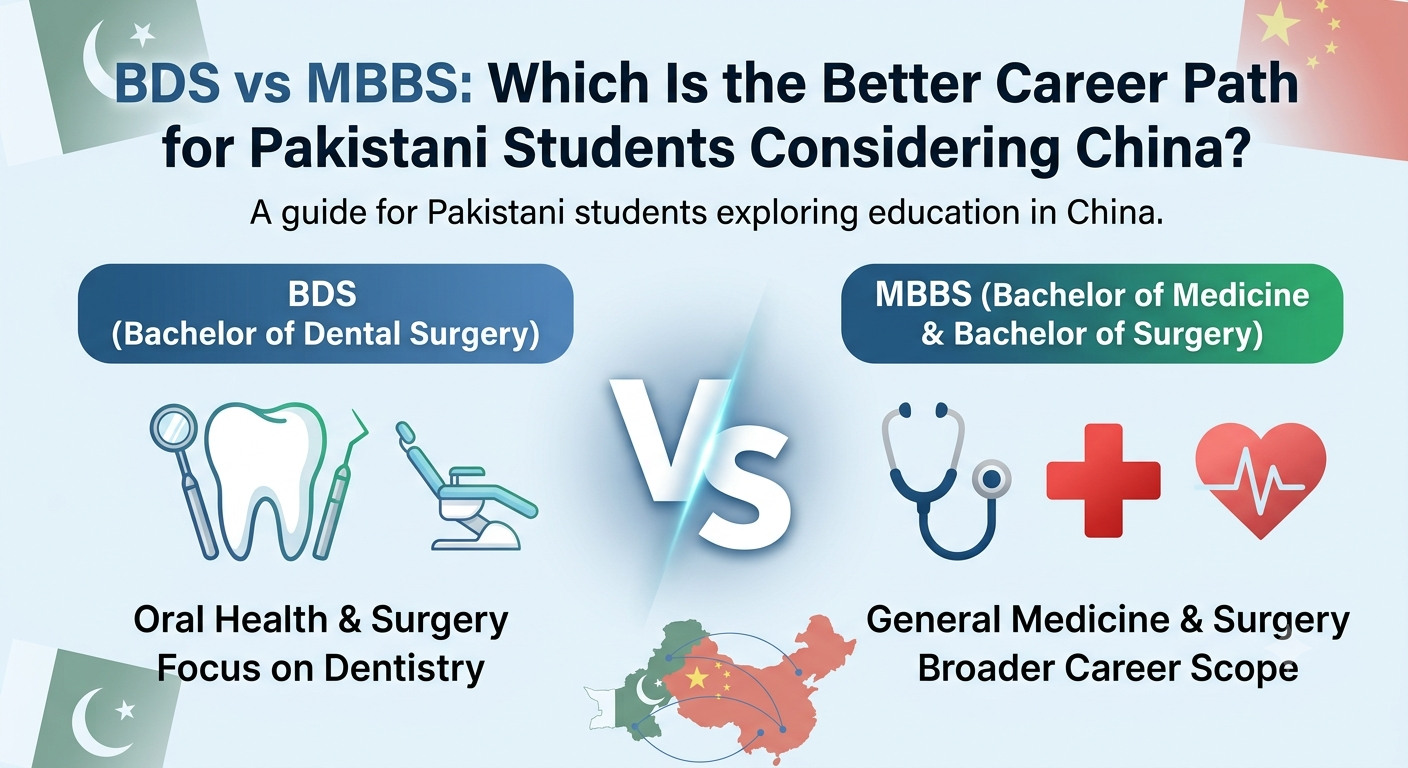
Neither BDS nor MBBS is universally the better choice for Pakistani students considering China; the more useful question is which path aligns with a specific student’s academic strengths, career timeline preferences, and long-term goals.
MBBS offers broader diagnostic training, a longer specialization pathway through FCPS, and generally stronger government-sector demand in Pakistan, while BDS offers a shorter postgraduate specialization track, more accessible private practice setup, and a skill-based curriculum better suited to students who prefer focused, hands-on clinical work over broad-system diagnostic reasoning.
This comparison matters specifically for students weighing options in China, because several Chinese universities structure their MBBS and BDS programs differently than Pakistani domestic institutions do, in duration, fee structure, and in some cases, shared program costs between the two degrees.
Getting this comparison right before committing to either program affects not just four to six years of study, but the licensing pathway, specialization timeline, and career flexibility that follow graduation.
Advisory conversations with Pakistani families weighing BDS against MBBS in China consistently reveal a pattern: students and parents often default to MBBS based on its higher perceived prestige, without fully considering that BDS graduates generally reach independent, specialized practice faster and with greater autonomy in setting up private practice.
Conversely, some students underestimate how much broader and more demanding MBBS training is, assuming both programs represent a similar workload simply because both lead to a registered healthcare profession.
Program Structure Comparison
| Aspect | MBBS | BDS |
|---|---|---|
| Typical Duration in China | 5+1 or 6 years total, including internship (varies by university; some structure it as 1+5) | Commonly 5+1 years at Chinese universities, though Pakistani domestic BDS programs are typically shorter at 4+1 years |
| Academic Focus | Broad, whole-body medical training across multiple systems | Focused specifically on oral, dental, and maxillofacial health |
| Admission Eligibility for Chinese Programs | Minimum HSSC percentage (commonly 60–70%, varies by university), age limit typically 18–25 or broader | Similar HSSC percentage and age requirements; MDCAT is not required for direct admission to most Chinese MBBS/BDS programs, unlike domestic Pakistani colleges |
| Clinical Training Style | Broad diagnostic reasoning, longer clinical rotations across specialties | Concentrated manual and procedural skill training in dental-specific techniques |
Since MDCAT is a domestic Pakistani admission requirement and is generally not required for direct entry into Chinese MBBS or BDS programs, students should not assume the two application processes carry identical prerequisites; Chinese admission criteria for either degree are typically based on HSSC academic performance and program-specific eligibility rather than a standardized entrance exam.
Fee Structure: How BDS and MBBS Compare at Chinese Universities
| University | MBBS Tuition Structure | BDS Tuition Structure | Notes |
|---|---|---|---|
| Jiamusi University | Same fee applies as BDS | Same fee applies as MBBS | Some Chinese universities price both programs identically under a shared fee schedule |
| Other Chinese Medical Universities (General Pattern) | Program-specific tuition, generally set independently by each university | Program-specific tuition, sometimes lower than MBBS depending on the institution | Fee structures vary significantly; confirming the specific fee schedule for each program at a given university remains necessary rather than assuming parity |
Since fee parity between MBBS and BDS is not universal across Chinese universities, students should not assume cost alone favors one program over the other without checking the specific university’s current fee structure.
Career Pathway After Graduation
| Stage | MBBS Pathway | BDS Pathway |
|---|---|---|
| Licensing Authority in Pakistan | Pakistan Medical and Dental Council (PMDC), medical registration criteria | Pakistan Medical and Dental Council (PMDC), separate dental-specific registration criteria |
| Post-Graduation Exam | National Registration Examination (NRE), covering medical competencies | Dental-specific registration and licensing assessment, distinct from the medical NRE |
| House Job Requirement | Typically structured as 6 months Medicine and 6 months Surgery | Required house job at a recognized dental teaching hospital |
| Postgraduate Specialization Track | FCPS residency, generally 4 to 6 years, across specialties such as cardiology, surgery, pediatrics, and gynecology | FCPS or MDS dental specialization, generally 2 to 4 years, across specialties such as orthodontics, oral surgery, prosthodontics, periodontology, and pediatric dentistry |
| Private Practice Setup | Possible, though generally requires greater capital investment and infrastructure | Comparatively more accessible, with dentists often able to establish independent clinics with lower setup costs |
The shorter postgraduate specialization timeline for BDS graduates is one of the more significant practical differences between the two paths, since it generally allows dental graduates to reach independent specialized practice sooner than their medical counterparts pursuing FCPS.
Practice Context and Demand Patterns
| Consideration | MBBS/Medicine | BDS/Dentistry |
|---|---|---|
| Government Sector Demand in Pakistan | Comparatively stronger, with a larger number of hospital and public-sector positions available | Comparatively more limited in the government sector, though growing in private and urban markets |
| Private Practice Autonomy | Achievable but generally requires more capital and infrastructure | Generally more accessible; dentists frequently establish independent clinics with lower entry costs |
| Global Demand | Consistently strong across most licensing pathways (Pakistan, UK, US, Gulf) | Also in consistent global demand, with dentistry recognized as a steadily required service across most healthcare markets |
| Typical Practice Setting | Hospitals, clinics, specialized medical centers | Dental clinics, hospital dental departments, private practice |
Published data on the Pakistani market indicates fresh MBBS graduates generally find comparatively more immediate government and private-sector employment opportunities than fresh BDS graduates, while established specialists in both fields report significantly higher earning potential than entry-level positions in either profession, particularly through private practice or specialization.
How China Fits Into This Comparison Against Other Study Destinations?
| Country | MBBS/BDS Availability for Pakistani Students | Program Duration | Recognition Path for Pakistan-Bound Graduates |
|---|---|---|---|
| China | Both MBBS and BDS widely available, English-medium options common | 5+1 to 6 years depending on program and university | PMDC recognition required for both, via separate medical and dental registration processes |
| United Kingdom | Both available, though BDS seats for international students are comparatively limited | 5 years (medicine) or 5 years (dentistry), varies by institution | PMDC recognition required for Pakistan-bound practice, in addition to UK-specific registration for UK practice |
| Canada | Limited direct-entry seats for both programs | Varies by institution | PMDC recognition required for Pakistan-bound practice, in addition to Canadian registration for Canada practice |
| Australia | Both available, generally with high tuition costs | Varies by institution | PMDC recognition required for Pakistan-bound practice, in addition to Australian registration for Australia practice |
China’s relatively higher availability of both MBBS and BDS seats for Pakistani students, compared with more limited seat availability in Western destinations, is part of why it remains a widely considered option for both degree paths. Visa and enrollment trends have also shifted meaningfully in recent years.
According to ICEF Monitor’s 2026 analysis of student mobility trends, study visa rejection rates for Pakistani applicants have risen sharply across several Big Four destinations, with more than 70% of Pakistanis refused an F-1 visa in the US in 2026, and Pakistani applicants to the UK seeing sponsored study visa rejection rates spike from 5.6% to 41% year-over-year.
Against this backdrop, China’s inbound international enrollment reached roughly 380,000 foreign students from nearly 200 countries during the 2024/25 academic year, according to Chinese Ministry of Education figures reported via China Daily, reflecting continued access for both MBBS and BDS applicants even as other destinations tighten.
Factors That Deserve Careful Evaluation
- Academic fit: Considering whether broad, multi-system diagnostic reasoning (MBBS) or focused, hands-on procedural skill (BDS) better matches personal academic strengths and interests.
- Budget planning: Confirming the actual fee structure for each program at a specific university, since cost parity between MBBS and BDS is not guaranteed across every institution.
- Career goals: Weighing the longer FCPS specialization timeline in medicine against the comparatively shorter FCPS/MDS timeline in dentistry, based on how quickly independent specialized practice is desired.
- Visa compliance: Recognizing that visa and admission documentation requirements are largely similar for both programs at most Chinese universities.
- Language requirements: Confirming whether HSK-4 or other language milestones apply differently to MBBS versus BDS programs at the specific university under consideration.
- Post-study opportunities: Evaluating government-sector demand versus private-practice autonomy, since these differ meaningfully between medicine and dentistry in the Pakistani job market.
How Study Sphere Advisors Supports Students
Questions Students Usually Ask Before Applying
Is MBBS always more expensive than BDS at Chinese universities? Not necessarily. Some universities, such as Jiamusi University, apply the same tuition fee to both programs, while others price them differently, so the specific fee structure should be confirmed per university.
Does BDS require the same admission criteria as MBBS in China? Generally, yes — similar HSSC percentage and age requirements typically apply to both programs, and MDCAT is not required for direct admission to most Chinese MBBS or BDS programs.
Which path leads to faster specialization: MBBS or BDS? BDS specialization through FCPS or MDS generally takes 2 to 4 years, compared with 4 to 6 years for FCPS medical specialization, making dentistry’s postgraduate timeline comparatively shorter.
Is government-sector job demand the same for MBBS and BDS graduates in Pakistan? No. MBBS graduates generally find more government and hospital-sector positions available, while BDS graduates more commonly pursue private practice or urban dental clinic settings.
Additional Questions Students Often Have
Does PMDC recognize BDS and MBBS degrees from China through the same process? No. PMDC maintains separate registration criteria for medical (MBBS) and dental (BDS) graduates, even though both fall under its regulatory authority.
Can a student switch from BDS to MBBS, or vice versa, partway through a Chinese program? This is not standard practice and would generally require a fresh admission process; the decision between the two is best made before enrollment rather than assumed to be flexible later.
Is private practice genuinely more accessible for dentists than doctors? Based on general market patterns, yes — dental clinics typically require less capital and infrastructure to establish compared with a private medical practice.
Does a Chinese BDS degree take the same duration as a Chinese MBBS degree? Not always. While BDS in China is commonly structured as 5+1 years at several universities, this differs from domestic Pakistani BDS programs, which are typically 4+1 years, so program duration should be confirmed per Chinese university.
Is international demand for dentists comparable to demand for doctors? Both professions maintain consistent global demand, though the specific licensing and registration process differs by country and by degree, as with the Pakistan-specific PMDC pathway.
Conclusion
Choosing between BDS and MBBS for study in China comes down to matching program structure, licensing pathway, and long-term career pattern to personal academic strengths and goals, rather than assuming one degree is categorically superior.
MBBS offers broader medical training and stronger government-sector demand in Pakistan, balanced against a longer specialization timeline, while BDS offers a shorter postgraduate specialization track and more accessible private practice, balanced against a narrower clinical scope. Reviewing the specific fee structure, program duration, and recognition pathway for each option at a given Chinese university provides a clearer, evidence-based basis for this decision than general assumptions about prestige or difficulty alone.
Making the Decision
Students evaluating their study abroad options often benefit from expert guidance when comparing universities, scholarships, visa requirements, and long-term career opportunities. Study Sphere Advisors assists students in understanding admission requirements, documentation processes, and recognition criteria relevant to Chinese medical and dental universities. Students seeking personalized guidance on their specific academic profile can reach out to the advisory team for further information.
Leave a Reply