
Pakistani students applying for an MBBS degree abroad often make avoidable mistakes before admission is finalized. The most serious errors usually involve choosing an institution without checking recognition, overlooking Pakistan Medical & Dental Council (PM&DC) requirements, submitting incomplete academic documents, misunderstanding language requirements, missing scholarship deadlines, or treating the university admission and visa processes as separate tasks.
These mistakes can affect more than admission. For medical students, the choice of institution can influence future licensing, registration, clinical training, and eligibility for examinations after graduation. PM&DC’s current guidelines require Pakistani students entering foreign undergraduate medical or dental institutions to meet specific academic, MDCAT, registration, institution-recognition, curriculum, attendance, and visa-related conditions.
Based on recurring patterns seen during international medical admission planning, students are often more focused on securing an offer letter than checking whether the entire educational pathway fits their long-term career plans. A careful application therefore starts with eligibility and recognition, followed by university selection, documentation, scholarship planning, and visa compliance.
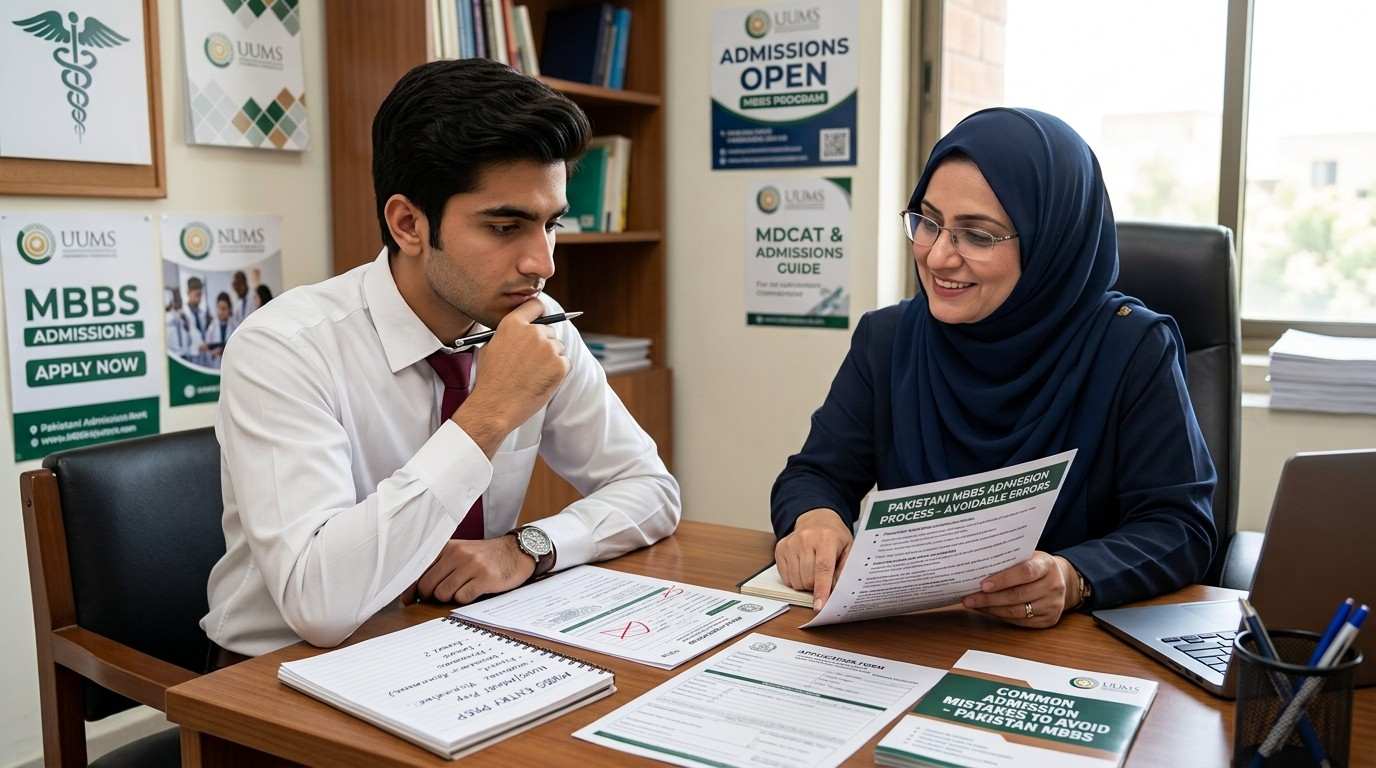
[Image: Pakistani MBBS applicant reviewing university admission documents and recognition requirements]1. Choosing a University Before Checking Recognition
One of the most consequential mistakes is selecting a university based only on its name, location, tuition structure, social-media recommendations, or an agent’s suggestion.
For Pakistani medical students, recognition needs to be checked at the right time, not after admission. PM&DC’s 2026 guidelines state that the foreign institution must be included in the approved framework relevant to foreign medical graduates, and the qualification must be awarded by an institution recognized by the relevant regulatory authority in its country.
| Requirement | What Students Should Check | Why It Matters |
|---|---|---|
| PM&DC requirements | Current foreign medical admission guidelines | Non-compliance can affect later eligibility |
| Institution recognition | Recognition by the relevant authority in the country of study | Supports qualification validity |
| ECFMG-related listing | Whether the institution meets the applicable international listing requirements | Important for students considering international licensing pathways |
| Medical program | MBBS/clinical medicine structure and duration | The degree structure must meet applicable requirements |
| Clinical training | Affiliated teaching hospitals and clinical exposure | Important for medical education and future licensing |
| Future licensing | PM&DC/NRE and other intended country’s requirements | Admission does not automatically create a right to practise |
PM&DC maintains a foreign qualifications section and recognized foreign institution information, so students should verify the current status rather than rely on an old university list or third-party claim.
2. Ignoring PM&DC Eligibility Requirements
Another common error is assuming that meeting a Chinese or other foreign university’s admission criteria automatically makes a Pakistani applicant eligible under Pakistani regulations.
For example, PM&DC’s current foreign undergraduate medical guidelines specify academic requirements, MDCAT conditions for relevant Pakistani students, student registration before departure, curriculum requirements, and other conditions.
| Requirement | Current PM&DC Guideline | Practical Implication |
|---|---|---|
| F.Sc. Pre-Medical | Minimum 60% for students completing intermediate education in Pakistan | Academic eligibility should be checked before applying |
| MDCAT | At least 50% for applicable students | A foreign university offer does not replace this requirement |
| PM&DC student registration | Required before proceeding abroad | Should be planned before departure |
| Program duration | At least five years with required curriculum and hours | Course structure needs verification |
| Attendance | Minimum 80% | Students should understand university attendance policies |
| NRE | Required for licensing under the guideline | Future licensing should be considered from the beginning |
| Local language | At least six months where the medium of instruction is not English, under the stated guideline | Language preparation cannot be treated as an afterthought |
The PM&DC policy was updated in June 2026, making it especially important to use current regulatory information rather than older admission advice.
3. Assuming Every English-Taught MBBS Program Is Identical
An English-medium program does not necessarily mean that every part of medical education will take place in English.
Students should examine the teaching language, clinical communication requirements, Chinese-language courses, hospital environment, and whether local-language preparation is built into the curriculum.
China’s Ministry of Education has established quality-control provisions for undergraduate medical education in English for international students. These provisions include a six-year structure for the English-taught clinical medicine program and requirements concerning curriculum, clinical skills, English teaching capacity, and eligible institutions.
| Language Factor | Question to Ask |
|---|---|
| Classroom language | Are core medical subjects taught in English? |
| Clinical language | What language is used during hospital rotations? |
| Chinese language | Is Chinese language training included? |
| Medical terminology | Does the curriculum include Chinese medical terminology? |
| Local communication | Will students need Chinese to communicate with patients? |
| Graduation requirements | Are language or clinical requirements different from the initial admission conditions? |
4. Submitting Incomplete or Inconsistent Documents
A technically eligible student can still experience delays because documents contain inconsistent names, dates, grades, translations, or missing attestations.
Common examples include a passport name that does not exactly match academic records, incomplete transcripts, unclear scans, expired documents, or certificates that require additional verification.
| Document | Mandatory for Most Applications | Common Problem |
|---|---|---|
| Passport | Yes | Name or date-of-birth mismatch |
| SSC/O-Level certificate | Usually | Missing or unclear copy |
| HSSC/F.Sc. certificate | Yes for relevant applicants | Incorrect subject or marks information |
| Academic transcript | Yes | Missing pages or inconsistent grades |
| MDCAT evidence | Where applicable | Incorrect or incomplete record |
| Medical certificate | University dependent | Wrong format or outdated certificate |
| Police clearance | Visa/application dependent | Incorrect validity or authentication |
| Financial evidence | University/visa dependent | Insufficient or inconsistent supporting documents |
Students should create one master document file and use the same personal details throughout university and visa applications.
5. Applying Too Late for Scholarships
Scholarship planning is another area where applicants lose opportunities. A student may wait for university admission before researching funding, only to discover that the scholarship deadline has already passed.
Scholarship rules differ significantly between government, university, provincial, and institutional schemes.
| Scholarship Route | Typical Coverage | What Students Should Check |
|---|---|---|
| Government scholarship | May include tuition, accommodation, stipend or other support depending on scheme | Eligibility, nationality, academic criteria and deadline |
| University scholarship | Often tuition-related support | University-specific conditions |
| Merit scholarship | Based on academic performance | Minimum grades and continuation requirements |
| Need-based support | Financial circumstances may be considered | Financial documentation |
| Partial scholarship | Covers only selected costs | Remaining tuition and living expenses |
The key lesson is simple: scholarship research should begin before submitting the university application, not after receiving an offer.
6. Treating the Visa Process as an Afterthought
Admission and visa approval are connected, but they are not the same decision.
For students going to China for long-term study, the X1 visa is used for study exceeding 180 days. The Chinese visa application process requires an Admission Notice and the relevant JW201/JW202 form. X1 holders must also apply for a residence permit within 30 days of entering China.
| Visa Requirement | Description | Importance |
|---|---|---|
| Admission Notice | Issued by the Chinese institution | Core study-visa document |
| JW201/JW202 | Visa application form for study in China | Required for X1 applications |
| Passport | Must meet applicable validity requirements | Essential identity document |
| Financial evidence | May be requested depending on circumstances | Demonstrates ability to support study |
| Police clearance | May be required for Pakistani applicants | Must meet current authentication requirements |
| Residence permit | Required after entering China on X1 | Must be completed within the applicable period |
The Chinese Visa Application Service Center in Karachi currently notes specific documentation and authentication requirements for Pakistani applicants, showing why students should check the current local checklist instead of relying on an older visa guide.
7. Confusing Admission With Future Medical Licensing
Getting an MBBS admission letter is not the same as becoming eligible to practise medicine.
A student may successfully complete admission, obtain a visa, graduate, and still need to satisfy additional licensing requirements in Pakistan or another country.
PM&DC’s current framework states that Pakistani graduates of foreign medical institutions must meet applicable requirements and pass the National Registration Examination (NRE) to obtain a licence.
This is particularly important for students who intend to return to Pakistan. The intended career destination should therefore influence university selection from the beginning.
8. Relying on Outdated Admission Information
Foreign medical education regulations can change. Students sometimes use advice from older Facebook posts, YouTube videos, previous admission cycles, or friends who enrolled several years earlier.
This can be risky because requirements for student registration, MDCAT, NRE, recognized institutions, visas, and documentation may change.
PM&DC’s public announcements show multiple updates during 2026 concerning foreign medical admissions, student registration, MDCAT, and NRE matters.
Bonus Tip:
Check the date of every important rule. A university brochure may describe its own admission requirements accurately while not reflecting current Pakistani regulatory requirements.
What Students Should Assess Before Moving Forward?
Before submitting an MBBS application abroad, applicants should evaluate the complete pathway rather than focusing only on admission.
| Decision Factor | Key Question |
|---|---|
| Budget planning | Can the family support tuition, accommodation, travel, insurance and other costs throughout the program? |
| Academic fit | Does the applicant meet both university and Pakistani regulatory requirements? |
| University recognition | Is the institution currently acceptable for the intended pathway? |
| Career goal | Does the program support the country where the student eventually wants to practise? |
| Language | Can the student manage academic and clinical communication requirements? |
| Visa compliance | Are the admission and visa documents consistent and complete? |
| Clinical exposure | Are appropriate affiliated hospitals and clinical rotations available? |
| Post-study pathway | What examinations, registration or licensing steps follow graduation? |
How Study Sphere Advisors Supports Students?
University Selection Guidance
Study Sphere Advisors can help students compare medical universities against academic qualifications, recognition considerations, program structure and intended post-graduation pathway.
Admission Processing Support
Admission Processing Support can help applicants organize academic records, application information and supporting documents while identifying inconsistencies before submission.
Study Visa Assistance
Study Visa Assistance can help students understand the documentation and application requirements for obtaining a student visa, including guidance on preparing and organizing the required paperwork.
Work Visa Consultation
Work Visa Consultation can provide guidance on the requirements and potential pathways for graduates who plan to pursue employment opportunities after completing their studies.
Questions Students Usually Ask Before Applying
Is an admission offer enough to start studying medicine abroad?
No. Pakistani students must also consider applicable PM&DC requirements, student registration, institution recognition and future licensing requirements.
Should recognition be checked before or after admission?
Before paying deposits or committing to the university. Recognition should be part of the initial university-selection process.
Can students apply for scholarships after receiving admission?
Sometimes, but many scholarships have separate deadlines and selection procedures. Waiting for admission can reduce available options.
Does an English-medium MBBS eliminate the need to learn the local language?
No. Clinical environments may require communication with local patients and staff, and Pakistani regulatory requirements may also impose language-preparation conditions depending on the destination.
Additional Questions Students Often Have
Can students change universities after starting an MBBS program?
Transfers depend on the institutions, academic credits, immigration rules and regulatory requirements. A transfer should never be assumed to be automatic.
Does university ranking alone determine suitability?
No. For a medical applicant, recognition, curriculum, clinical training, regulatory compatibility and career pathway can be more relevant than a general university ranking.
Should parents verify documents too?
Yes. A second review can identify errors in names, dates, academic records and financial documents before submission.
Can visa requirements change after admission?
Yes. Visa procedures and document checklists can be updated. Applicants should verify the current requirements through the relevant official visa authority before submission.
What should students do if two universities appear equally suitable?
Compare their recognition status, curriculum, clinical exposure, language requirements, total study obligations, scholarship conditions and alignment with the student’s intended licensing pathway.
Conclusion
The most common admission mistakes Pakistani MBBS applicants make are rarely limited to filling out an application incorrectly. The larger risk is making a decision without checking the complete pathway from eligibility and recognition to admission, visa compliance, clinical education and future licensing.
A careful applicant should verify PM&DC requirements, confirm institutional recognition, understand the language and curriculum structure, prepare consistent documentation, research scholarships early and consider post-graduation licensing before committing to a university. The goal should not simply be to obtain an admission letter, but to choose an educational pathway that remains workable through graduation and the next stage of a medical career.
How Study Sphere Advisors Can Help?
Students evaluating study-abroad options can benefit from structured guidance when comparing universities, admission requirements, scholarships and visa documentation. Study Sphere Advisors provides relevant educational advisory support for university selection, admission processing, scholarship planning and visa documentation. Students seeking personalized guidance can contact the advisory team through the official website for further information.
Leave a Reply