
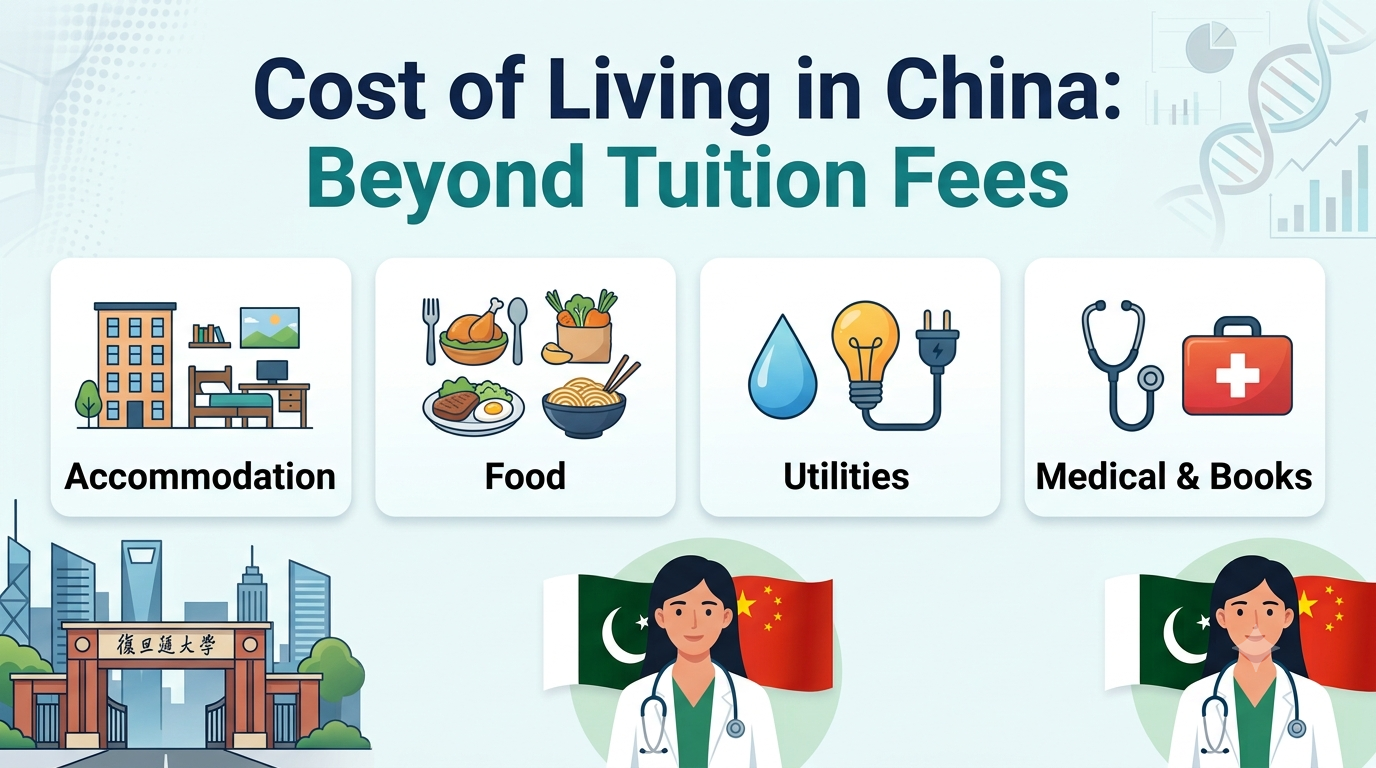
Beyond the tuition and hostel fees already listed in a Chinese university’s admission package, Pakistani MBBS students typically need an additional 1,000 to 2,500 RMB (roughly 140 to 350 USD) per month to cover food, local transport, mobile data, and personal expenses, depending on the city and lifestyle. Since most Chinese medical universities bundle hostel accommodation into the annual fee structure, the day-to-day cost of living that families need to budget for separately is smaller than the headline tuition figure suggests, but still requires planning.
This distinction matters because Pakistani families often calculate affordability based on the university’s advertised fee package alone, without setting aside a monthly living allowance for the years between tuition payments. Students who underestimate this ongoing cost sometimes find themselves managing tighter monthly budgets than expected, particularly in their first semester before they learn which local options — campus canteens, public transport passes, shared accommodation for outings — offer the best value. Parents transferring funds periodically from Pakistan also benefit from knowing what a realistic monthly figure looks like, rather than estimating based on assumptions carried over from other study destinations.
Advisory conversations with Pakistani students already studying medicine in China reveal a consistent pattern: most manage comfortably on campus canteen meals and public transport, but underestimate two specific costs early on, a VPN subscription needed to access familiar apps and services, and the cost difference between Tier 1 cities (Beijing, Shanghai, Guangzhou) and the Tier 2 and Tier 3 cities where many Chinese medical universities are actually located. Students who assume big-city living costs apply uniformly often overbudget, while those who assume every city is equally affordable sometimes underbudget if their university happens to be in a higher-cost location.
What University Fee Packages Typically Already Cover?
Before estimating additional living costs, it helps to separate what is usually already included in a Chinese medical university’s fee structure from what a student needs to budget for independently.
| Cost Category | Typically Included in University Fee Package | Typically Paid Separately by the Student |
|---|---|---|
| Hostel/Accommodation | Yes, in most cases (commonly shared rooms) | Upgrades to private or double-sharing rooms, where offered |
| Tuition | Yes | Not applicable |
| Insurance and Visa Extension | Often included or billed at actual cost during the program | Sometimes billed separately upon arrival, depending on the university |
| Food | No | Yes, budgeted independently each month |
| Local Transport | No | Yes, budgeted independently each month |
| Mobile Data/Internet | No | Yes, budgeted independently each month |
| Personal and Miscellaneous Expenses | No | Yes, budgeted independently each month |
Since fee structures vary by university, confirming exactly what is bundled into a specific admission package remains an important step before estimating the additional monthly living budget.
Monthly Living Cost Breakdown (Beyond Tuition and Hostel)
| Expense Category | Typical Monthly Range (RMB) | Approx. USD | Notes |
|---|---|---|---|
| Food (campus canteen-based diet) | 600–1,500 RMB | 85–210 USD | Cooking independently, where kitchen access is available, can reduce this by 30–40% |
| Local Transport (metro, bus, shared bikes) | 100–400 RMB | 15–55 USD | Costs rise for students living farther from campus or relying on ride-hailing apps frequently |
| Mobile Data/SIM Plan | 30–100 RMB | 5–15 USD | Basic plans are available at the lower end for students who primarily use campus Wi-Fi |
| VPN Subscription | Approx. 25–70 RMB | 3–10 USD | Commonly needed to access apps and services used for communication with family in Pakistan |
| Toiletries, Laundry & Basic Household Items | Varies | Modest, ongoing | Often overlooked in early budget estimates |
| Estimated Additional Monthly Total | 1,000–2,500 RMB | 140–350 USD | Varies significantly by city tier and personal lifestyle choices |
How City Choice Affects the Monthly Budget?
| City Tier | Example Cities | Relative Cost of Living | Relevance to Pakistani MBBS Students |
|---|---|---|---|
| Tier 1 | Beijing, Shanghai, Guangzhou | Highest; rent and dining costs significantly above the national average | Fewer Pakistani MBBS programs are based here; costs should be checked individually if applicable |
| Tier 2/3 | Cities including Xianning, Jining, Kunming, Nanchong, and Jiamusi (where many MBBS programs are located) | Moderate to low; noticeably cheaper than Tier 1 cities for food, transport, and daily expenses | Most Pakistani MBBS students are based in these cities, keeping monthly living costs toward the lower end of the national range |
Since the majority of Chinese medical universities offering MBBS programs to Pakistani students are located in Tier 2 and Tier 3 cities rather than Beijing or Shanghai, most students’ actual monthly living costs fall closer to the lower end of national estimates rather than the higher end frequently cited in general cost-of-living guides.
How China’s Cost of Living Compares to Other Study Destinations?
| Country | Approx. Monthly Living Cost (Excluding Tuition) | Work Rights (During Study) | Notes for Pakistani Students |
|---|---|---|---|
| China | Roughly 140–350 USD (Tier 2/3 cities); higher in Tier 1 cities | Limited; primarily clinical/internship exposure for medical students | Hostel is often bundled into the university fee package, reducing separate housing costs |
| United Kingdom | Substantially higher, particularly in major cities | Restricted for medical students | Housing typically represents the largest independent monthly cost |
| Canada | High, particularly for housing in major cities | Restricted for most programs | Living costs vary significantly by province and city |
| Australia | High, particularly in Sydney and Melbourne | Part-time work rights outside clinical placements | Housing and general living costs are considerably higher than in China’s Tier 2/3 cities |
Visa and enrollment conditions across these destinations have also shifted in recent admission cycles, which indirectly affects how many Pakistani students weigh cost of living alongside visa access. According to ICEF Monitor’s 2026 analysis of student mobility trends, study visa rejection rates for Pakistani applicants have risen sharply across several Big Four destinations, with more than 70% of Pakistanis refused an F-1 visa in the US in 2026, and Pakistani applicants to the UK seeing sponsored study visa rejection rates spike from 5.6% to 41% year-over-year.
Against this backdrop, China’s inbound international enrollment reached roughly 380,000 foreign students from nearly 200 countries during the 2024/25 academic year, according to Chinese Ministry of Education figures reported via China Daily — a combination of comparatively lower living costs and continued visa access that has kept China firmly on Pakistani families’ shortlists.
Food, Halal Availability, and Dietary Considerations
Campus canteens generally offer the most economical daily meals, typically ranging from 15 to 25 RMB per proper meal, with street food options costing even less. Halal food availability varies by city and university; several Chinese medical universities that host large Pakistani student populations provide halal canteens or nearby halal restaurants, though this should be confirmed for each specific university rather than assumed universally, since availability is less consistent outside cities with an established international student community.
Factors That Deserve Careful Evaluation
- Budget planning: Separating what the university fee package already covers (typically tuition and hostel) from what requires an independent monthly budget (food, transport, communication, personal items).
- Academic fit: Considering how a university’s city tier affects daily living costs alongside academic and recognition factors, rather than treating cost of living as a separate, unrelated decision.
- Career goals: Recognizing that lower living costs in Tier 2/3 cities do not affect a program’s recognition status or long-term licensing pathway.
- Visa compliance: Maintaining bank statements that reflect realistic monthly living costs, since visa applications generally require proof of sufficient funds for both tuition and living expenses.
- Language requirements: Budgeting time, rather than significant additional cost, for adjusting to a Chinese-language environment outside the classroom, particularly for daily transactions.
- Post-study opportunities: Understanding that living cost planning applies throughout the full program duration, including the internship year, not just the first year of study.
How Study Sphere Advisors Supports Students?
Study Visa Assistance: Guidance on preparing the documentation required for a Chinese student visa application, including proof of sufficient funds for both tuition and living expenses.
Work Visa Guidance: Information and guidance on post-study work visa requirements, eligibility criteria, documentation, and application procedures for graduates who wish to explore employment opportunities after completing their studies.
Questions Students Usually Ask Before Applying
Is hostel accommodation already included in a Chinese university’s fee package? In most cases, yes, though this should be confirmed for each specific university, since some offer room-sharing upgrades at an additional cost.
How much should be budgeted monthly beyond tuition and hostel fees? Typically 1,000 to 2,500 RMB (roughly 140 to 350 USD) per month, covering food, local transport, mobile data, and personal expenses, with the actual figure depending on city and lifestyle.
Are living costs the same in every Chinese city hosting MBBS programs? No. Tier 1 cities such as Beijing and Shanghai carry noticeably higher living costs than the Tier 2 and Tier 3 cities where most Pakistani MBBS programs are actually located.
Is halal food easily available near Chinese medical universities? Availability varies by city and university; several universities with established Pakistani student communities offer halal canteens or nearby options, but this should be confirmed for the specific institution rather than assumed.
Additional Questions Students Often Have
Does the monthly living cost estimate change during the internship year? Living costs generally remain similar during the internship year, though schedule changes during clinical rotations may affect food and transport patterns compared with earlier academic years.
Is a VPN subscription legally required, or optional? A VPN is commonly used by international students to access certain apps and services; students should use such tools within the applicable regulations of their host institution and country.
Do visa applications require proof of living expense funds, separate from tuition? Visa documentation generally expects evidence of sufficient funds covering both tuition and reasonable living expenses, so bank statements should reflect a realistic combined estimate.
Can cooking at home significantly reduce monthly costs? Yes, where kitchen access is available; independent cooking can lower food costs by an estimated 30 to 40 percent compared to eating out for most meals.
Are transport costs significantly different for students living far from campus? Yes. Students commuting frequently between off-campus housing and a distant campus typically see higher monthly transport costs than those living on or near campus.
Conclusion
Cost of living in China for Pakistani MBBS students, once tuition and hostel fees are accounted for separately, typically adds 1,000 to 2,500 RMB per month depending on city tier and lifestyle choices. Understanding what a university’s fee package already covers, budgeting realistically for food, transport, communication, and personal expenses, and accounting for city-specific cost differences gives families a clearer, more complete picture of the total financial commitment involved in pursuing an MBBS in China.
Making the Decision
Students evaluating their study abroad options often benefit from expert guidance when comparing universities, scholarships, visa requirements, and long-term career opportunities. Study Sphere Advisors assists students in understanding admission requirements, documentation processes, and budgeting considerations relevant to studying medicine in China. Students seeking personalized guidance on their specific academic profile can reach out to the advisory team for further information.
Leave a Reply