
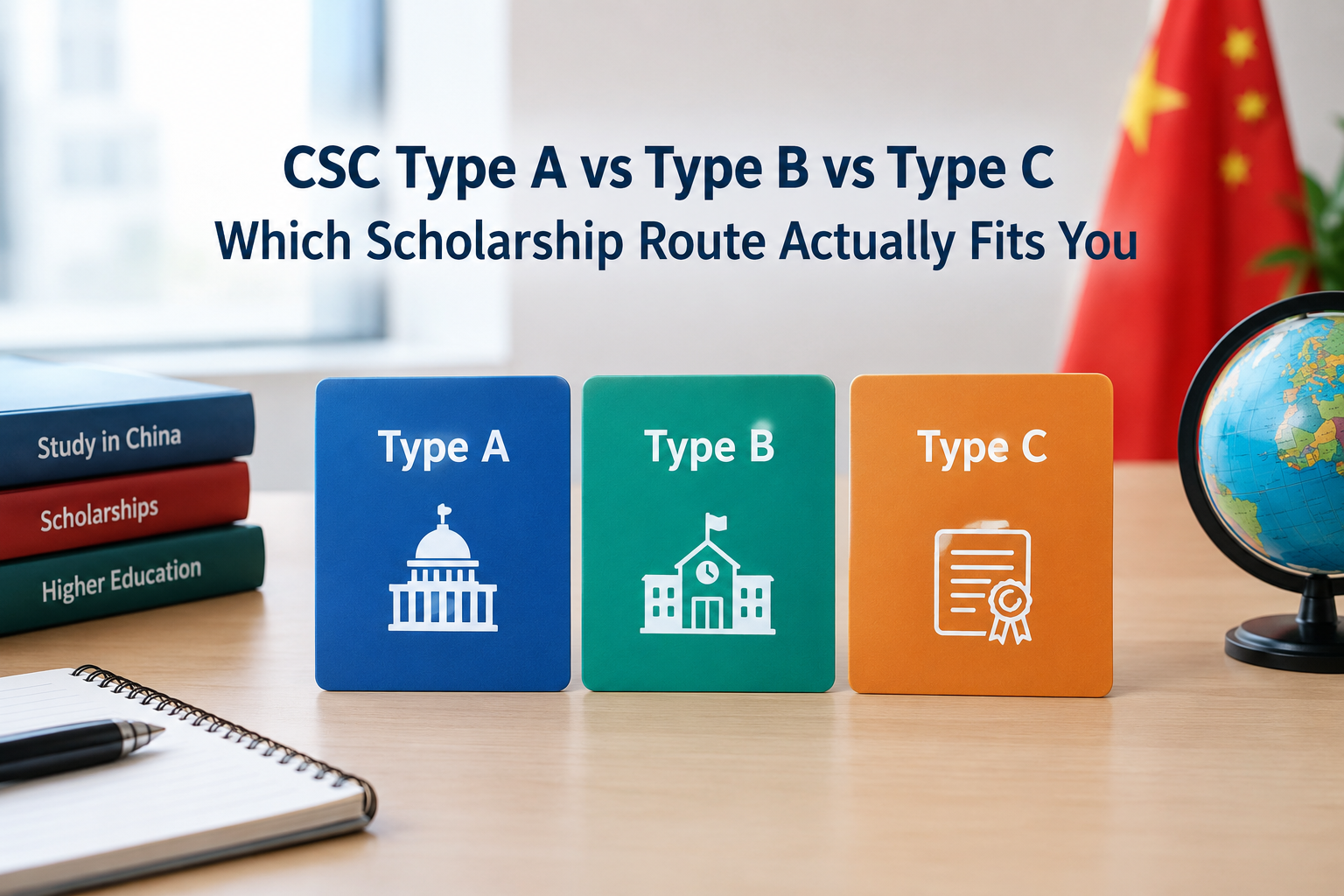
For most international applicants, Type A fits students applying through a government or designated dispatching authority, while Type B fits applicants applying directly to a participating Chinese university. Type C needs more caution because Chinese universities and scholarship guides do not use the label consistently. It can refer to a university-managed or designated scholarship route rather than one universal CSC category.
The right route therefore depends less on the letter and more on who receives the application, which agency number is required, the degree level, the university’s rules, and the current scholarship announcement. Experience with China admission applications shows that applicants often make mistakes by choosing a category before checking the receiving authority and programme requirements.
Understand what each CSC route actually means
The following distinction provides the most useful starting point before an applicant creates a scholarship application.
| Route | Usually handled by | Typical application channel | Best suited to |
|---|---|---|---|
| Type A | Government or designated dispatching authority | Embassy, ministry, HEC or another nominated authority | Applicants applying through an official national or bilateral scholarship channel |
| Type B | Participating Chinese university | Direct application to the university plus CSC application where required | Applicants who have selected a specific Chinese university and programme |
| Type C | Varies by programme or institution | Depends on the specific scholarship announcement | Applicants whose university or programme explicitly identifies a Type C route |
Type A commonly includes the Bilateral Program, which operates through educational cooperation arrangements between China and other governments or institutions. Type B generally refers to the Chinese University Program, where the Chinese university handles the institutional selection process.
Type C requires verification rather than assumption. Some scholarship resources describe it as a performance-based or university-managed route, while other current guidance treats the category differently. Applicants should therefore follow the terminology used by the specific university and current CSC application cycle.
Match the route to your application situation
| Applicant situation | More relevant route | Why |
|---|---|---|
| Applying through a national education authority | Type A | The authority may nominate eligible candidates to the Chinese side |
| Applying through a Chinese embassy under a bilateral programme | Type A | The dispatching authority manages the initial selection |
| Applying directly to a selected Chinese university | Type B | The university evaluates and recommends applicants |
| Already studying in China and considering an institution-specific scholarship | Check the university’s current rules | The term Type C can have institution-specific meaning |
| Unsure which agency number to enter | Do not submit yet | The correct agency number depends on the receiving authority |
For applicants from Pakistan, this distinction is particularly important. The Higher Education Commission states that it acts as the nominating agency for the Type-A HEC–Chinese Government Scholarship, while applicants pursuing Type B or other CSC programmes are responsible for their own applications and correspondence.
Check the agency number before submitting
The agency number identifies the receiving institution or authority in the CSC application system. Entering an incorrect number can direct the application through the wrong channel.
Bonus Tip: Never copy an agency number from an old scholarship post. Confirm it in the current university, embassy, HEC or official scholarship announcement for the intake being targeted.
Know which route gives you the strongest application fit
Type A can be useful when a student’s country has an active government-to-government scholarship arrangement. It may also provide access to undergraduate, master’s and doctoral opportunities depending on the specific programme. The Shanghai government guidance confirms that the Bilateral Program can support undergraduate, postgraduate and scholar categories.
Type B becomes more practical when the applicant already has a clear university and programme preference. Universities assess applicants according to their own admission requirements, available scholarship places and programme conditions. HUST, for example, explains that Type B applicants apply directly through the university and are selected from qualified applicants after academic review.
Type C should be treated as a verification category, not automatically as a third equivalent option. Before selecting it, confirm exactly what the university means by Type C, whether it is funded through CSC, and whether it is intended for new applicants or existing students.
Review the technical requirements before choosing
| Requirement | What applicants should verify |
|---|---|
| Citizenship | Whether the programme accepts the applicant’s nationality |
| Degree level | Bachelor, master’s, doctoral or scholar category |
| Academic qualification | Required previous degree or school qualification |
| Age | Programme-specific maximum age requirements |
| Language | HSK, IELTS, TOEFL or other programme-specific evidence |
| CSCA | Required for undergraduate applicants under current applicable rules |
| Pre-admission document | Whether the university requires a pre-admission or acceptance document |
| Agency number | Correct code for the selected application channel |
| Deadline | Current deadline of the receiving authority or university |
| Medical documents | Current health examination requirements |
| Scholarship coverage | Tuition, accommodation, insurance and living allowance as stated in the current announcement |
For example, current Chinese Government Scholarship guidance generally lists age benchmarks of under 25 for bachelor’s applicants, under 35 for master’s applicants and under 40 for doctoral applicants, but applicants must still follow the specific programme announcement. Undergraduate applicants also need to account for the CSCA requirement under current applicable rules.
Check the funding instead of assuming full coverage
A scholarship label does not automatically guarantee identical benefits across every programme.
| Funding element | What to verify |
|---|---|
| Tuition | Full waiver, partial waiver or programme-specific treatment |
| Accommodation | University dormitory, accommodation allowance or another arrangement |
| Living allowance | Whether a monthly stipend is included |
| Medical insurance | Whether comprehensive insurance is provided |
| Airfare | Only where specifically stated in the programme terms |
| Preparatory study | Whether language preparation is included and for how long |
| Scholarship duration | Standard programme duration or a shorter award period |
Current university guidance shows that full CGS awards can include tuition, accommodation, medical insurance and a monthly allowance, while partial awards may differ. The exact benefits depend on the scholarship programme and award notice.
Things to Consider Before Making a Decision
Start with the application authority, not the scholarship label. If a national authority controls the application, the process and deadline can differ significantly from a direct university application.
Next, check whether the chosen university actually offers the desired programme under the selected route. A scholarship application does not replace university admission requirements.
Finally, examine the language of instruction, academic prerequisites, document requirements and intake deadline together. A student can meet the general CSC conditions but still fail to qualify for a particular programme.
Bonus Tip: For Pakistani undergraduate applicants, check CSCA requirements before finalizing the university shortlist. HEC’s current guidance specifically states that CSCA applies to undergraduate applicants, including those applying through Type A and directly through Type B or other applicable CSC routes.
Practical support for China study applications
Study Sphere Advisors can assist with the parts of a China application that require careful document and programme matching:
- University Admission Assistance
Helps applicants organize university choices around programme requirements, academic background and admission conditions. - Scholarship Assistance
Supports applicants in understanding scholarship routes, application requirements and programme-specific documentation. - Document Verification
Checks application documents against stated admission and scholarship requirements before submission. - Study Visa Assistance
Helps applicants understand the documentation and procedural requirements after admission and scholarship decisions.
Common Questions Before Applying
Should I choose Type A or Type B first?
Choose based on the application authority. Type A normally runs through a designated dispatching authority, while Type B normally starts with the Chinese university.
Can I apply for Type A and Type B?
Separate scholarship applications may be possible, but applicants must follow each programme’s rules. Receiving multiple applications does not mean multiple scholarships can be awarded.
Is Type C always a CSC scholarship?
No. The label is not used consistently enough to assume that. Verify the exact programme description and funding source from the university or official scholarship announcement.
Do I need a pre-admission letter for Type B?
It depends on the university and programme. Some institutions require or strongly recommend pre-admission documentation, while others follow different procedures.
Does the scholarship application guarantee university admission?
No. Scholarship selection and university admission involve eligibility and academic review. Meeting scholarship conditions does not automatically guarantee admission.
What to Check After Choosing Your Route
After identifying the appropriate route, build the application around the specific university, programme and current intake rules. Verify the agency number, deadline, academic requirements, language requirements and required supporting documents before submitting.
For applicants who need clarification on China study applications, Study Sphere Advisors can be contacted at studysphereadvisor@gmail.com or 0301 6823658 for guidance on the relevant application process. The final decision should remain based on the current requirements issued by the scholarship authority and selected Chinese university.
Leave a Reply