
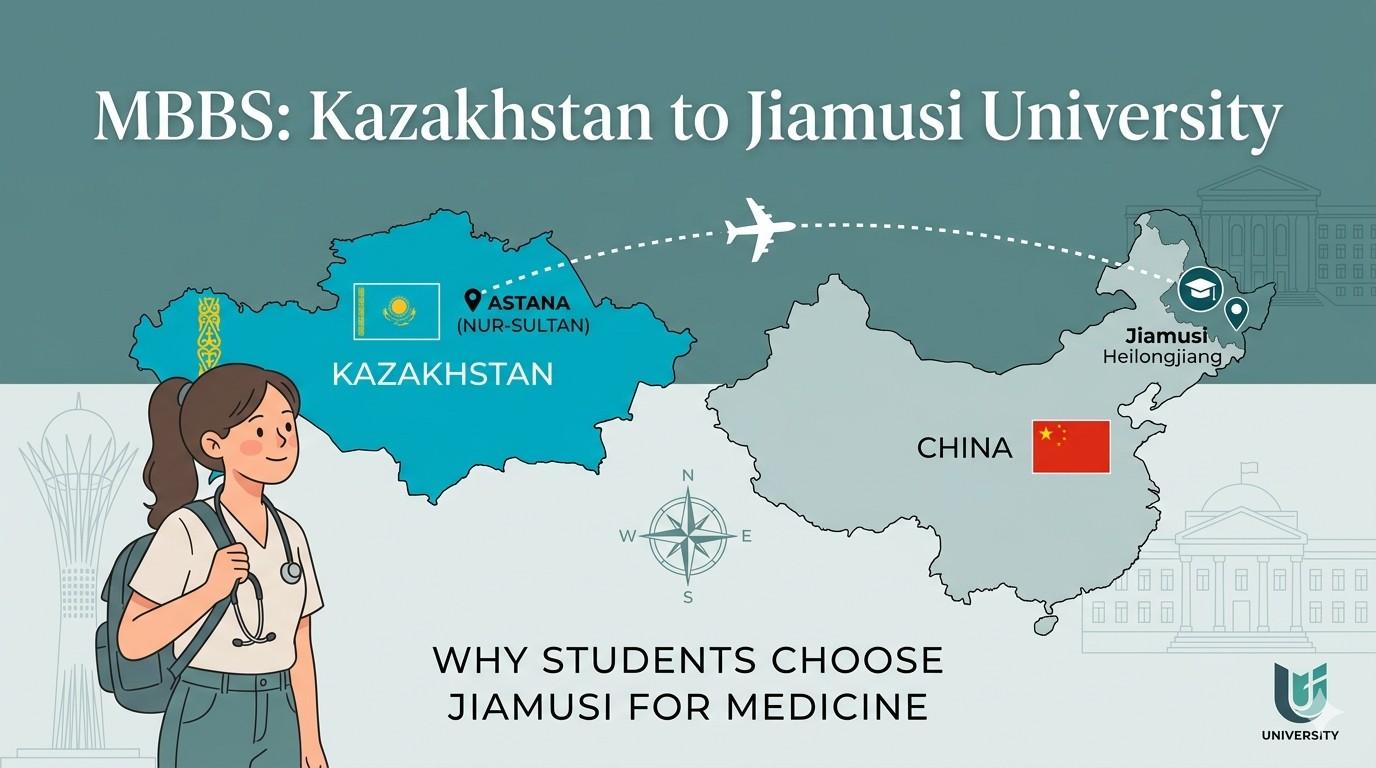
Students from Kazakhstan are increasingly choosing Jiamusi University for MBBS in China because it delivers a WHO-recognised, English-medium medical degree at an accessible cost, with a six-year curriculum (five years academic + one-year internship) built on internationally validated standards.
Located in Heilongjiang Province and established in 1947, Jiamusi University holds accreditation from the World Health Organization (WHO), the National Medical Commission (NMC) of India, the Pakistan Medical and Dental Council (PMDC), the World Federation for Medical Education (WFME), and the Educational Commission for Foreign Medical Graduates (ECFMG) in the USA, with accreditations that allow graduates to sit licensing examinations including USMLE, PLAB, and AMC worldwide.
For Kazakhstani medical aspirants, the appeal is concrete: China shares a direct border with Kazakhstan, travel time is short, the visa process is straightforward, and the cost of living in Jiamusi is significantly lower than in Western destinations. Study Sphere Advisors works with students navigating this route and consistently finds that the combination of geographic accessibility, institutional recognition, and structured clinical training makes Jiamusi University a practical and credible choice, not just an affordable one.
What Makes Jiamusi University Stand Out for International Medical Students?
Institutional Profile and Academic Foundation
Jiamusi University is a comprehensive public university under the Education Department of Heilongjiang Province. It covers 1.49 million square metres of campus, operates 26 colleges, and maintains 69 research institutes. The university hosts over 24,900 full-time students, including more than 600 international students from over 40 countries each year. Its research output is substantial, with over 5,800 academic papers published, including 428 indexed in SCI, SSCI, and EI databases.
The MBBS programme spans 11 academic disciplines, covering subjects from Anatomy and Physiology through Obstetrics and Gynaecology, Radiology, and Emergency Medicine. The First Affiliated Hospital of Jiamusi University, founded in 1946, functions as the primary teaching hospital, a fully equipped, large-scale institution where clinical rotations take place from the early years of the programme.
Bonus Tip: Students planning to practise in China after graduation will need HSK Level 4 Chinese language proficiency. However, those intending to return to Kazakhstan or move to another country can complete the full programme in English without this requirement.
Recognition and Licensing Pathways
| Accrediting or Licensing Body | Relevance for Kazakhstan Graduates |
| World Health Organization (WHO) | Degree is globally listed and accepted |
| NMC India | Eligible for FMGE/NExT if practising in India |
| PMDC Pakistan | Eligible for Pakistan medical licensing |
| ECFMG / USMLE (USA) | Can pursue US residency and licensure |
| PLAB (UK) | Eligible to apply for UK General Medical Council registration |
| AMC (Australia) | Can sit Australian Medical Council exam |
| WFME | International postgraduate education pathways open |
This breadth of recognition matters directly for Kazakhstani students. Kazakhstan shares recognised medical frameworks with several of these bodies, and graduates who return home or pursue postgraduate studies in Europe, the USA, or beyond have a clear licensing pathway available.
According to PLOS One research published in 2025 based on data spanning 2003–2018, geographic proximity and trade relations between the home country and China are significant factors in student mobility decisions, an advantage Kazakhstan holds directly, given its shared land border with China.
Why Kazakhstan Specifically Sends Students to Chinese Medical Universities?
Kazakhstan’s own domestic higher education system is expanding, but medical seat availability remains competitive relative to demand. Students who do not secure a government-subsidised seat face either expensive private options domestically or study abroad. China has emerged as one of the top destinations because of direct access, low visa rejection rates, English-medium instruction, and internationally recognised degrees.
The ICEF Monitor reported in October 2025 that Kazakhstan itself hosted over 31,000 international students in 2024 and is targeting 150,000 by 2029, a sign of a region where cross-border academic mobility is growing in both directions. For Kazakhstani students heading to China, the same proximity logic applies in reverse: China is not a distant foreign country but a neighbouring academic option accessible via direct flights.
Jiamusi, situated in Heilongjiang (China’s northernmost province), shares a climate profile familiar to students from Kazakhstan: cold winters and defined seasonal variation. This reduces one common friction point in international study decisions: climate adaptation.
Programme Structure and Clinical Training
| Programme Element | Details |
| Total Duration | 6 years (5 academic + 1 internship) |
| Medium of Instruction | English (Chinese available as secondary) |
| Teaching Hospital | First Affiliated Hospital of Jiamusi University (founded 1946) |
| Academic Disciplines | 11, including Clinical Medicine, Dentistry, Biomedical Engineering |
| Research Institutions | 69 research institutes on campus |
| International Collaborations | Academic partnerships with 38 universities across 14 countries |
| Campus Area | 1.49 million square metres |
| Campus Security | 24-hour on-campus security; separate hostels for male and female students |
Clinical exposure begins formally during the internship year but is integrated progressively through affiliated hospital visits and practicals throughout the programme. The university maintains academic exchange relationships with institutions in the USA, Russia, Japan, South Korea, and the UK, providing students with access to international medical conferences and short-term exchange programmes.
Bonus Tip: Confirm directly with the university’s International Culture Exchange Centre (ICEC) regarding your specific clinical rotation hospital before enrolling. Students who do this avoid surprises about placement logistics during the internship year.
Key Factors to Evaluate Before Applying
Choosing Jiamusi University is a long-term commitment. Several practical factors deserve serious attention before submitting an application.
Language in clinical settings. All formal teaching is conducted in English. However, patient interaction during clinical rotations in Chinese hospitals requires at least functional Mandarin. Students should assess how quickly they can build basic conversational proficiency and factor this into their preparation timeline.
Part-time work restrictions. Chinese student visa regulations prohibit part-time employment. Budget planning must account for the full duration of study without supplemental income. This is a legal requirement, not a university policy.
NMC registration status. Regulatory recognition can be updated. Always verify Jiamusi University’s current status on the NMC’s official published list before making a final decision, rather than relying solely on third-party consultancy materials.
Climate in Heilongjiang. Jiamusi experiences harsh winters, with temperatures regularly dropping well below freezing. Students from southern Kazakhstan will find this more extreme than their home climate. Factor in appropriate housing and winter readiness costs.
Post-graduation licensing in Kazakhstan. While WHO recognition opens most doors, students who intend to practise specifically in Kazakhstan should check with Kazakhstan’s Ministry of Health regarding the equivalency process for Chinese MBBS degrees. Requirements can vary by country.
Hostel availability. On-campus hostel spaces are limited. Early application, well before the September intake deadline, significantly improves the chance of securing on-campus accommodation.
How Study Sphere Advisors Can Support Your Application?
Study Sphere Advisors works with students pursuing international education pathways, including those requiring complex visa and documentation processes. Relevant services include:
- Student Visa Assistance: End-to-end guidance on Chinese student visa requirements, document preparation, and submission timelines for Kazakhstani applicants.
- Study Visa Consultation: Country-specific advice on eligibility, documentation standards, and visa category selection to align with your programme and intended stay duration.
- Business and Work Visa Support: For parents or guardians requiring short-term visit or business visas to China for university orientation or student welfare visits.
Questions Students Ask Before Applying
Is NEET required for Kazakhstan students?
NEET is mandatory for Indian nationals seeking foreign MBBS programmes under NMC guidelines, but Kazakhstan is not India. Kazakhstani students should verify the specific entrance and eligibility criteria that apply to their nationality directly through the university’s international admissions office.
Is the MBBS degree valid for practising medicine in Kazakhstan?
Kazakhstan’s Ministry of Health governs this directly. WHO recognition is a strong positive indicator, but the final authority on equivalency for domestic practice is Kazakhstan’s health regulatory body.
How long does the student visa process take for China?
Processing typically takes around 30 days after the university issues a formal admission letter. Begin the visa application immediately upon receiving admission confirmation to avoid delays ahead of the September intake.
Can students transfer to another university mid-programme?
Transfer policies vary significantly by institution and country. Mid-programme transfers from Chinese medical universities are uncommon and complex. Treat the six-year commitment as final when making the decision.
Long-Term Questions About MBBS from Jiamusi University
Does Jiamusi University’s MBBS meet global postgraduate entry requirements?
Yes, for most recognised destinations. ECFMG certification opens US residency pathways; PLAB allows UK licensing applications; AMC eligibility covers Australia. Graduates should research the specific requirements of the country where they intend to pursue postgraduate training, as exam formats and pass rates differ.
How does the six-year structure at Jiamusi compare with medical programmes in other countries?
Most internationally benchmarked MBBS programmes run five to six years. Jiamusi’s 5+1 model (five academic years plus a one-year hospital internship) aligns with standard international frameworks recognised by WHO and WFME.
What postgraduate research opportunities exist after Jiamusi MBBS?
Jiamusi University offers master’s degree programmes across 36 disciplines and holds two authorised doctoral degree subjects with two post-doctoral research stations. Graduates who wish to stay in China for postgraduate medical specialisation have clear academic pathways available.
What are the hostel and living conditions like for international students?
On-campus hostels provide furnished apartments with bathrooms, kitchen access, refrigerators, internet, and 24-hour hot and cold water. Separate facilities are maintained for male and female students. The city of Jiamusi itself is a mid-sized Chinese city, not a major metropolis, with lower consumer prices than Beijing or Shanghai.
Is there support for students who struggle academically during the programme?
The university maintains a student-to-faculty ratio and academic support infrastructure oriented toward its international cohort, which numbers over 600 students from more than 40 countries. The International Culture Exchange Centre (ICEC) handles international student affairs and is the appropriate point of contact for academic or administrative issues during the programme.
Make an Informed Decision
Jiamusi University offers Kazakhstani students a structured, internationally recognised path to an MBBS degree, one that combines geographic proximity, English-medium instruction, credible clinical training, and a wide range of post-graduation licensing options. The decision, however, needs to be grounded in specific factors: Kazakhstan’s own licensing requirements for foreign MBBS holders, individual language readiness for clinical environments, and accurate financial planning for the full six-year duration.
Students who research these details thoroughly before applying consistently find the process less disruptive and the outcome more aligned with their actual career goals.
Leave a Reply