
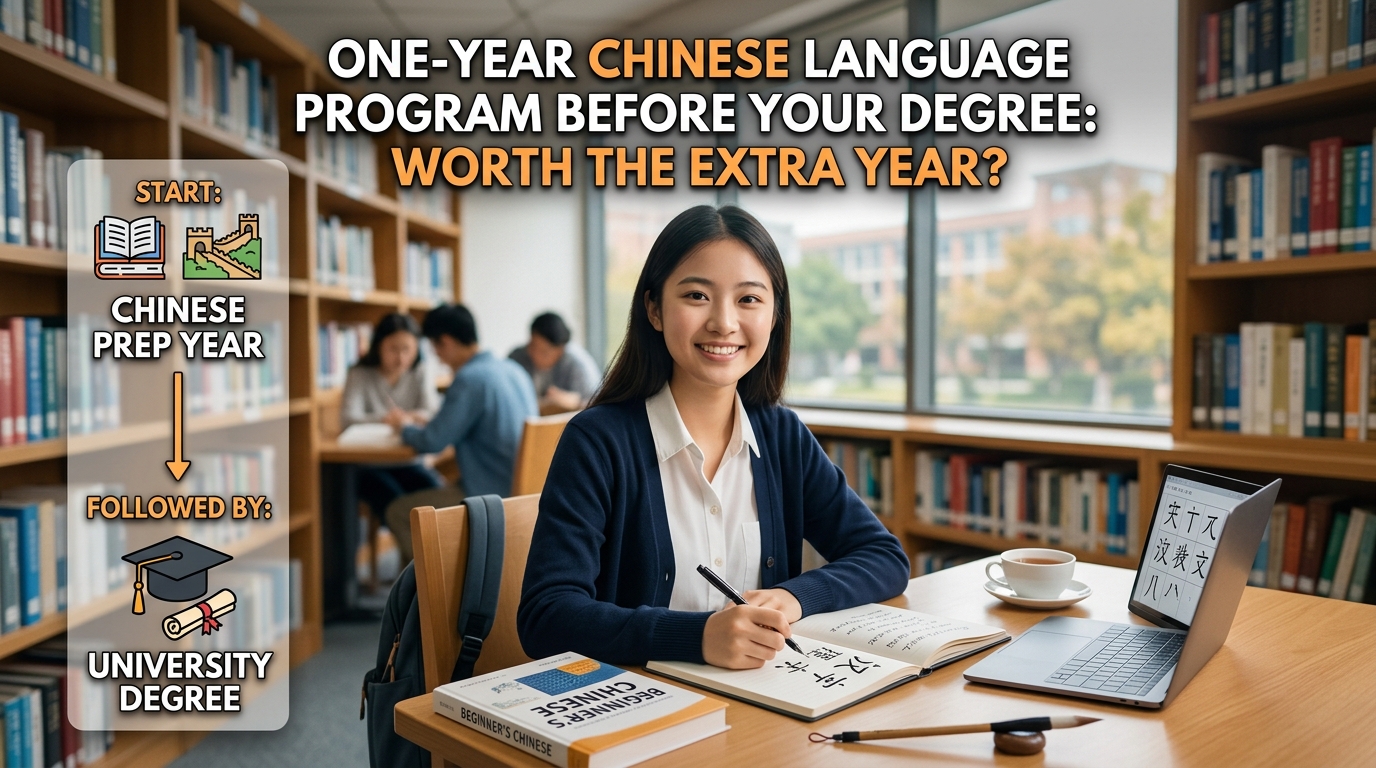
A one-year Chinese language program before a degree can be worth the extra year when the target programme is taught in Chinese, the applicant does not yet meet the required HSK level, or daily communication and academic preparation are major concerns. It becomes less useful when the intended degree is fully English-taught and the university does not require additional Chinese preparation.
The decision should therefore start with the language of instruction and the university’s entry requirement, not simply the desire to learn Chinese. Current 2026 university admissions show that Chinese-taught programmes can require different HSK levels depending on the degree and discipline. Hangzhou Dianzi University, for example, lists HSK 4 for undergraduate Chinese-taught programmes and HSK 5 for master’s and doctoral programmes, while other universities set different thresholds.
[Image: International student studying Mandarin with Chinese textbooks and a university admission plan on a desk]When an extra language year makes sense
A preparatory year becomes more valuable when Chinese will directly affect academic performance. Reading textbooks, understanding lectures, communicating with supervisors and completing administrative tasks can require much stronger language ability than basic conversational Chinese.
| Student situation | Value of a one-year Chinese program |
|---|---|
| Chinese-taught bachelor’s degree | High if current HSK is below the university requirement |
| Chinese-taught master’s degree | High when academic Chinese needs significant improvement |
| Chinese-taught medical programme | Potentially high, particularly where clinical communication will matter |
| English-taught degree | Moderate to low unless the student wants Chinese for daily life or future work |
| Already holds the required HSK level | Usually lower unless stronger academic Chinese is needed |
| Planning to work in China after graduation | Potentially high because practical communication can extend beyond classroom requirements |
The strongest case exists when the language year solves a specific admission or academic problem. It should not become an extra year simply because Chinese sounds useful.
Understand what the language year actually prepares you for
Not every Chinese language programme has the same academic purpose. Some focus mainly on general Chinese, while others are designed around Chinese language education, literature or related fields.
| Programme type | Main purpose | Typical outcome |
|---|---|---|
| Chinese language study | General language development | Improved reading, writing, listening and speaking |
| International Chinese Language Education | Chinese language plus teaching-related preparation | Language and Chinese education skills |
| Chinese language and literature | Academic study of Chinese language and literature | Stronger academic and subject-specific Chinese |
| University preparatory Chinese | Language preparation before degree study | Progress toward the institution’s degree-entry requirement |
Current 2026 scholarship guidance illustrates these differences. Huaqiao University lists an 11-month Chinese language study route requiring at least HSK 3 with a score of 210, while its International Chinese Language Education route has different HSK requirements.
Fudan University similarly lists a one-year Chinese language study programme with a maximum duration of 11 months and an HSK 3 requirement of at least 210 for the 2026 intake.
Compare the language requirement with the degree requirement
The biggest mistake is assuming that completing one year automatically qualifies a student for the next degree. The progression must be confirmed with the university.
| Question | What to verify before enrolling |
|---|---|
| Required HSK level | Exact level and minimum score for the target degree |
| HSK validity | Whether the university accepts the certificate’s validity period |
| Degree language | Chinese, English or mixed instruction |
| Internal progression | Whether the language programme guarantees or facilitates degree progression |
| Separate admission | Whether a new degree application is required |
| Academic assessment | Whether the university conducts an internal language or academic assessment |
| Programme availability | Whether the intended degree remains open for the next intake |
| Scholarship rules | Whether language study and degree study have separate scholarship conditions |
For example, Zhejiang University states that applicants to Chinese-taught programmes must provide an HSK certificate unless they qualify for an exemption based on previous Chinese-medium education.
Some universities also permit applicants who do not yet meet the Chinese requirement to undertake Chinese language study before entering the degree programme. Zhaoqing University explicitly states that applicants below its Chinese-language requirement can apply for Chinese language study and proceed to the degree after reaching the required level.
Do not confuse HSK progress with degree readiness
Passing an HSK level is useful, but academic readiness involves more than a certificate.
A student may understand everyday conversations yet struggle with technical vocabulary in medicine, engineering or business. The opposite can also happen: a student may meet an HSK threshold but still need practice understanding lectures or writing academic assignments.
Bonus Tip: During a language year, build vocabulary around the intended degree. A future MBBS student should not study only everyday Chinese. Medical terminology, hospital communication and formal academic language can become important later.
Consider the regional learning environment
China’s universities operate across very different regions, and students may encounter differences in local accents, food, climate and daily communication. Standard Mandarin remains the foundation for formal study, but regional exposure can affect everyday adjustment.
For students choosing between universities, consider whether the city provides opportunities to use Mandarin outside class. A language programme becomes more effective when students regularly use Chinese in shops, transport, accommodation, campus activities and routine administrative situations.
Students moving from Pakistan should also prepare for seasonal differences. Northern cities can have much colder winters than many parts of Pakistan, while southern and coastal regions can have hotter, more humid conditions. This does not determine language progress, but it can influence daily adjustment during an intensive academic year.
Check whether the extra year changes your academic timeline
An additional year affects more than language ability. It changes the overall study sequence, visa planning, scholarship arrangements and expected graduation timeline.
Bonus Tip: Create a complete timeline before accepting the language programme. Include the language year, HSK target date, degree application, admission decision, visa stage and expected degree completion. This makes it easier to identify whether the additional year genuinely solves a problem.
Things to Consider Before Making a Decision
Ask these questions before choosing a one-year Chinese programme:
- Does the target degree require Chinese?
- What HSK level does the university actually require?
- Can the current academic profile meet the degree requirement without a preparatory year?
- Does the language programme provide a recognised pathway into the intended degree?
- Will a new application be required after completing the language course?
- Does the scholarship cover the language year, the degree, or both?
- Does the programme teach academic Chinese relevant to the intended subject?
- Is the additional year justified by the student’s long-term career plans?
Do not select a language programme simply because it is available. Select it because the programme fills a clearly identified academic or language gap.
Relevant support for planning China study
Study Sphere Advisors can assist with the preparation stages that directly affect this decision:
- Course Selection
Helps compare Chinese-taught and English-taught degree pathways against the student’s academic background and language level. - University Admission Assistance
Supports applicants in checking programme requirements, language conditions and admission pathways. - Scholarship Assistance
Helps applicants understand whether relevant scholarship routes apply to language preparation and subsequent degree study. - Study Visa Assistance
Provides guidance on documentation and application requirements after the appropriate study pathway has been identified.
Common Questions Before Choosing a Language Year
Can I start a degree without HSK?
Some English-taught degrees do not require HSK, while Chinese-taught programmes commonly have Chinese-language requirements. The exact rule comes from the selected university and programme.
Does one year guarantee HSK 4 or HSK 5?
No. Progress depends on the starting level, study intensity, attendance, practice and examination performance. A programme may prepare students for an HSK target without guaranteeing a particular result.
Can I study Chinese and apply for a degree at the same university?
Sometimes. Universities may offer preparatory or language pathways, but progression conditions differ. Confirm whether a separate degree application and academic assessment are required.
Is a one-year programme useful for an English-taught degree?
It can improve daily communication and cultural adjustment, but it may not be academically necessary. The value depends on the student’s career plans and intended use of Chinese.
Should medical students consider Chinese preparation?
It can be particularly useful when the intended programme involves Chinese-language study or future interaction in Chinese-speaking clinical environments. The exact language requirement should be checked against the medical university and programme.
Make the Extra Year Serve a Clear Purpose
A one-year Chinese language programme is most worthwhile when it directly supports the next academic stage. For a Chinese-taught degree, it can provide structured preparation and help close a language gap. For an English-taught degree, the additional year requires stronger justification.
Study Sphere Advisors can be contacted at studysphereadvisor@gmail.com or 0301 6823658 for guidance on evaluating university and language-study pathways. Before committing, compare the target degree’s actual language requirement, progression rules and long-term study plan rather than treating an extra year as automatically beneficial.
Leave a Reply