
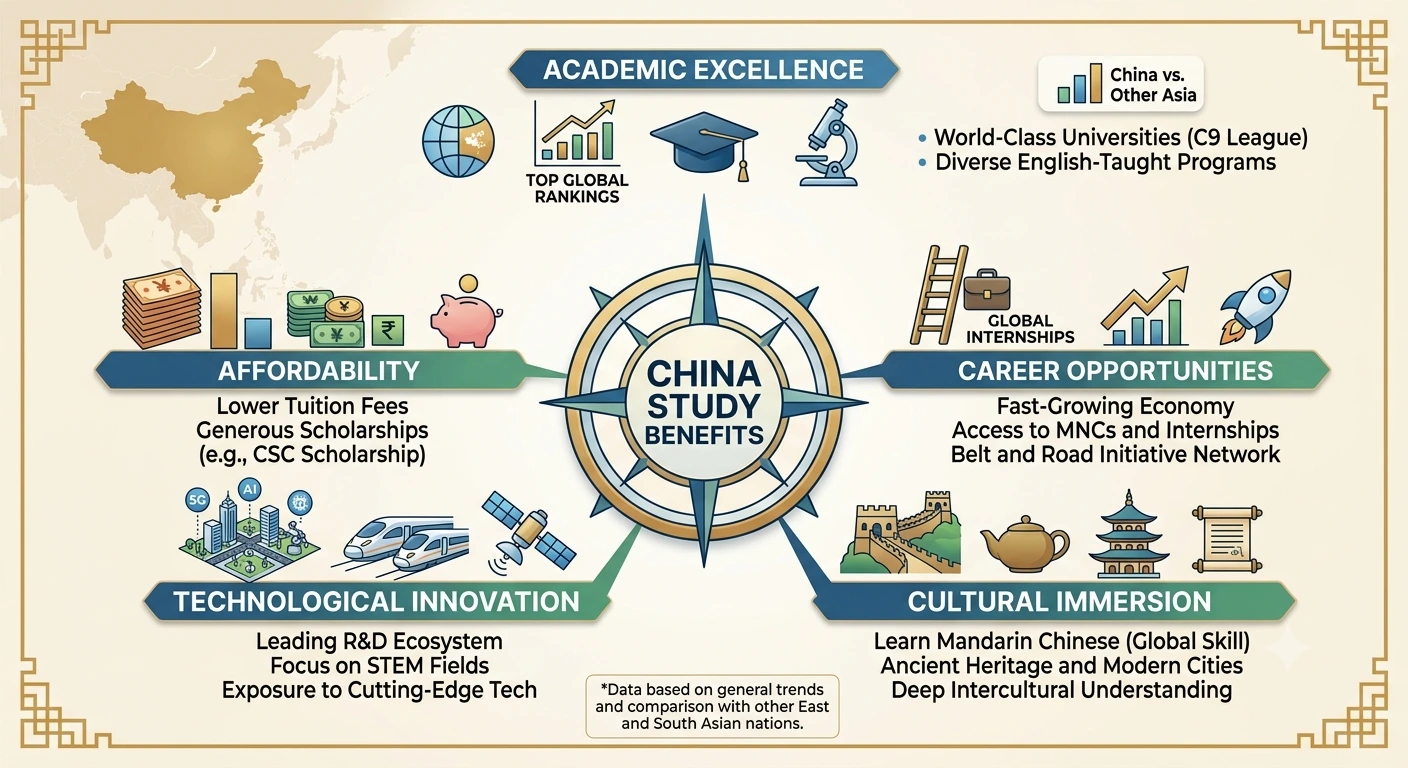
China offers several advantages for international students when compared with many other Asian study destinations. These advantages include a large number of globally ranked universities, extensive research infrastructure, broad program availability in English, strong industry connections, and a growing international student ecosystem. For students evaluating higher education opportunities across Asia, China often provides a combination of academic quality, technological advancement, and global career exposure.
Based on extensive experience guiding students through international education pathways, Study sphere advisors has observed that students frequently compare China with countries such as Malaysia, South Korea, Japan, Singapore, and Thailand before making a final decision. Understanding the differences in academic systems, research opportunities, language environments, and post-graduation prospects helps students make informed decisions aligned with long-term educational goals.
How China Compares With Other Popular Asian Study Destinations
The table below highlights key factors students typically evaluate before selecting a study destination.
| Academic and Student Factors | China | Japan | South Korea | Malaysia | Singapore | Thailand |
|---|---|---|---|---|---|---|
| Number of Universities | Very High | High | High | Moderate | Limited | Moderate |
| Research Infrastructure | Excellent | Excellent | Excellent | Good | Excellent | Good |
| English-Taught Programs | Extensive | Moderate | Growing | Extensive | Extensive | Moderate |
| Technology Exposure | Very High | High | High | Moderate | High | Moderate |
| International Student Population | Large | Moderate | Growing | Large | Large | Moderate |
| Industry Partnerships | Extensive | Strong | Strong | Moderate | Strong | Moderate |
| STEM Opportunities | Excellent | Excellent | Excellent | Good | Excellent | Good |
| Scholarship Availability | High | Moderate | Moderate | Moderate | Limited | Moderate |
According to UNESCO Institute for Statistics and data from major Asian higher education authorities, China remains one of the largest destinations for international students in Asia due to its rapidly expanding university sector and research capabilities.
Academic Strengths That Make China Stand Out
China has invested heavily in higher education over the past two decades. Universities have expanded research facilities, international partnerships, and academic programs that align with global workforce demands.
Strong Presence in Global University Rankings
Many Chinese universities consistently appear in major global rankings published by QS World University Rankings and Times Higher Education. These institutions offer advanced laboratories, research centers, and collaborative projects with international universities.
Wide Range of Study Programs
Students can choose from:
- Engineering
- Medicine
- Computer Science
- Artificial Intelligence
- Business Administration
- International Trade
- Environmental Sciences
- Data Analytics
This diversity allows students to pursue specialized academic pathways that may not be available in some smaller Asian education systems.
Bonus Tip: Students interested in emerging technologies should review university research publications before applying. Research output often provides a more accurate indicator of academic strength than rankings alone.
Research and Innovation Opportunities
China has become a global leader in scientific research and technological development.
Research Indicators Across Major Asian Destinations
| Research Factor | China | Japan | South Korea | Malaysia | Singapore |
|---|---|---|---|---|---|
| Research Funding Availability | Very High | High | High | Moderate | High |
| AI Research Activity | Very High | High | High | Moderate | High |
| Engineering Research Facilities | Excellent | Excellent | Excellent | Good | Excellent |
| International Research Collaboration | Extensive | Extensive | Strong | Moderate | Strong |
| Publication Output | Very High | High | High | Moderate | High |
According to the World Intellectual Property Organization (WIPO), China has ranked among the world’s leading countries for patent applications and innovation activity in recent years, creating valuable learning environments for students in research-focused disciplines.
Access to Modern Technology and Industry Networks
Many Chinese universities maintain partnerships with technology firms, manufacturing companies, healthcare organizations, and research institutes.
Students often benefit from:
- Industry-led workshops
- Research internships
- Innovation incubators
- Technology exhibitions
- Academic-industry collaborations
These opportunities help bridge the gap between classroom learning and practical application.
Bonus Tip: Students planning careers in engineering or technology should prioritize universities located near major innovation hubs such as Beijing, Shanghai, Shenzhen, and Hangzhou.
Student Life and International Environment
China hosts students from numerous countries, creating multicultural academic communities.
Student Experience Factors
| Student Experience Element | China | Japan | South Korea | Malaysia |
|---|---|---|---|---|
| International Student Communities | Large | Moderate | Growing | Large |
| Campus Facilities | Excellent | Excellent | Excellent | Good |
| Cultural Exposure | High | High | High | Moderate |
| Transportation Networks | Excellent | Excellent | Excellent | Good |
| Digital Infrastructure | Very High | High | High | Moderate |
Students gain exposure to diverse perspectives while developing intercultural communication skills that are increasingly valuable in international careers.
Factors Students Should Evaluate Before Choosing China
Every study destination has strengths and limitations. Students should assess personal goals before making a decision.
Language Expectations
Although many programs are taught in English, daily life may involve some Mandarin communication. Learning basic Mandarin can improve adaptation and enhance networking opportunities.
Academic Expectations
Chinese universities often maintain rigorous academic standards, particularly in STEM and research-intensive programs.
Regional Differences
Educational environments can vary significantly between cities.
| Region | Characteristics |
|---|---|
| Beijing | Research-focused institutions, government partnerships, strong academic reputation |
| Shanghai | International environment, business-focused opportunities, global exposure |
| Shenzhen | Technology and innovation ecosystem |
| Wuhan | Strong engineering and scientific research institutions |
| Guangzhou | International trade and business opportunities |
Climate Considerations
Students should also consider climate preferences:
| Region Type | Typical Conditions |
|---|---|
| Northern China | Cold winters and seasonal variation |
| Central China | Four distinct seasons |
| Southern China | Warmer temperatures and higher humidity |
| Coastal Areas | Moderate climate with maritime influence |
Bonus Tip: Reviewing climate conditions before application helps students prepare for housing, clothing, and lifestyle adjustments.
Educational Support Services Available Through Study sphere advisors
Study sphere advisors supports students throughout various stages of international education planning through services such as:
- Study Visa Services – Assistance with educational visa documentation and application preparation.
- Student Visa Guidance – Support for compliance requirements and admission-related visa processes.
- Business Visa Services – Assistance for educational delegations, institutional visits, and academic collaborations.
- Work Visa Support – Guidance for individuals pursuing eligible professional opportunities after meeting relevant requirements.
Questions Students Often Ask Before Choosing a Study Destination
Is China a better option for STEM subjects?
China offers strong advantages in engineering, technology, artificial intelligence, and scientific research due to significant investment in innovation and research infrastructure.
Do Chinese universities offer English-medium programs?
Many universities provide undergraduate and postgraduate programs taught entirely in English, particularly in medicine, engineering, business, and technology fields.
How does China compare for research opportunities?
China generally provides broader access to research facilities and large-scale innovation projects than many developing Asian study destinations.
Is cultural adaptation difficult?
Most students adapt successfully by participating in campus activities, engaging with local communities, and learning basic Mandarin communication skills.
Additional Questions Students Ask After Starting Their Studies
Can international students participate in research projects during their degree?
Many universities allow students to join faculty-led research initiatives, particularly at postgraduate levels.
How important is learning Mandarin after enrollment?
Mandarin is not always required academically, but it can improve networking, internships, and daily communication.
Do Chinese universities collaborate with international institutions?
Many universities maintain exchange programs, joint research initiatives, and academic partnerships with institutions worldwide.
Are extracurricular activities available for international students?
Most universities offer student organizations, sports activities, cultural events, and volunteer opportunities.
What skills do students commonly gain from studying in China?
Students often develop research capabilities, intercultural communication skills, adaptability, and exposure to advanced technological environments.
Key Takeaways for Future Students
China offers a unique combination of academic quality, research opportunities, technological advancement, and international exposure that distinguishes it from many other Asian study destinations. While countries such as Japan, South Korea, Singapore, Malaysia, and Thailand each provide valuable educational opportunities, China’s scale, innovation ecosystem, and university network create significant advantages for many students.
Students should evaluate academic goals, preferred learning environments, language considerations, research interests, and long-term career objectives before making a final decision.
Leave a Reply