
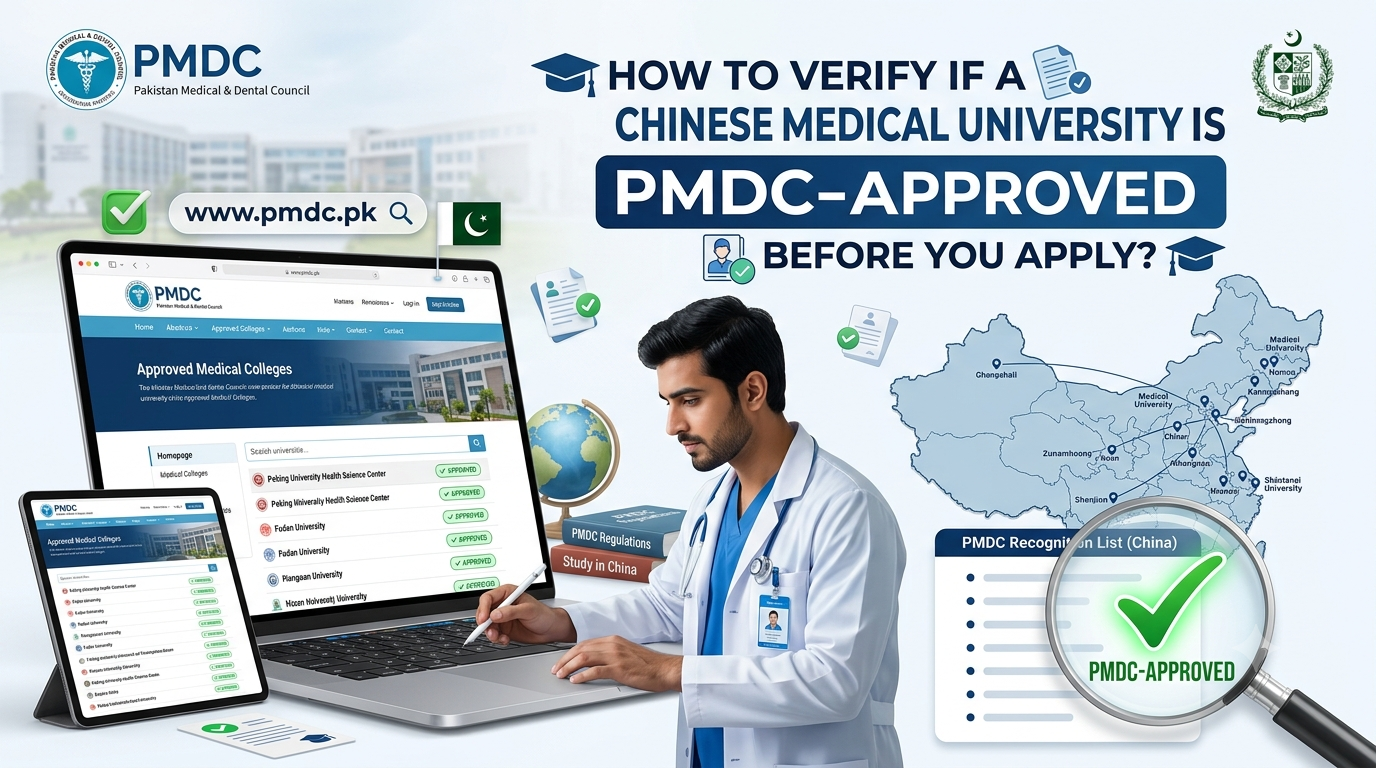
Verifying whether a Chinese medical university is PMDC-approved means checking the university’s exact name and city against PMDC’s official “List of Foreign Recognized Institutions (Undergraduate),” published on pmdc.pk, rather than relying on a consultancy’s claim, a university brochure, or a WHO or ECFMG badge alone. This single check determines whether a Pakistani student can later sit the National Registration Examination (NRE) and register to practice in Pakistan, regardless of how strong the university’s degree program or international reputation may be.
This verification step matters to every Pakistani student considering an MBBS or BDS program in China, because PMDC’s recognized institutions list is dynamic, universities are added, moved between verification categories, or occasionally removed as PMDC’s own review process continues. Parents comparing admission offers and students choosing between multiple universities both need to know how to check this directly, rather than treating an admission consultant’s assurance or a university’s marketing material as sufficient confirmation.
Advisory conversations with Pakistani families researching Chinese medical universities reveal a recurring and costly mistake: confusing two similarly named institutions, or assuming that WHO recognition, ECFMG listing, or a general claim of “PMDC recognized” printed on an admission flyer is equivalent to confirming the university’s exact name appears on PMDC’s current undergraduate list. Since many Chinese university names are similar, a university’s name and its city together, not the name alone, distinguish one from another with a near-identical name, this confusion is common and avoidable with a direct check.
Where PMDC Publishes Recognition Information?
PMDC maintains its recognition information on its official website, pmdc.pk, rather than through a single search box. The relevant information is distributed across a few specific sections.
| PMDC Resource | What It Shows | Where to Find It |
|---|---|---|
| List of Foreign Recognized Institutions (Undergraduate) | The primary list relevant to MBBS/BDS applicants | Published as a downloadable document on pmdc.pk, often linked from the FAQs or Colleges section |
| Recognised Institutes with Attached Hospitals | Confirms whether an institution’s affiliated hospitals are also recognized for clinical training | Listed separately from the main undergraduate list |
| Foreign Medical Institutions section | General information on foreign institution policy and categorization | Found under the Colleges or Institutions menu on pmdc.pk |
| Recognized Foreign PG Qualifications | Relevant only to postgraduate qualifications, not MBBS/BDS admission | A separate list; should not be confused with the undergraduate list |
Since PMDC periodically updates these documents, checking the most recently published version rather than a saved or forwarded copy from a previous year is the safer approach.
Step-by-Step Verification Process
| Step | Action | Why It Matters |
|---|---|---|
| 1. Visit the official PMDC website | Navigate to pmdc.pk directly rather than a third-party consultancy page | Avoids outdated or unofficial copies of the list |
| 2. Locate the Foreign Recognized Institutions (Undergraduate) list | Usually found under the Colleges/Institutions section or linked from the FAQs page | This is the specific list relevant to MBBS/BDS applicants, not the postgraduate list |
| 3. Download the current list document | PMDC publishes this as an official PDF, updated periodically | Screenshots or excerpts shared informally may be outdated |
| 4. Search for the university’s exact full name and city | Use the full institutional name as it appears on the admission offer, including the city | Confusingly similar names are common among Chinese universities |
| 5. Note the verification category, if listed | PMDC categorizes institutions (commonly referred to as List A, B, or C) based on the level of independent accreditation verification completed | A lower category does not necessarily mean rejection, but indicates a different verification stage |
| 6. Cross-check WDOMS and WFME status independently | Confirm the university also appears in the World Directory of Medical Schools and holds WFME accreditation | These are separate from, but often referenced alongside, PMDC’s own assessment |
| 7. Re-verify closer to enrollment and again before graduation | Since the list is dynamic, a check performed at the research stage should be repeated before finalizing payment and again before relying on it for exam registration | Institutions can shift categories or be reassessed over time |
Understanding PMDC’s Institution Categorization
PMDC groups recognized foreign institutions into categories based on how much independent verification and accreditation each has completed, rather than a simple approved-or-not-approved status.
| Category | General Meaning | Practical Implication |
|---|---|---|
| Category A | Institutions verified through two-tier independent accreditation | Generally represents the most thoroughly verified group |
| Category B | Institutions verified through one-tier accreditation, with further verification in progress | May shift to Category A once additional accreditation is completed |
| Category C | Institutions under process of inspection or initial accreditation | Represents an earlier verification stage; status can change as the review continues |
Because these categories are described by PMDC as dynamic, an institution’s category at the time a student applies is not necessarily fixed for the full duration of the program, which is one reason periodic re-verification is advisable rather than a single check at the admission stage.
Common Verification Mistakes to Avoid
| Mistake | Why It’s a Problem | Better Approach |
|---|---|---|
| Relying on an admission consultant’s verbal confirmation | Claims of “PMDC recognized” are not always cross-checked against the current list | Request the specific line item from the current PMDC list showing the university’s exact name |
| Matching only the university’s general name | Similar names (e.g., a university in one Chinese province versus a similarly named one in another) can be mistaken for each other | Confirm both the full name and the city match exactly |
| Treating WHO or ECFMG listing as equivalent to PMDC approval | These are separate recognition systems maintained by different organizations | Verify each recognition system independently, since they serve different purposes |
| Using an old or forwarded copy of the PMDC list | The list is updated periodically, and older copies may not reflect current status | Download the most recently published version directly from pmdc.pk |
| Assuming postgraduate recognition applies to undergraduate admission | PMDC maintains separate lists for undergraduate and postgraduate foreign qualifications | Confirm the university appears specifically on the undergraduate list for MBBS/BDS purposes |
How This Verification Step Fits Into Broader Study-Destination Planning?
| Country | Relevant Recognition Body for Pakistani Students | Verification Approach |
|---|---|---|
| China | PMDC’s Foreign Recognized Institutions (Undergraduate) list | Direct name-and-city match against PMDC’s published list |
| United Kingdom | PMDC (for Pakistan-bound practice) alongside UK’s own GMC/GDC registers | Requires checking both PMDC’s list and UK-specific registers depending on intended practice location |
| Canada | PMDC (for Pakistan-bound practice) alongside Canadian medical regulatory bodies | Similar dual-verification approach as the UK |
| Australia | PMDC (for Pakistan-bound practice) alongside AMC registers | Similar dual-verification approach as the UK and Canada |
Visa and enrollment patterns across these destinations have shifted in recent admission cycles, which is part of why verifying recognition carefully before committing to a specific country and university matters more than ever. According to ICEF Monitor’s 2026 analysis of student mobility trends, study visa rejection rates for Pakistani applicants have risen sharply across several Big Four destinations, with more than 70% of Pakistanis refused an F-1 visa in the US in 2026, and Pakistani applicants to the UK seeing sponsored study visa rejection rates spike from 5.6% to 41% year-over-year.
China’s inbound international enrollment, by contrast, reached roughly 380,000 foreign students from nearly 200 countries during the 2024/25 academic year, according to Chinese Ministry of Education figures reported via China Daily, a trend that has made verifying Chinese university recognition an increasingly common and necessary step for Pakistani applicants.
Factors That Deserve Careful Evaluation
- Academic fit: Confirming recognition status before comparing tuition, teaching language, or campus facilities, since a well-regarded but unrecognized institution does not solve the eventual licensing requirement.
- Budget planning: Avoiding non-refundable application and admission fees paid toward a university whose recognition status has not been independently confirmed.
- Career goals: Deciding early whether the intention is to practice in Pakistan, which makes the PMDC undergraduate list the primary reference point for verification.
- Visa compliance: Keeping a copy of the verification result (the relevant PMDC list page or PDF) alongside other admission documents for future reference.
- Language requirements: Confirming instruction language claims (English medium, bilingual) independently, since recognition status and teaching language are separate considerations.
- Post-study opportunities: Understanding that recognition verification at admission does not eliminate the later requirement to pass the NRE for a Pakistani license.
How Study Sphere Advisors Supports Students
Study Visa Assistance Guidance on preparing the documentation required for a Chinese student visa application, reducing the risk of delays caused by incomplete paperwork.
Work Visa Consultation Orientation on the requirements and pathway for a work visa for graduates considering employment or internship opportunities in China after completing their program.
Questions Students Usually Ask Before Applying
Is a university’s own claim of “PMDC approved” sufficient confirmation? No. This claim should be independently verified against PMDC’s currently published Foreign Recognized Institutions (Undergraduate) list.
Does WHO or ECFMG recognition mean a university is automatically PMDC-approved? No. These are separate recognition systems maintained by different organizations, and each should be verified independently.
Where exactly on PMDC’s website is the relevant list found? It is generally accessible through the Colleges/Institutions section or linked from the FAQs page on pmdc.pk, published as a specific undergraduate foreign institutions list.
What should be done if a university’s exact name cannot be found on the list? Treat this as a reason to seek direct clarification from PMDC or reconsider the specific institution, rather than assuming a partial or similar name match is sufficient.
Additional Questions Students Often Have
Can a university’s PMDC category change after a student has already enrolled? Yes. PMDC describes its categorization as dynamic, meaning institutions can move between verification tiers as additional accreditation is completed.
Is the undergraduate list the same as the postgraduate qualifications list? No. PMDC maintains separate lists, and MBBS/BDS applicants should refer specifically to the undergraduate foreign institutions list.
How often is the PMDC list updated? PMDC updates its recognized institutions documentation periodically; specific update frequency is not fixed, which is why checking the most recent version before major decisions is advisable.
Does appearing on the PMDC list guarantee eligibility for the NRE after graduation? Appearing on the list is a prerequisite, but graduates must still independently meet NRE eligibility and registration requirements after completing their degree.
Should the affiliated teaching hospital also be checked separately? Yes. PMDC maintains a separate reference for recognized institutes with attached hospitals, relevant to confirming that clinical training facilities are also recognized.
Final Words
Confirming that a Chinese medical university is PMDC-approved comes down to a specific, repeatable process: locating PMDC’s current Foreign Recognized Institutions (Undergraduate) list on pmdc.pk, matching the university’s exact full name and city, understanding its verification category, and cross-checking WDOMS and WFME status independently. Treating this as an ongoing check rather than a one-time confirmation at admission gives Pakistani students and their families a more reliable basis for evaluating university choice against long-term licensing and career plans.
Making the Decision
Students evaluating their study abroad options often benefit from expert guidance when comparing universities, scholarships, visa requirements, and long-term career opportunities. Study Sphere Advisors assists students in understanding admission requirements, documentation processes, and recognition criteria relevant to Chinese medical and dental universities. Students seeking personalized guidance on their specific academic profile can reach out to the advisory team for further information.
Leave a Reply