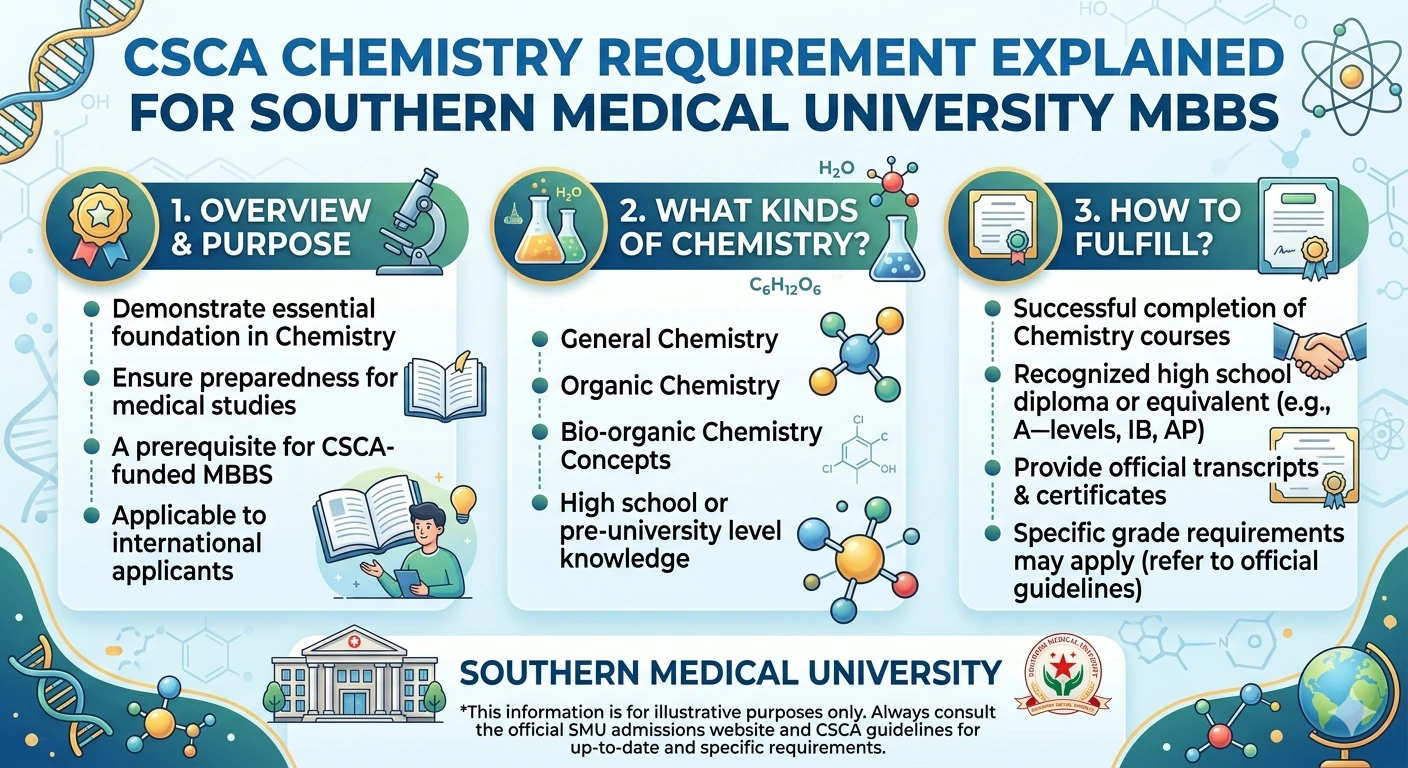
The CSCA Chemistry requirement for Southern Medical University MBBS refers to the minimum chemistry competency level that applicants must demonstrate through CSCA assessment or equivalent pre-medical qualification. It ensures students entering MBBS can handle foundational concepts such as organic chemistry, biochemistry, and general chemical principles needed in early medical studies.
In practical admission evaluation, chemistry is treated as a core screening subject alongside biology and physics. Failure to meet the required chemistry benchmark typically leads to application delays or rejection, even if other academic areas are strong. This content explains how the requirement works, what standards are expected, and how applicants are evaluated based on real admission patterns followed in Chinese medical universities.
The insights are based on documented admission frameworks used for international MBBS applicants and academic evaluation patterns observed in China’s medical education system.
Understanding CSCA Chemistry Requirement for MBBS Admission
CSCA Chemistry requirement is designed to measure whether a student has pre-university level chemistry knowledge equivalent to higher secondary science education. Southern Medical University uses this benchmark to ensure readiness for medical coursework in pharmacology, pathology, and biochemistry.
The evaluation is not only theoretical. It also includes problem-solving ability, numerical chemical calculations, and understanding of molecular structures.
| Academic Area Evaluated in CSCA Chemistry | Skills Tested | MBBS Relevance |
|---|---|---|
| General Chemistry | Atomic structure, periodic trends | Foundation for biochemistry |
| Organic Chemistry | Functional groups, reactions | Drug synthesis understanding |
| Physical Chemistry | Thermodynamics, kinetics | Pharmacology principles |
| Analytical Chemistry | Titration, concentration | Clinical diagnostics basics |
Admission Alignment with Southern Medical University Standards
Southern Medical University follows structured eligibility mapping where CSCA Chemistry is aligned with Chinese Ministry of Education international admission policies. According to MOE China guidelines (2024), international MBBS candidates must demonstrate “equivalent science proficiency at senior secondary level” for eligibility consideration.
A second reference from WHO Global Health Workforce Education Report (2023) confirms that medical programs globally require chemistry competency validation to ensure patient safety readiness during clinical training.
| Requirement Category | CSCA Chemistry Standard | Equivalent International Benchmark |
|---|---|---|
| Minimum Academic Level | Higher secondary chemistry pass | A-Level Chemistry / IB HL Chemistry |
| Practical Knowledge | Basic lab safety & experiments | School laboratory certification |
| Numerical Accuracy | Stoichiometry & molarity | Pre-medical entrance standards |
| Conceptual Understanding | Reaction mechanisms | Undergraduate foundation level |
Key Chemistry Topics Covered in CSCA Evaluation
The chemistry portion of CSCA assessment focuses on structured scientific understanding rather than memorization. Evaluation patterns show repeated emphasis on applied concepts used in early MBBS semesters.
| Core Topic Area | Subtopics Included | Difficulty Level |
|---|---|---|
| Inorganic Chemistry | Periodic table, bonding, acids & bases | Moderate |
| Organic Chemistry | Hydrocarbons, alcohols, biomolecules | High |
| Physical Chemistry | Gas laws, energy changes | Moderate |
| Biochemistry Basics | Enzymes, proteins, metabolism | High |
Bonus Insight from Academic Evaluation Practice
- Students who revise reaction mechanisms visually perform better in CSCA Chemistry assessments.
- Concept mapping improves retention of organic chemistry pathways.
- Practicing numerical conversions reduces exam-time errors significantly.
Comparison of Chemistry Qualification Pathways for MBBS Entry
Different education systems are evaluated differently when applying for MBBS at Southern Medical University.
| Qualification Type | Chemistry Depth | Admission Acceptance Strength | Key Limitation |
|---|---|---|---|
| CSCA Certification | Standardized evaluation | High if passed with required score | Requires exam preparation |
| A-Level Chemistry | Advanced theoretical + practical | Strong acceptance | System-specific syllabus |
| IB Chemistry HL | Research-based learning | Very strong acceptance | Complex assessment style |
| High School Science Certificate | Basic foundation level | Conditional acceptance | May require bridging test |
This comparison shows that CSCA Chemistry acts as a standardization tool for applicants from diverse education systems.
Things to Consider Before Meeting Chemistry Requirement
Meeting CSCA Chemistry expectations requires structured preparation rather than short-term study. Admission evaluations often identify gaps in conceptual clarity rather than factual knowledge.
Key factors include:
- Consistency in understanding reaction mechanisms instead of rote learning
- Ability to solve numerical chemistry problems under time constraints
- Familiarity with laboratory safety and experimental interpretation
- Alignment of previous curriculum with Chinese MBBS science standards
Bonus Practical Guidance
- Focus on NCERT/AS-level equivalent chemistry foundations before advanced topics
- Practice MCQs from past CSCA-style question banks
- Strengthen weak areas in organic chemistry early, as it carries higher weightage
Academic Support and Visa Guidance Services
Support services are often required for students navigating MBBS admission requirements across international universities.
- Study Visa Assistance – Structured documentation support for academic visa submission processes.
- Student Visa Advisory – Guidance on eligibility, embassy requirements, and interview preparation.
- Business Visa Support – Documentation assistance for short-term academic visits or consultations.
- Work Visa Information Services – Clarification on post-study work eligibility pathways.
Study sphere advisors provides structured academic advisory support aligned with international medical admission processes.
Common Questions Before Applying for MBBS Chemistry Requirement
Is CSCA Chemistry mandatory for all MBBS applicants
Yes, it is commonly required or used as an equivalent evaluation method for chemistry competency in international applicants.
Can weak chemistry background still qualify for admission
Applicants may qualify if they complete bridging preparation or meet equivalent academic standards in other recognized qualifications.
How difficult is CSCA Chemistry compared to school exams
It is moderately more advanced than standard high school exams due to its application-based question format.
Does laboratory experience affect evaluation results
Yes, familiarity with experimental chemistry improves conceptual clarity and problem-solving speed.
Frequently Asked Academic Questions
What happens if chemistry score is below requirement level
Applications may be deferred or redirected to preparatory science programs before MBBS entry.
Is CSCA Chemistry based only on theory
No, it includes numerical problems and applied scientific reasoning in addition to theory.
Do Chinese universities accept international chemistry syllabuses directly
Only if they match equivalency standards set by Chinese medical education authorities.
How early should chemistry preparation begin
Preparation is typically recommended at least 6–12 months before admission assessments.
Is chemistry more important than biology in MBBS admission
Both are essential, but chemistry is often used as a foundational screening subject.
Conclusion
CSCA Chemistry requirement for Southern Medical University MBBS is a structured benchmark used to ensure academic readiness in core medical sciences. It focuses on conceptual strength in inorganic, organic, and physical chemistry aligned with international medical education standards.
Applicants who understand the subject structure early and align preparation with competency-based learning methods tend to perform more consistently in admission assessments. Evaluation is designed to test readiness for medical coursework rather than memorization ability.
Leave a Reply