
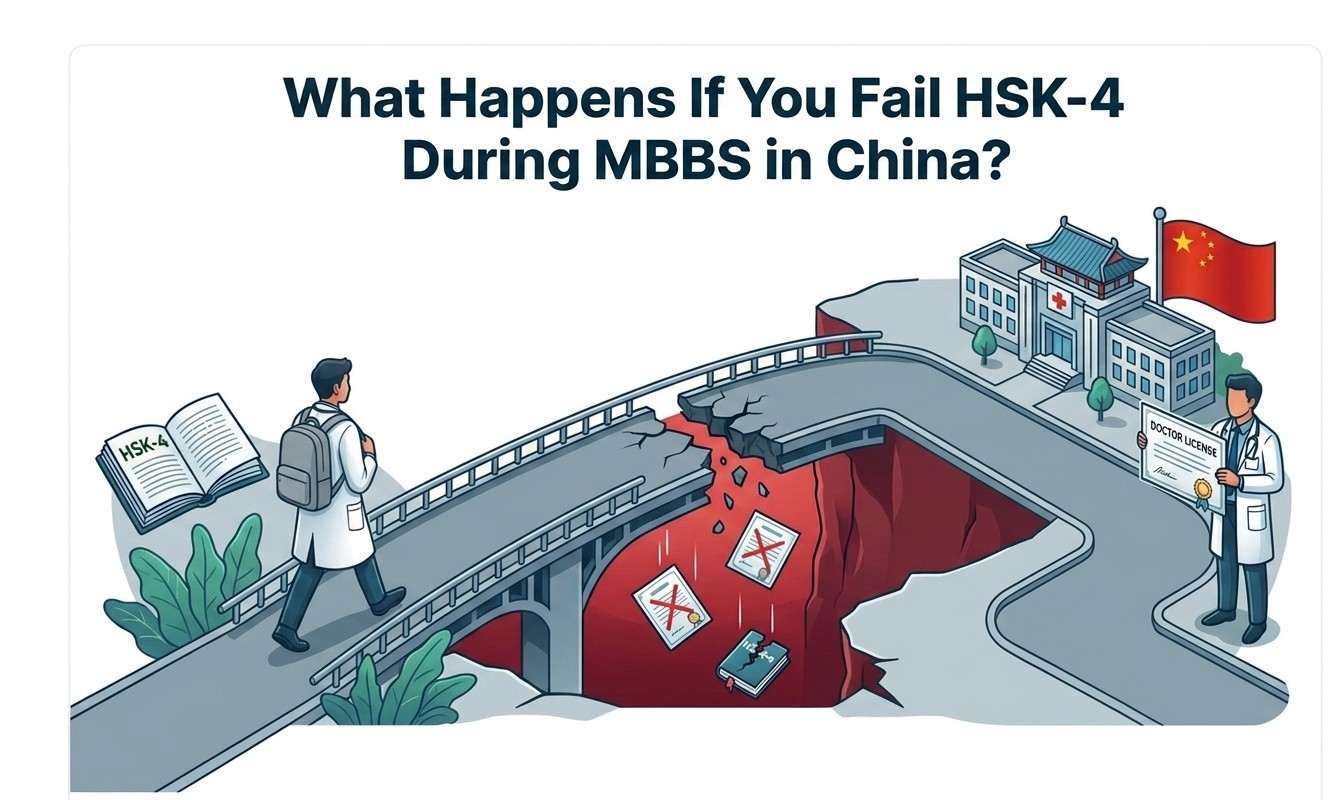
Failing HSK-4 during MBBS in China does not automatically mean that a student will lose admission or be removed from the university. The actual consequence depends on the university’s academic regulations and the stage at which HSK-4 is required. Some students may be allowed to retake the examination, while others may face delays in clinical training, internship progression, scholarship continuation, or graduation clearance.
This issue matters particularly for international MBBS students because Chinese language training is part of the broader educational framework for English-medium medical programmes. China’s Ministry of Education states that Chinese language is a compulsory component throughout undergraduate medical education taught in English for international students, partly because medical training involves living in China and communicating in clinical environments.
In student advisory cases, one common mistake is assuming that an English-medium MBBS programme removes the need to plan for Chinese language development. In practice, HSK targets can differ between universities. Some institutions may require HSK-4 before internship or graduation, while others may set different internal milestones. For example, Study Sphere Advisors’ published university information shows that language requirements can vary, including cases where HSK-4 is linked to internship progression.
Why HSK-4 Can Matter During MBBS in China?
The Chinese Ministry of Education’s quality standards for English-medium undergraduate medical education require Chinese language and Chinese medical terminology within the curriculum, with students expected to pass relevant course assessments. The purpose is practical as well as academic because future clinical work may involve communication with patients, hospitals, and medical staff.
However, students should not assume that one national rule creates exactly the same HSK-4 deadline at every medical university. Universities can apply their own academic progression rules, so the admission offer, student handbook, international student regulations, and medical faculty requirements should be checked carefully.
| Situation | Possible Outcome | What the Student Should Do |
|---|---|---|
| HSK-4 is an internal graduation requirement | Graduation may be delayed until the requirement is completed | Confirm the final deadline and available retake opportunities |
| HSK-4 is required before clinical internship | Internship progression may be postponed | Ask whether a supplementary examination or later test date is accepted |
| HSK-4 is part of a compulsory Chinese course | The student may need to repeat or clear the course assessment | Review academic probation and reassessment rules |
| HSK-4 affects scholarship conditions | Continued funding may depend on meeting academic requirements | Check the scholarship agreement and annual review criteria |
| HSK-4 is not yet required at the student’s current stage | Immediate progression may continue | Start preparation early rather than waiting for the deadline |
The Ministry of Education has previously recognised HSK-4 as a benchmark for certain international undergraduate pathways, while also allowing institutions to determine Chinese-language requirements for self-funded international students. This reinforces the importance of checking the individual university’s current rules rather than relying only on another student’s experience.
The Most Common Academic Consequences
A Retake May Be the First Option
For many students, failing HSK-4 is not the end of the academic pathway. The first question should be whether the university accepts another HSK attempt or provides a supplementary route.
Students should immediately confirm the next available test date and whether the university accepts the updated result after the original deadline.
Clinical Training Could Be Affected
Language ability becomes more important as students move closer to patient-facing training. China’s official standards state that international medical graduates should be able to communicate effectively with patients and medical personnel, while Chinese language remains part of the curriculum.
A university may therefore connect language requirements with internship eligibility or clinical placement. This does not mean every failed HSK-4 result automatically cancels an internship, but students should obtain written confirmation from the faculty.
Graduation Could Be Delayed
If HSK-4 or an equivalent Chinese-language standard is included in graduation requirements, a student may complete medical coursework but still need to satisfy the language requirement before receiving final academic clearance.
This can create problems with future licensing timelines, postgraduate applications, or employment planning.
What Students Should Check With Their University Immediately?
| Requirement to Confirm | Why It Matters | Recommended Action |
|---|---|---|
| Required HSK level | Universities may set different standards | Request the current written policy |
| Deadline | The requirement may apply before internship or graduation | Confirm the exact academic stage |
| Retake policy | A failed attempt may not be final | Ask about the next accepted examination |
| Internship eligibility | Clinical placement rules may be separate | Contact the medical faculty |
| Academic status | Repeated failures may affect progression | Review probation or reassessment rules |
| Scholarship conditions | Academic performance can influence renewal | Read the scholarship agreement |
| Graduation clearance | Outstanding requirements can delay documents | Confirm all final academic conditions |
Does Failing HSK-4 Affect Your Chinese Student Visa?
Failing HSK-4 does not normally create an automatic visa cancellation by itself. A student’s immigration status is more closely connected to maintaining lawful enrolment and completing required residence formalities.
The greater concern arises if an unresolved academic issue eventually affects enrolment status, programme progression, or the university’s decision to continue the student’s registration.
| Visa-Related Factor | Potential Effect of Failing HSK-4 |
|---|---|
| Valid university enrolment | Usually unaffected by one failed test unless university rules state otherwise |
| Residence permit renewal | Depends on continued student status and university documentation |
| Academic suspension | Could create immigration implications if enrolment is interrupted |
| Delayed graduation | May affect the timeline for post-study planning |
| University transfer | Requires careful review of admission and immigration procedures |
Students should avoid making assumptions based on social media advice. Academic consequences and immigration consequences are not always the same issue.
How Failing HSK-4 Can Affect Scholarships?
Scholarship consequences depend on the scholarship provider and the conditions attached to the award. Some scholarships focus on annual academic performance, attendance, conduct, or overall progress rather than one examination alone.
| Scholarship Factor | Possible Impact |
|---|---|
| One failed HSK attempt | May not automatically end funding |
| Failure to meet a compulsory academic milestone | May affect renewal or eligibility |
| Delayed academic progression | Could affect future scholarship assessment |
| Strong overall academic record | May provide context during review |
| Repeated failure without improvement | May create greater concerns |
Students should never assume that scholarship continuation is guaranteed. The written scholarship terms should be treated as the primary source.
What Students Should Assess Before Moving Forward?
A student who fails HSK-4 should assess the broader academic plan instead of focusing only on the examination result.
| Decision Area | Questions to Consider |
|---|---|
| Budget planning | Can the student manage additional living or academic costs if progression is delayed? |
| Academic fit | Is the current programme structure manageable alongside Chinese-language study? |
| Career goals | Will delayed graduation affect licensing or postgraduate plans? |
| Visa compliance | Will academic progression continue without affecting student status? |
| Language requirements | Is HSK-4 the final requirement, or is a higher level needed later? |
| Post-study opportunities | Does the intended career path require stronger Chinese communication skills? |
For Pakistani students, long-term planning should also include the requirements that apply when returning home or seeking professional opportunities elsewhere. Completing an MBBS degree and meeting a university’s language requirement do not, by themselves, guarantee a licence to practise in another country.
How Study Sphere Advisors Supports Students?
University Selection Guidance
Study Sphere Advisors can help students compare programme structures, language expectations, and academic progression requirements before choosing a university.
Admission Processing Support
Students can receive guidance on understanding admission conditions and reviewing whether academic requirements align with their existing qualifications and preparation.
Study Visa Assistance
Students can receive guidance on understanding study visa requirements, preparing relevant documentation, and completing the visa application process for studying in China.
Work Visa Consultation
Students considering career opportunities after graduation can receive guidance on understanding work visa pathways, documentation requirements, and factors that may affect eligibility for employment in China.
Common Concerns Before Starting the Process
Should I leave my MBBS programme if I fail HSK-4?
Not immediately. First, confirm whether a retake, supplementary assessment, or additional preparation period is available.
Can I continue attending MBBS classes after failing?
This depends on the university’s progression rules and the stage at which HSK-4 is required.
Should I change universities?
A transfer should only be considered after comparing academic recognition, credit transfer rules, language requirements, and long-term career implications.
Is HSK-4 difficult for an MBBS student?
Difficulty depends on prior Chinese-language exposure and study consistency. Starting early generally creates less pressure than attempting intensive preparation shortly before a deadline.
Additional Questions Students Often Have
How soon can I retake HSK-4?
Test availability depends on the examination schedule and location. Students should check current authorised testing arrangements and their university’s deadline for accepting a new result.
Can my university accept another Chinese language qualification?
Some institutions may have internal alternatives, but students should obtain written confirmation before registering for a different examination.
Will HSK failure appear on my final medical degree?
A failed external examination attempt is not necessarily recorded on the degree itself. The more important issue is whether the student eventually fulfils all graduation requirements.
Can stronger Chinese skills help during clinical training?
Yes. The ability to understand patients and communicate basic information can support clinical learning, although students should always work within the university’s supervision and training framework.
Should I wait until clinical years to study Chinese seriously?
That approach can increase pressure. The Ministry of Education’s standards make Chinese language a continuing part of English-medium undergraduate medical education, so gradual preparation is generally more manageable.
Conclusion
Failing HSK-4 during MBBS in China is a problem that requires prompt action, but it does not automatically end a student’s medical education. The outcome depends on the university’s specific rules, the timing of the requirement, available retake opportunities, and whether the result affects internship, scholarship, or graduation progression.
The most practical decision framework is straightforward: confirm the university policy in writing, identify the next academic deadline, understand any effect on student status, and create a realistic language preparation plan. Students should evaluate these factors alongside their medical career goals and long-term plans.
Contact for Educational Guidance
Students evaluating MBBS options in China often benefit from structured guidance when comparing university requirements, admission conditions, scholarship frameworks, and academic preparation. Study Sphere Advisors assists students in understanding educational pathways, admission requirements, documentation processes, and study visa planning.
For further information, students can contact the advisory team at +92 3193371281 or studysphereadvisor@gmail.com.
Leave a Reply