
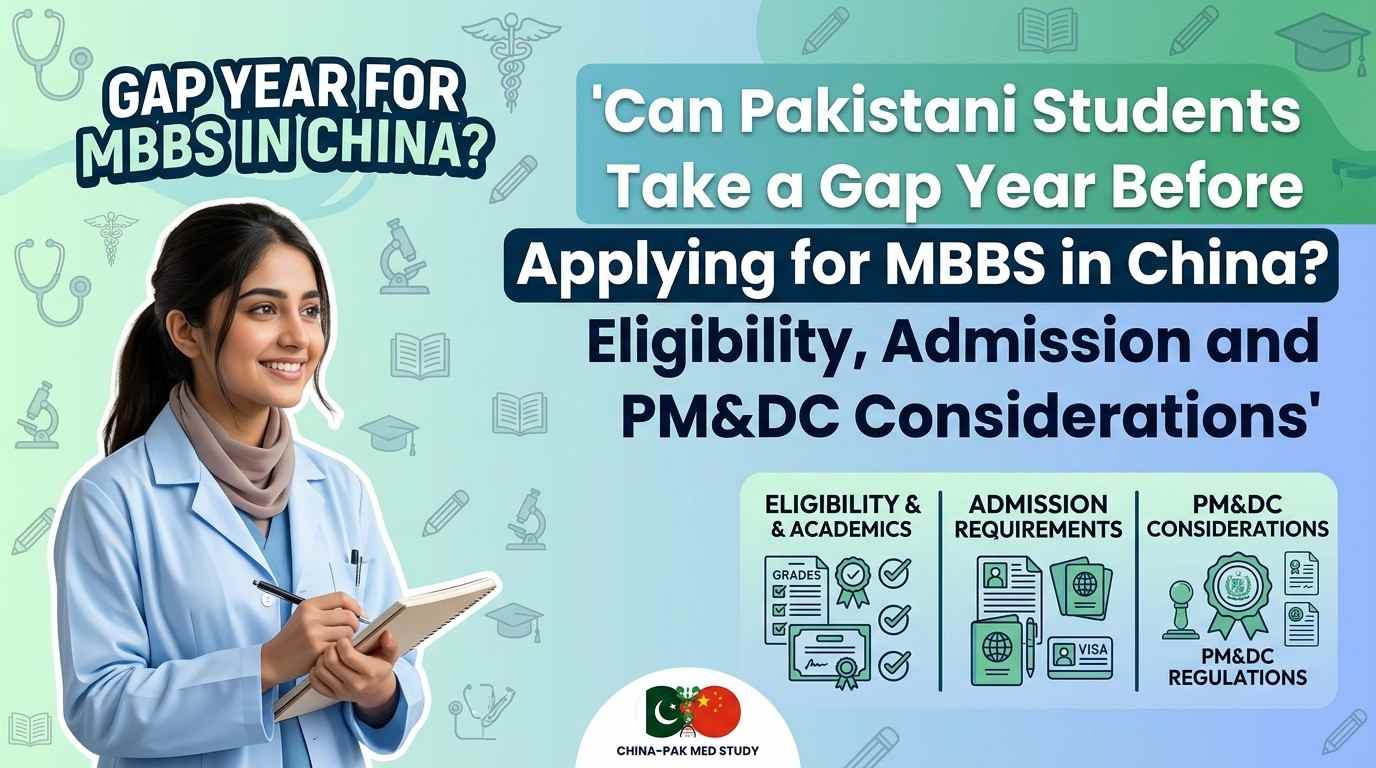
Pakistani students can generally take a gap year before applying for MBBS in China. A gap year does not automatically make a student ineligible for admission. However, acceptance depends on the individual university’s admission rules, the applicant’s academic record, age requirements, document validity, and the explanation provided for a longer study gap. Students planning to return to Pakistan should also consider whether their chosen university and qualification align with the applicable requirements of the Pakistan Medical & Dental Council (PM&DC).
This question matters particularly for students who need time after FSc or A-levels to improve grades, prepare for entry requirements, arrange finances, learn Chinese, or reconsider their university options. A gap can be useful when it has a clear purpose, but an unexplained or poorly documented gap may create complications during admission or later document review.
From student application patterns, a common issue is assuming that every Chinese medical university applies the same gap-year policy. In practice, admission criteria can differ by institution and intake. Study Sphere Advisors therefore treats the gap period as only one part of a wider application assessment that should include academic eligibility, university recognition, language preparation, documentation, and long-term licensing plans.
Is a Gap Year Accepted for MBBS Admission in China?
There is no single rule stating that every Chinese medical university accepts or rejects students solely because they took a gap year. Universities usually assess applicants according to their published international student admission requirements.
For Pakistani applicants, the most important distinction is between having a gap and meeting the university’s current eligibility requirements.
| Requirement Area | What Students Should Check | Why It Matters |
|---|---|---|
| Academic qualification | FSc Pre-Medical, A-levels or another accepted equivalent | The qualification must meet the university’s academic entry criteria |
| Study gap | Number of years since the last qualification and university-specific policy | Some institutions may request an explanation or apply age-related conditions |
| Academic performance | Marks or grades in relevant science subjects | Medical programmes may have minimum academic thresholds |
| Age | Published age limits for international applicants | Requirements can differ between universities |
| Health status | Medical examination and required health documentation | Required for international student enrolment and visa procedures |
| Passport validity | Valid passport with sufficient validity | Necessary for admission and visa documentation |
| Programme language | English-medium or Chinese-medium requirements | Students must meet the relevant language conditions |
China’s Ministry of Education maintains the broader regulatory framework for international education, while individual universities publish their own admissions conditions. Applicants should therefore rely on the current requirements of the specific institution rather than assuming that one university’s gap policy applies across China.
How Long a Gap Can Pakistani Students Have?
A one-year or multi-year gap is not automatically disqualifying. The practical question is whether the chosen university accepts applicants with that academic timeline.
Students with longer gaps should be prepared to explain what they did during that period. Relevant activities may include further study, language preparation, employment, exam preparation, volunteering, family responsibilities, or other documented activities.
| Gap Situation | Typical Admission Consideration | Recommended Action |
|---|---|---|
| 1-year gap after FSc/A-levels | Often manageable if other requirements are met | Check the university’s current policy |
| 2-3 year gap | May receive additional scrutiny depending on the institution | Prepare a clear academic and activity timeline |
| Longer gap | Acceptance may vary significantly by university and age criteria | Confirm eligibility before submitting applications |
| Gap with additional study | Can demonstrate continued academic engagement | Include transcripts or certificates |
| Gap with no clear documentation | May raise questions during application review | Prepare an accurate explanation supported by available evidence |
Why Documentation Matters?
A gap explanation should be factual and consistent with the applicant’s documents. Students should avoid creating unnecessary inconsistencies between application forms, educational timelines, and visa documentation.
A longer gap does not necessarily indicate weak academic potential. However, unexplained timelines can make it harder for admissions teams to understand an applicant’s recent educational background.
Admission Requirements Pakistani Students Should Review
Admission to MBBS programmes in China should be assessed at the university level. Students should not submit applications based only on general information from agents, social media posts, or outdated admission guides.
| Document or Requirement | Usually Required | Additional Notes |
|---|---|---|
| Academic transcripts | Yes | Science subject performance may be reviewed |
| Secondary school certificate | Yes | Must meet the university’s accepted qualification standard |
| Passport | Yes | Should remain valid throughout the application process |
| Passport-size photographs | Usually | Follow the institution’s format requirements |
| Application form | Yes | Information should match supporting documents |
| Personal statement or study plan | Sometimes | May help explain academic goals or a study gap |
| Medical examination | Usually required for later enrolment or visa processes | Follow the applicable official format |
| Police clearance or non-criminal record | May be required | Requirements can vary by institution and procedure |
| Gap explanation | Depends on the university | More relevant for longer gaps |
| Language evidence | Depends on programme language | English-medium and Chinese-medium programmes may have different requirements |
PM&DC Considerations Before Choosing a Chinese Medical University
For students intending to practise medicine in Pakistan, the decision should not be based only on admission availability or a university’s international ranking.
PM&DC requirements, foreign medical qualification rules, recognition considerations, and licensing procedures can change. Students should verify the current status of their intended university and understand the applicable pathway before enrolling.
| PM&DC Consideration | What Students Should Assess | Long-Term Importance |
|---|---|---|
| University eligibility or recognition status | Whether the institution meets applicable PM&DC requirements for the student’s intended pathway | Critical before enrolment |
| Programme structure | Duration, clinical training and qualification awarded | Relevant to future credential evaluation |
| Licensing pathway | Current requirements for foreign medical graduates | Affects the ability to pursue medical practice in Pakistan |
| Academic records | Consistency of transcripts and degree documentation | Important for future verification |
| Internship and clinical requirements | Whether additional requirements apply after graduation | May affect career planning |
PM&DC publishes regulatory information relevant to medical education and professional registration in Pakistan. Because regulatory requirements may change, students should use the current official PM&DC information rather than relying on older recognition lists or social media claims.
English-Medium and Chinese-Medium MBBS Options
The language of instruction can influence both admission preparation and the student’s experience after arrival.
| Programme Type | Main Academic Language | Key Consideration During Gap Year | Student Planning Requirement |
|---|---|---|---|
| English-medium medicine | English | Improve academic readiness and English communication | Confirm clinical and local language expectations |
| Chinese-medium medicine | Chinese | Use the gap period for structured Chinese language preparation | Meet the university’s required language level |
Even students enrolled in English-medium programmes may need practical Chinese language skills for daily life or clinical interaction. Students should confirm how the university handles language instruction and hospital-based training.
China remains a major destination for internationally mobile students. UNESCO’s international education data and broader global mobility reporting show the continued importance of cross-border education, although students should assess programme suitability rather than choosing a destination solely because of international student numbers.
Scholarship Planning During a Gap Year
A gap year can provide time to prepare stronger scholarship applications, but students should understand that scholarships are competitive and have separate eligibility and deadline requirements.
| Scholarship Type | Possible Coverage | Eligibility Considerations | Planning Advice |
|---|---|---|---|
| Chinese Government Scholarship | May include tuition and other approved benefits depending on the scheme | Academic profile and programme eligibility | Review the relevant annual application cycle |
| University scholarships | Varies by institution | May depend on academic performance or admission status | Check directly with the university |
| Provincial or local scholarships | Varies by location and programme | Availability depends on the applicable scheme | Confirm whether international medical students are eligible |
| Merit-based awards | Partial or other specified support | Academic achievement and university criteria | Keep academic documents and achievements organised |
Students should not assume that taking a gap year automatically reduces scholarship eligibility. However, age limits, application cycles, academic performance, and programme-specific rules may affect eligibility.
What Students Should Assess Before Moving Forward?
| Decision Factor | Questions to Ask |
|---|---|
| Budget planning | Can education and living costs be funded throughout the programme? |
| Academic fit | Does the programme structure suit the student’s science background and learning ability? |
| Career goals | Is the student planning to practise in Pakistan, China, or another country? |
| PM&DC planning | Has the current official position and relevant pathway been checked before enrolment? |
| Visa compliance | Can the student provide accurate and complete documents for the Chinese student visa process? |
| Language preparation | Will additional Chinese language skills be needed for clinical training or daily life? |
| Post-study opportunities | What licensing, examination or immigration requirements may apply after graduation? |
How Study Sphere Advisors Supports Students?
University Selection Guidance
Study Sphere Advisors can help students compare university admission criteria, programme structures, language expectations, and long-term academic suitability.
Admission Processing Support
Students can receive guidance on preparing applications, organising academic records, and identifying institution-specific requirements that may affect applicants with study gaps.
Study Visa Assistance
Students can receive guidance on understanding required documentation and preparing for the Chinese student visa application process after meeting university admission requirements.
Questions Students Usually Ask Before Applying
Can I apply after a three-year gap?
Possibly. Eligibility depends on the university’s current admission policy, age requirements, academic profile, and other conditions.
Do I need to explain my gap year?
Some universities may request clarification, particularly for longer gaps. A factual and documented explanation is preferable.
Will a gap affect my Chinese student visa?
A gap alone does not automatically prevent a student visa application. However, applicants should ensure that their educational history and supporting documents are accurate and consistent.
Should I take a gap year to learn Chinese?
It can be useful, particularly for students considering Chinese-medium programmes or those who want stronger language preparation before clinical exposure.
FAQ: Additional Questions Students Often Have
Does PM&DC accept every Chinese MBBS degree?
No student should assume automatic acceptance. The applicable PM&DC requirements and the status of the specific institution and qualification should be checked through current official sources before enrolment.
Can I change universities after starting MBBS in China?
Transfer options depend on the policies of both institutions, credit recognition, immigration status, and programme compatibility. Transfers should not be assumed to be straightforward.
Can a gap year improve my MBBS application?
Yes, if used productively for academic preparation, language learning, relevant study, or improving application readiness. The value depends on what the student accomplishes during the period.
Is an English-medium programme enough for clinical training?
Not always. Students should check whether local language skills are needed for patient communication or clinical placements.
When should I start preparing my application?
Students should begin by reviewing the intended university’s current intake requirements and document deadlines rather than waiting until the final application period.
Conclusion
Taking a gap year before applying for MBBS in China does not automatically prevent Pakistani students from gaining admission. The stronger approach is to assess each university’s eligibility rules, maintain clear academic documentation, use the gap period productively, and evaluate long-term medical licensing plans before accepting an offer.
The most important decision is not simply whether a university accepts a study gap. Students should assess academic fit, language readiness, visa compliance, financial planning, and the current PM&DC considerations connected with their future career goals.
Contact Study Sphere Advisors for Educational Guidance
Students evaluating MBBS in China often benefit from structured guidance when comparing universities, scholarship opportunities, admission requirements, and student visa documentation. Study Sphere Advisors assists students in understanding educational pathways, admission requirements, university selection, and documentation processes. Students seeking personalised guidance can contact the advisory team through the contact details available on the Study Sphere Advisors website.
Before making a final decision, students should evaluate their own academic goals, intended licensing pathway, and long-term career plans against the current requirements of their chosen university and relevant regulatory authorities.
Leave a Reply