
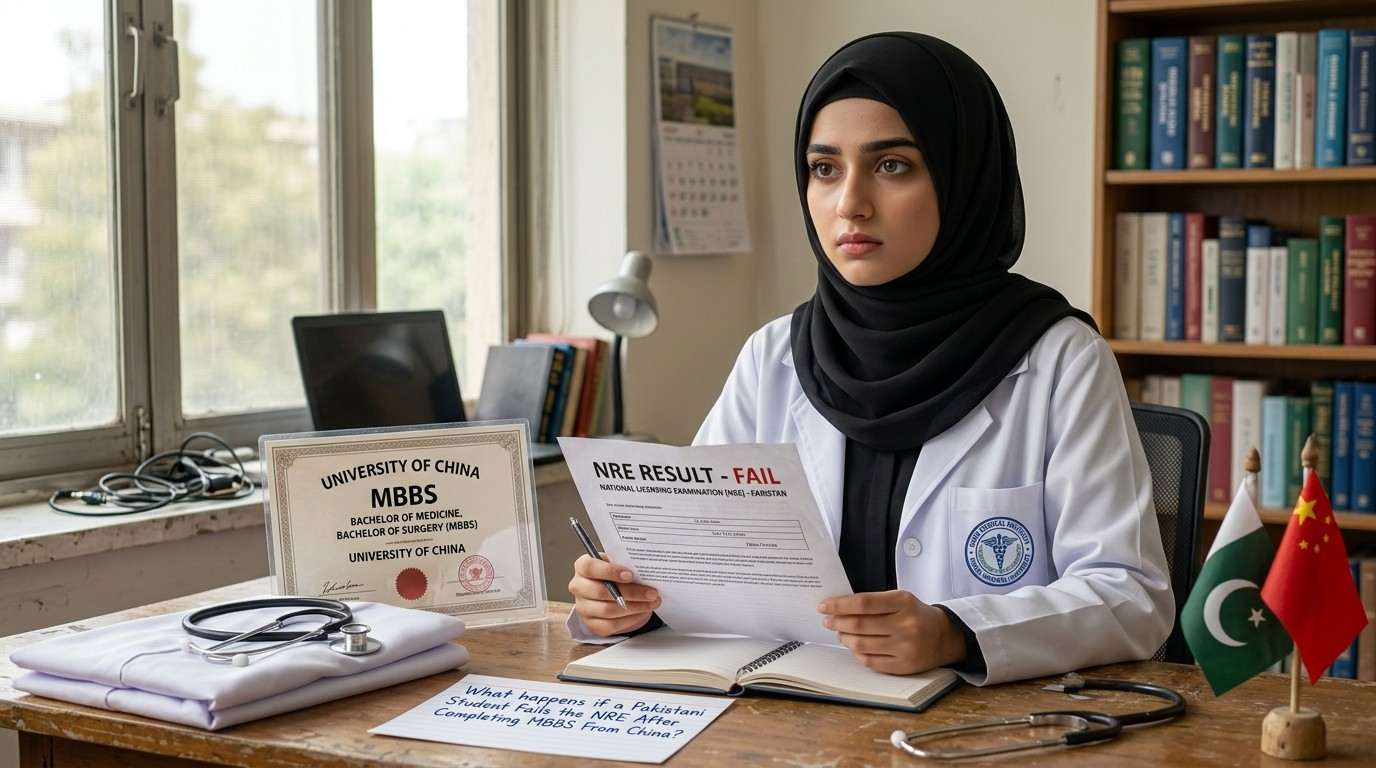
A Pakistani student who completes an MBBS degree from China but fails Pakistan’s National Registration Examination (NRE) does not automatically lose the medical degree. However, failing the examination means the graduate cannot obtain the relevant registration required to independently practise medicine in Pakistan until the applicable licensing requirements are successfully completed. The immediate next step is usually to understand the reason for the unsuccessful result, prepare for a future attempt where permitted, and review alternative education or career pathways without assuming that the degree alone guarantees clinical practice rights.
This issue matters because Pakistani students planning to study MBBS in China need to assess the entire pathway, not only university admission and graduation. University recognition, degree documentation, internship arrangements, licensing eligibility, examination performance, language preparation, and post-graduation career goals can all affect the outcome.
Student advisory discussions commonly show that many families focus heavily on admission availability or tuition affordability but spend less time checking the licensing pathway before enrolment. A safer approach is to verify current requirements with the Pakistan Medical and Dental Council and relevant Chinese education authorities before making a final admission decision, because licensing rules can change. China also remains a major destination for international higher education, with official education policy and university information governed through national and institutional systems.
What Does Failing the NRE Mean in Practical Terms?
The consequences depend on the graduate’s individual eligibility status and the regulations in force at the time of application.
| Situation | Practical Meaning | Recommended Action |
|---|---|---|
| NRE not passed | The graduate may not proceed to unrestricted medical practice in Pakistan solely on the basis of the foreign MBBS degree | Review the current PMDC pathway and applicable examination rules |
| Degree completed from a recognised or eligible institution | Academic qualification may remain valid as an educational credential, subject to regulator requirements | Preserve transcripts, degree, internship records, and verification documents |
| Internship or clinical training requirements remain relevant | Additional documentation or training verification may be required | Confirm requirements directly with the relevant regulator |
| Future examination attempt is permitted | The graduate may be able to prepare and apply again under the rules then in force | Build a structured preparation plan based on identified weaknesses |
| Graduate changes career direction | Non-clinical, research, academic, healthcare administration, or further-study options may exist | Check entry requirements for each pathway separately |
The key distinction is between holding a medical degree and being licensed to practise medicine in a particular jurisdiction. These are not automatically the same thing.
Why Chinese MBBS Graduates Should Check Licensing Eligibility Before Enrolment?
Pakistan’s medical licensing framework is controlled by the relevant national regulator. Requirements concerning foreign qualifications, examinations, registration, documentation, and clinical practice should therefore be checked from official sources rather than relying on agent claims, social media groups, or outdated university advertisements.
| Factor to Verify Before Admission | Why It Matters | What Students Should Check |
|---|---|---|
| University status | A degree may need to meet regulatory conditions | Current recognition or eligibility information |
| MBBS curriculum | Course structure affects academic preparation | Programme duration, subjects, clinical training |
| Medium of instruction | Language can affect clinical learning | Whether classroom and hospital training requirements differ |
| Internship structure | Clinical training records may be important later | Location, duration, supervision, and documentation |
| Licensing pathway | Graduation alone does not establish practice rights | Current PMDC examination and registration requirements |
| Document verification | Missing records can delay future applications | Degree, transcript, internship, and institutional documents |
The World Directory of Medical Schools can provide information about listed medical schools, but listing in a directory should not be treated as a guarantee of eligibility for licensing in Pakistan or any other country. Licensing authorities set their own rules.
What Options May Be Available After an Unsuccessful NRE Result?
An unsuccessful result should not automatically lead to an immediate decision to abandon the medical field. Students should first identify whether the issue was examination preparation, academic knowledge gaps, clinical reasoning, documentation, eligibility, or another regulatory matter.
| Possible Next Step | Purpose | Important Consideration |
|---|---|---|
| Review examination performance | Identify weak subjects or recurring gaps | Use official examination guidance where available |
| Prepare for another permitted attempt | Improve performance through targeted revision | Confirm current attempt and eligibility rules |
| Complete further academic study | Develop expertise in another health-related area | A higher qualification does not automatically replace medical licensing |
| Explore research pathways | Apply medical knowledge outside direct patient practice | Universities may require additional qualifications |
| Consider healthcare administration or public health | Build a non-clinical career direction | Job eligibility depends on employer and qualification requirements |
| Explore another country’s licensing route | Assess opportunities in another jurisdiction | Each country has separate examination and registration rules |
Failing the NRE Does Not Automatically Create a Visa Problem
A student visa used for education in China and the graduate’s professional licensing status in Pakistan are separate matters. After graduation, immigration status depends on the destination country’s applicable visa and residence rules rather than the NRE result itself.
| Situation | Visa or Immigration Consideration | Key Action |
|---|---|---|
| Returning to Pakistan after graduation | Follow travel and immigration rules applicable to the student’s status | Maintain valid travel documents |
| Remaining in China after studies | A new legal basis for residence may be required | Check current Chinese immigration requirements |
| Applying for postgraduate study abroad | A new student visa may be required | Meet the destination’s admission and visa rules |
| Seeking employment abroad | A work visa or work authorisation may be necessary | Meet employer, licensing, and immigration conditions |
Students should avoid assuming that an MBBS degree automatically provides the right to work clinically in China, Pakistan, or another country. Professional licensing and immigration permission are separate processes.
How to Reduce the Risk Before Choosing MBBS in China?
The strongest strategy is to evaluate the complete educational and professional pathway before paying an admission deposit.
Eligibility and Planning Checklist
| Requirement or Decision Area | What to Assess | Why It Is Important |
|---|---|---|
| Academic eligibility | Current university admission criteria | Helps avoid applying to an unsuitable programme |
| Regulatory pathway | Current PMDC requirements for foreign graduates | Connects admission decisions with career goals |
| Chinese language exposure | Clinical communication expectations | Hospital training may require local-language interaction |
| Curriculum | Pre-clinical and clinical structure | Supports realistic academic preparation |
| Internship | Training location and documentation | Can affect future verification requirements |
| Financial planning | Full education and living budget | Reduces pressure to choose based only on initial tuition |
| Career objective | Pakistan, China, or another country | Determines which licensing pathway requires attention |
UNESCO’s Global Convention on the Recognition of Qualifications promotes principles for fair recognition of higher education qualifications across participating systems, but recognition of an academic qualification does not override national rules for regulated professions such as medicine.
What Students Should Assess Before Moving Forward?
Students deciding whether to study MBBS in China should evaluate the decision against their individual goals rather than relying only on rankings or admission availability.
| Decision Factor | Questions to Ask |
|---|---|
| Budget planning | Can the full duration of study and living costs be funded without depending on uncertain future income? |
| Academic fit | Does the student have the science foundation and study discipline required for medical education? |
| Career goals | Is the primary objective to practise in Pakistan, another country, or pursue a non-clinical health career? |
| Licensing pathway | What examinations and registrations are currently required in the intended country of practice? |
| Language requirements | What language skills are needed for classes, clinical training, and future employment? |
| Visa compliance | Can the student maintain the conditions of the relevant student or future work visa? |
| Post-study opportunities | What realistic pathways exist if the original licensing plan does not work as expected? |
How Study Sphere Advisors Supports Students?
University Selection Guidance
Study Sphere Advisors can help students compare programme structures, documentation requirements, clinical training arrangements, and factors relevant to long-term educational planning.
Admission Processing Support
Students can receive guidance on understanding admission documentation and checking whether programme information is clearly documented before moving forward.
Study Visa Assistance
Guidance can help students understand the documentation and procedural requirements associated with applying for a study visa for China.
Work Visa Consultation
Students considering employment opportunities after graduation can receive guidance on understanding work visa requirements, documentation, and possible pathways in their intended destination country.
Conclusion
Failing the NRE after completing MBBS from China can delay a graduate’s pathway to medical practice in Pakistan, but it does not automatically erase the academic qualification or end every future career option. The most important factors are the current licensing rules, the graduate’s eligibility status, academic preparation, documentation, and long-term career objective.
Students should therefore evaluate an MBBS pathway as a complete journey from university selection and clinical training to licensing, visa compliance, and post-study planning. Early verification is far safer than trying to resolve recognition or licensing questions after graduation.
Guidance for Students Evaluating Their Next Step
Students comparing MBBS options or reviewing their post-graduation pathway often benefit from carefully checking university documentation, current licensing requirements, study visa procedures, and long-term career plans. Study Sphere Advisors provides educational guidance on university selection, admission documentation, study visa processes, and pre-departure preparation.
For current contact details and further student support information, students can visit Study Sphere Advisors and review the appropriate contact options available on the website.
Leave a Reply