
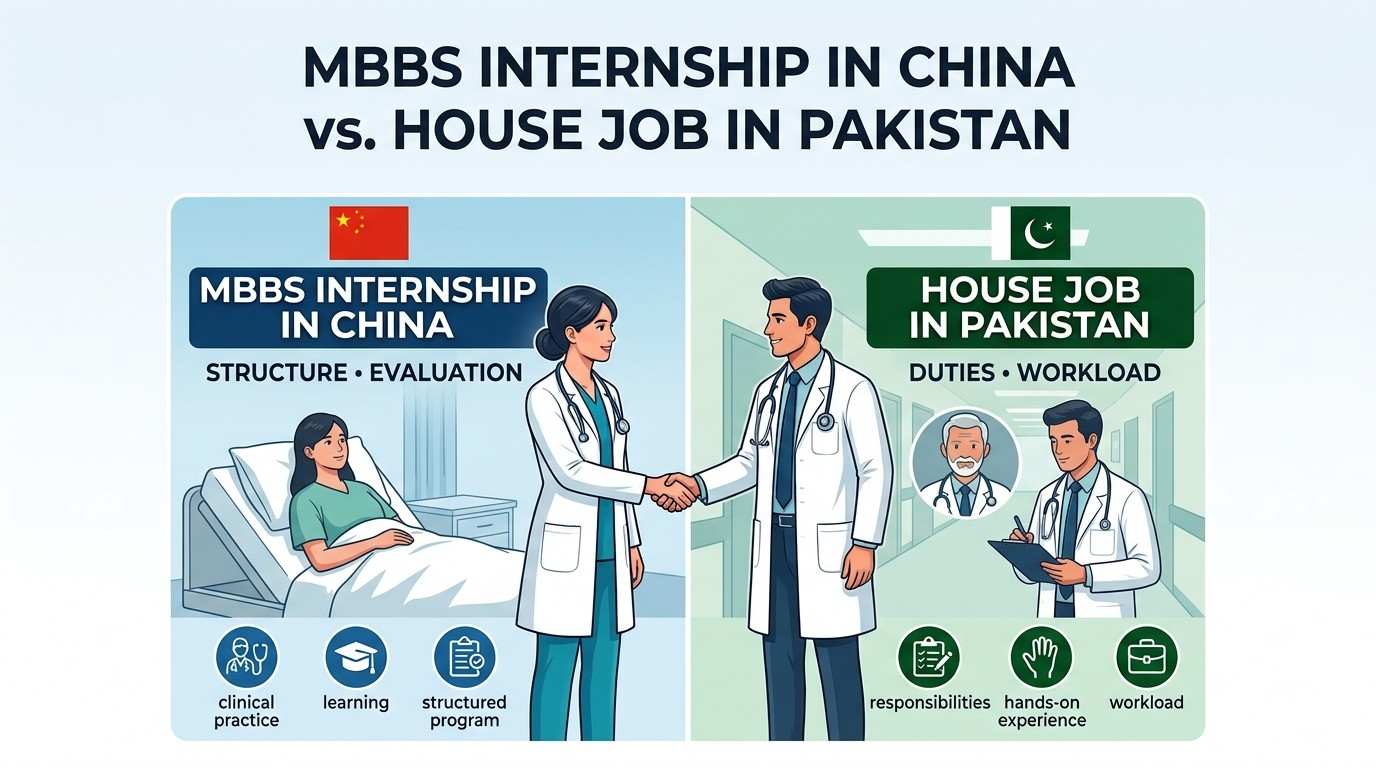
For Pakistani MBBS graduates, the main difference is that an MBBS internship in China is generally an academic clinical-training component connected to the Chinese medical degree, while a house job in Pakistan is supervised postgraduate clinical training completed after graduation and is closely tied to local professional registration and career progression. The two may look similar because both involve hospital-based clinical exposure, but their timing, structure, recognition, documentation, and licensing implications can differ significantly.
This distinction matters most to students planning to study medicine in China and later return to Pakistan. The key question is not simply where the internship takes place. Students need to assess whether the degree, university, internship arrangement, clinical training record, and subsequent licensing pathway align with the requirements applicable when they seek to practise in Pakistan. Requirements can change, so students should verify the latest rules with the relevant official authorities before making an admission or internship decision.
Why the Two Training Pathways Are Not Automatically the Same?
China’s Ministry of Education framework for English-taught undergraduate clinical medicine describes a six-year MBBS structure that includes clinical education and a one-year internship of at least 48 weeks. The internship may be arranged in the university’s teaching hospital or, under the stated framework, an approved overseas teaching hospital.
In Pakistan, PMDC describes house job eligibility as following successful completion of the medical programme and final professional examination, with a Provisional License allowing the graduate to join a house job programme at an accredited and recognized teaching hospital.
| Aspect | MBBS Internship in China | House Job in Pakistan |
|---|---|---|
| Position in medical education | Usually part of the undergraduate MBBS training structure | Postgraduate supervised clinical training after completion of the medical programme |
| Typical duration | One year, with at least 48 weeks under the Ministry of Education framework | Subject to the applicable PMDC house job framework and hospital programme requirements |
| Main purpose | Completion of clinical training required by the university programme | Supervised transition from graduate to clinical practice |
| Training location | University teaching hospital or another approved arrangement under the programme rules | PMDC-recognized and accredited teaching hospital |
| Primary oversight | Chinese university and relevant Chinese education and health authorities | PMDC, university verification, and recognized teaching hospitals |
| Student or graduate status | Generally remains connected to the undergraduate degree pathway until programme completion | Undertaken after qualification and programme completion |
| Licensing significance in Pakistan | Recognition depends on the graduate’s applicable PMDC pathway and current regulations | Directly connected to the Pakistani professional registration pathway |
| Key documentation | Internship certificate, rotation record, university completion documents and other required records | Provisional License, house job completion record and documents required for subsequent registration |
The most important practical point is that an internship certificate from China should not be assumed to have identical regulatory treatment to a Pakistani house job. PMDC currently publishes different licensing pathways for foreign-qualified graduates, and the applicable route can depend on factors including recognition of the qualification, internship or house job completion, foreign licensing status, examination requirements, and other eligibility conditions.
How MBBS Internship in China Usually Fits Into the Degree?
The Chinese system treats internship as an organized part of undergraduate medical education. The Ministry of Education’s published quality standards state that international MBBS programmes include clinical training and internship arrangements designed by the institution, with clerkship and internship completed through appropriate teaching hospitals.
For Pakistani students, this creates an important planning issue. A student should confirm the internship arrangement before accepting admission, rather than waiting until the final year.
| Requirement to Check | Why It Matters | Practical Question |
|---|---|---|
| University authorization | Determines whether the programme is officially structured for international medical students | Is the university authorized to enrol international students in the relevant clinical medicine programme? |
| Teaching hospital | Clinical exposure depends heavily on the hospital environment | Which hospital will host the internship? |
| Internship duration | The training period must meet programme and future regulatory expectations | How many weeks of supervised internship are formally documented? |
| Language environment | Patient interaction may require Chinese even when academic teaching is in English | What level of Chinese is needed during clinical rotations? |
| Rotation documentation | Future licensing authorities may request detailed evidence | Will the certificate list departments, dates and duration? |
| Overseas internship option | Not every university may handle external placement in the same way | Is an overseas internship formally permitted and approved by the university? |
A particularly important source-backed data point is that the Ministry of Education published a list for the 2023-2024 academic year covering 44 institutions and 3,048 planned places for international students in English-taught undergraduate clinical medicine. Students should therefore verify the current authorized intake and programme status for their admission year rather than relying on old agent lists or social media claims.
How House Job in Pakistan Works Differently?
A house job is more directly connected to the Pakistani medical regulatory system. PMDC states that graduates become eligible after university verification that they have passed their final professional examination and successfully completed their programme, after which they may receive a Provisional License and join an approved house job programme.
| Requirement | Details | Notes |
|---|---|---|
| Completed medical qualification | Final professional examination and programme completion must be verified | Requirements differ depending on whether the graduate is locally or foreign qualified |
| Provisional registration | Required before undertaking relevant supervised clinical training in Pakistan | Foreign graduates must comply with current PMDC rules |
| Recognized hospital | Training must take place within the applicable approved framework | Students should verify hospital recognition before joining |
| Licensing examinations | Foreign graduates may have examination requirements under the applicable PMDC pathway | Rules should be checked at the time of graduation |
| Completion documentation | Evidence of rotations and completed training may be required | Keep original certificates and detailed records |
PMDC issued a public notice in December 2025 stating that foreign medical and dental students and graduates may not undertake a house job, internship, clinical training, observership, or clerkship in Pakistan without Provisional Registration, in accordance with the applicable laws and policies.
This is especially relevant for a graduate who completes an MBBS in China and plans to return to Pakistan for clinical training.
Clinical Experience: What Students May Notice
The difference is not only regulatory. The daily clinical environment can also be different.
A student completing an internship in China may encounter a healthcare system, documentation process, patient communication style, and hospital workflow that differ from those in Pakistan. A house job in Pakistan can provide more direct familiarity with local disease patterns, referral systems, medical documentation, and the working environment the graduate may later enter.
| Clinical Consideration | Internship in China | House Job in Pakistan |
|---|---|---|
| Patient communication | Chinese language ability may affect interaction | Urdu, English and regional languages may be used |
| Hospital workflow | Based on the host institution and Chinese healthcare environment | Based on Pakistani hospital systems |
| Local professional exposure | Stronger exposure to the Chinese healthcare setting | Stronger familiarity with Pakistani clinical practice |
| Academic integration | Often linked to completion of the MBBS programme | Focused on supervised postgraduate clinical experience |
| Future career preparation | Useful for students pursuing further opportunities connected with China | Particularly useful for students planning a Pakistani clinical career |
This does not mean one experience is universally better. The right option depends on the graduate’s intended licensing jurisdiction and career plan.
Important Considerations Before Moving Forward
Students planning an MBBS in China should make their internship decision part of the original admission strategy.
| Factor | What Students Should Assess |
|---|---|
| Budget planning | Accommodation, travel, insurance and possible relocation costs during clinical training |
| Academic fit | Whether the programme structure and clinical environment match the student’s learning needs |
| Career goals | Whether the student plans to practise in Pakistan, China, or another country |
| Visa compliance | Whether the proposed internship arrangement is compatible with the student’s immigration and university status |
| Language requirements | Whether clinical communication requires additional Chinese-language preparation |
| Post-study pathway | Licensing examinations, registration, internship recognition and further training requirements |
| University selection | Current authorization, teaching hospital arrangements and documented internship structure |
How Study Sphere Advisors Supports Students?
University Selection Guidance
Study Sphere Advisors can help students compare programme structures, including clinical training arrangements, university documentation, and factors relevant to long-term educational planning.
Admission Processing Support
Students can receive guidance on understanding admission documents and checking whether programme information, including the expected training pathway, is clearly documented.
Study Visa Assistance
Support can focus on preparing and organizing documentation for the relevant student visa process and understanding the importance of maintaining compliance during the study period.
Work Visa Consultation
Students planning to pursue employment after completing their medical education can receive guidance on understanding general work visa requirements, documentation, and possible post-study employment pathways in their intended destination.
Questions Students Usually Ask Before Applying
Can an MBBS internship in China automatically replace a house job in Pakistan?
Not automatically. The applicable PMDC pathway and current recognition requirements must be checked before relying on an overseas internship for Pakistani licensing purposes.
Can a foreign medical graduate complete clinical training in Pakistan?
Yes, subject to the applicable PMDC requirements. PMDC’s December 2025 notice emphasizes that foreign graduates require Provisional Registration before undertaking house job, internship, or other listed clinical training in Pakistan.
Does an English-taught MBBS mean clinical work will also be entirely in English?
Not necessarily. Academic instruction and real-world patient communication are different issues. Students should confirm the language expectations for clinical rotations.
Should the internship plan influence university selection?
Yes. For students intending to return to Pakistan, the internship structure and documentation should be evaluated alongside recognition and licensing considerations.
Additional Questions Students Often Have
What documents should a student preserve after completing an internship in China?
Keep the internship certificate, detailed rotation record, graduation certificate, degree, transcript, hospital letters, and any licensing or verification documents issued by the relevant authorities.
Can a graduate immediately begin independent medical practice after an MBBS internship?
No assumption should be made based solely on internship completion. Medical practice requires compliance with the licensing and registration rules of the country where the graduate intends to work.
What if PMDC regulations change while the student is studying?
Students should follow official PMDC notices and verify the rules applicable to their graduation and licensing stage. Current requirements may differ from information available when admission was obtained.
Is Chinese language preparation important for MBBS students?
Yes, particularly for meaningful patient interaction and clinical learning. Even where academic teaching is delivered in English, the clinical environment may involve Chinese-speaking patients and staff.
Should parents verify information independently?
Yes. Parents and students should compare university documents with official education and regulatory sources instead of relying only on agents, advertisements, or informal student groups.
Conclusion
The difference between an MBBS internship in China and a house job in Pakistan is primarily about where the training sits within the medical education system and how it connects to professional licensing. China’s internship is generally structured as part of the undergraduate medical programme, while Pakistan’s house job is tied more directly to postgraduate supervised clinical practice and the PMDC registration framework.
Students should therefore evaluate four issues before making a decision: the university’s current programme status, the internship structure, the documentation provided after training, and the licensing pathway in the country where they plan to practise. The safest approach is to plan the full pathway before admission rather than trying to resolve recognition questions after graduation.
Guidance for Students Comparing Their Options
Students evaluating an MBBS pathway in China often benefit from structured guidance when comparing universities, clinical training arrangements, admission documents, study visa requirements, and long-term career considerations. Study Sphere Advisors assists students in understanding educational pathways, university selection, admission requirements, and documentation processes relevant to studying abroad.
Students seeking further information can visit Study Sphere Advisors and use the contact information published on the website to discuss their educational pathway.
Leave a Reply