
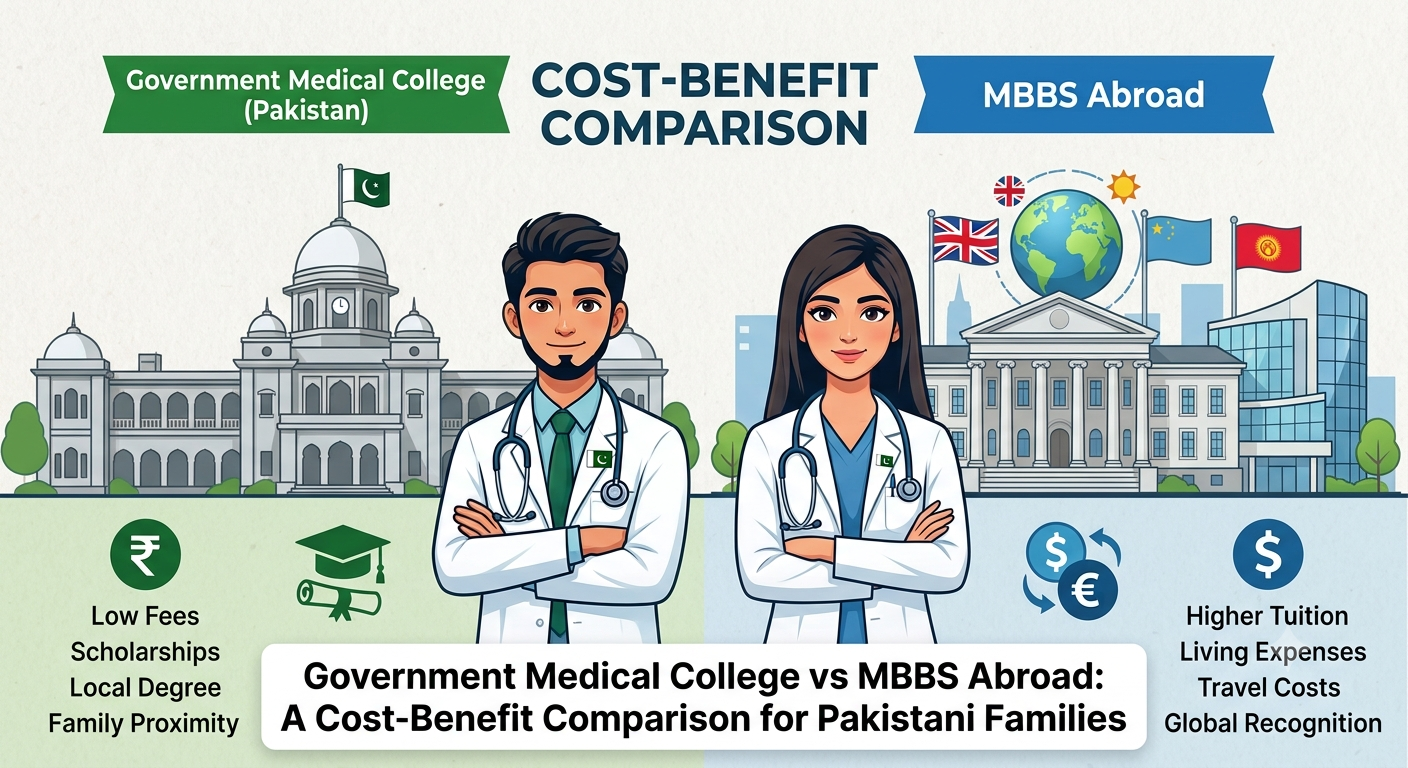
A government medical college in Pakistan costs a fraction of what MBBS abroad costs, typically under PKR 400,000 (roughly $1,400) for the full five-year program versus $15,000 to $35,000 or more for a comparable program in China, but access to that low cost depends on clearing an extremely competitive merit threshold, often 90% or higher aggregate, through the MDCAT and FSc combined score. For families whose child falls short of that threshold, the realistic financial comparison is not government college versus MBBS abroad, but private medical college in Pakistan versus MBBS abroad, and that comparison looks very different.
This distinction matters because many Pakistani families begin researching MBBS abroad only after discovering that a strong but not exceptional academic record, a respectable FSc score without a near-perfect MDCAT result, is not enough to secure a government seat. Understanding the real cost structures on both sides, government, private, and abroad, before committing to a preparation strategy or an application, helps families make a financially realistic decision rather than an emotionally driven one made under exam-season pressure.
Advisory conversations with Pakistani families weighing this decision consistently reveal a pattern: many assume MBBS abroad is automatically more expensive than any Pakistani option, without realizing that private medical colleges in Pakistan often cost as much as or more than several Chinese universities over the full program duration. Others assume government college admission is realistically within reach without accounting for how few seats exist relative to the number of qualified applicants each year.
Government Medical College in Pakistan: Cost and Access
| Aspect | Detail | Notes |
| Annual Tuition | Approximately PKR 20,000–100,000 per year | Heavily subsidized by the government; among the lowest-cost medical education options available |
| Total 5-Year Program Cost | Generally under PKR 400,000 (tuition only) | Additional costs (hostel, books, transport) apply separately, as with any program |
| Admission Requirement | MDCAT (55% minimum pass) combined with FSc and Matric marks in a weighted aggregate | Top public colleges have closed at 90% or higher aggregate in recent cycles |
| Total Public MBBS Seats Nationally | Approximately 4,800–11,000, depending on the source and year | Distributed across provinces, with Punjab typically offering the largest share |
| Competitiveness | Extremely high | Far more MDCAT-qualified applicants exist each year than available government seats |
Private Medical College in Pakistan: Cost and Access
| Aspect | Detail | Notes |
| Annual Tuition | Approximately PKR 1,500,000–3,500,000 per year, with PMDC capping most private colleges around PKR 1.8 million per year | A small number of institutions, such as Aga Khan University, are exempt from this cap and charge more |
| Total 5-Year Program Cost | Approximately PKR 7,500,000–17,500,000 (roughly $26,000–$61,000, depending on exchange rate) | Additional costs (hostel, mess, books, instruments) typically add PKR 100,000–250,000 per year |
| Admission Requirement | MDCAT still required (55% minimum), though the merit threshold for admission is generally lower than at top government colleges | Self-finance seats are sometimes available for students who do not meet open-merit cutoffs |
| Seat Availability | Considerably more seats than the government sector, spread across roughly 125 PMDC-recognized private institutions | Provides an alternative for students who clear MDCAT but not at the aggregate needed for government admission |
MBBS Abroad (China): Cost and Access
| Aspect | Detail | Notes |
| Annual Tuition/Fee Package (1st Year) | Commonly ranges from approximately $1,500 to $7,100 across Chinese universities reviewed in prior fee-structure guidance, depending on the specific institution | Figures vary meaningfully by university; confirming the current fee structure for each specific institution remains essential |
| Annual Fee (2nd Year Onwards) | Generally lower than the 1st-year figure, since one-time management or admission charges typically apply only once | Recurring annual costs still apply for tuition, hostel, and other charges |
| Admission Requirement | Typically 60–70% HSSC marks and an age limit (commonly 17–29, varying by university); MDCAT is generally not required for direct admission | A meaningfully lower merit threshold than Pakistani government medical colleges |
| Additional Costs | Application fees, visa documentation, HSK-4 language preparation (where required), and living expenses beyond the university fee package | Covered in more detail in separate guidance on cost of living and document attestation |
Side-by-Side Comparison
| Factor | Government College (Pakistan) | Private College (Pakistan) | MBBS Abroad (China) |
| Approx. Total Program Cost | Under PKR 400,000 (~$1,400) | PKR 7.5M–17.5M (~$26,000–$61,000) | Roughly $15,000–$35,000+ over the full program, depending on university |
| Admission Merit Threshold | Very high (often 90%+ aggregate) | Moderate (MDCAT pass required, lower aggregate than top government colleges) | Generally lower (60–70% HSSC, no MDCAT at most universities) |
| Seat Availability | Very limited relative to demand | More available than government seats | Generally more accessible, though subject to each university’s own intake capacity |
| Relocation Required | No | No | Yes, with associated visa, documentation, and living cost considerations |
| Recognition Path Post-Graduation | Direct, since the college is already PMDC-recognized domestically | Direct, since the college is already PMDC-recognized domestically | Requires confirming the specific university’s PMDC recognition status and passing the NRE, as covered in separate guidance |
For many families, MBBS abroad in China ends up positioned as a middle-ground option: costlier than a government seat but often less expensive than a private Pakistani college over the full program, while requiring a meaningfully lower admission merit threshold than either domestic government or top private options.
How China Compares to Other “Abroad” Destinations?
| Country | Approx. Tuition Range (Medical Program) | Admission Merit Requirement | Visa Complexity for Pakistani Applicants |
| China | Generally $1,500–$7,100 per year, depending on university | 60–70% HSSC typically; no MDCAT required at most universities | Moderate; documented visa and residence permit process, covered in separate guidance |
| United Kingdom | Substantially higher tuition for medicine | Competitive; often requires additional entrance exams | Visa rejection rates for Pakistani applicants have risen significantly in recent cycles |
| Canada | High tuition; very limited direct-entry seats for international students | Highly competitive | Visa processing times have lengthened in recent cycles |
| Australia | High tuition for medical programs | Competitive | Visa rejection rates have risen for South Asian applicants in recent cycles |
Visa and enrollment trends across these destinations have shifted meaningfully in recent years, which affects how “abroad” as a category should be evaluated rather than assuming all foreign options carry similar cost and access profiles.
According to ICEF Monitor’s 2026 analysis of student mobility trends, study visa rejection rates for Pakistani applicants have risen sharply across several Big Four destinations, with more than 70% of Pakistanis refused an F-1 visa in the US in 2026, and Pakistani applicants to the UK seeing sponsored study visa rejection rates spike from 5.6% to 41% year-over-year.
Against this backdrop, China’s inbound international enrollment reached roughly 380,000 foreign students from nearly 200 countries during the 2024/25 academic year, according to Chinese Ministry of Education figures reported via China Daily, positioning it as a comparatively more accessible “abroad” option relative to Western destinations, both financially and in terms of visa access.
Factors That Deserve Careful Evaluation
- Budget planning: Comparing the realistic total cost of each pathway, government, private, and abroad, over the full program length rather than the first year alone, since later-year costs and additional charges (hostel, insurance, living expenses) accumulate differently across each option.
- Academic fit: Honestly assessing MDCAT and FSc performance against actual recent closing merit figures for government colleges, rather than assuming borderline scores will be sufficient.
- Career goals: Recognizing that all three pathways lead to PMDC-eligible practice in Pakistan, provided the specific institution (domestic or foreign) holds current recognition, making long-term career outcomes broadly comparable once recognition is confirmed.
- Visa compliance: Factoring in the additional documentation, visa, and residence permit process required for study abroad, which does not apply to domestic government or private options.
- Language requirements: Considering HSK-4 or similar language milestones for Chinese universities, which have no equivalent requirement in Pakistani government or private colleges.
- Post-study opportunities: Understanding that career pathway options, including FCPS specialization or international licensing routes, remain available regardless of which of the three pathways a student completes, provided recognition requirements are met.
How Study Sphere Advisors Supports Students?
University Selection Guidance Helping families compare Chinese university fee structures, eligibility criteria, and recognition status against realistic academic and financial planning.
Study Visa Assistance Guidance on preparing the documentation required for a Chinese student visa application, relevant for families who determine MBBS abroad is the appropriate pathway.
Questions Students Usually Ask Before Applying
Is a government medical college always cheaper than MBBS abroad? In tuition terms alone, yes, but access depends on an extremely high merit threshold that most applicants do not meet, making the realistic comparison for many families private college versus MBBS abroad rather than government college versus abroad.
Is MBBS abroad more expensive than a private medical college in Pakistan? Not necessarily. Several Chinese universities’ total program costs fall within or below the range of Pakistani private medical college costs, though this varies significantly by specific institution.
Does MDCAT apply to MBBS programs in China? Generally no. Most Chinese universities admit Pakistani students based on HSSC academic performance and program-specific eligibility criteria, without requiring MDCAT.
Does studying MBBS abroad affect eligibility to practice in Pakistan? Not inherently, provided the specific foreign university holds current PMDC recognition and the graduate completes the required NRE and registration process, as covered in separate guidance.
Additional Questions Students Often Have
How many MBBS seats exist in Pakistan’s government sector each year? Estimates generally range from approximately 4,800 to 11,000 seats nationally, depending on the source and year, distributed across provinces.
Are there hidden costs in Pakistani private medical colleges beyond tuition? Yes. Hostel, mess, books, instruments, and examination fees typically add PKR 100,000–250,000 per year on top of tuition.
Does an MBBS abroad take longer to complete than a Pakistani program? Program duration varies by country and university; some Chinese universities structure the program as 5+1 years including internship, similar in overall length to Pakistan’s standard MBBS-plus-house-job structure.
Can a student who fails to secure a government seat still pursue a competitive medical career abroad? Yes. Since most Chinese universities apply a lower merit threshold than Pakistani government colleges, students with a solid but non-exceptional academic record often have more accessible options abroad.
Is currency fluctuation a significant factor in comparing these costs? Yes. Since MBBS abroad costs are typically quoted in RMB or USD, exchange rate movements against the Pakistani rupee can meaningfully affect the actual cost over a multi-year program, which is worth factoring into long-term budget planning.
Conclusion
Comparing government medical college, private medical college, and MBBS abroad in China comes down to weighing cost, admission merit requirements, and access realistically against a family’s specific academic and financial situation, rather than assuming one pathway is universally superior. Government college remains the lowest-cost option but is accessible only to a small percentage of top-scoring applicants, private Pakistani colleges offer more access at substantially higher cost, and MBBS abroad in China often occupies a middle financial ground with a comparatively lower merit threshold, provided recognition and visa requirements are carefully verified. Reviewing all three options against actual current costs and merit data, rather than assumptions carried from previous years or other families’ experiences, gives Pakistani families a clearer basis for this significant decision.
Making the Decision
Students evaluating their study abroad options often benefit from expert guidance when comparing universities, scholarships, visa requirements, and long-term career opportunities. Study Sphere Advisors assists students in understanding admission requirements, documentation processes, and recognition criteria relevant to Chinese medical universities. Students seeking personalized guidance on their specific academic profile can reach out to the advisory team for further information.
Leave a Reply