
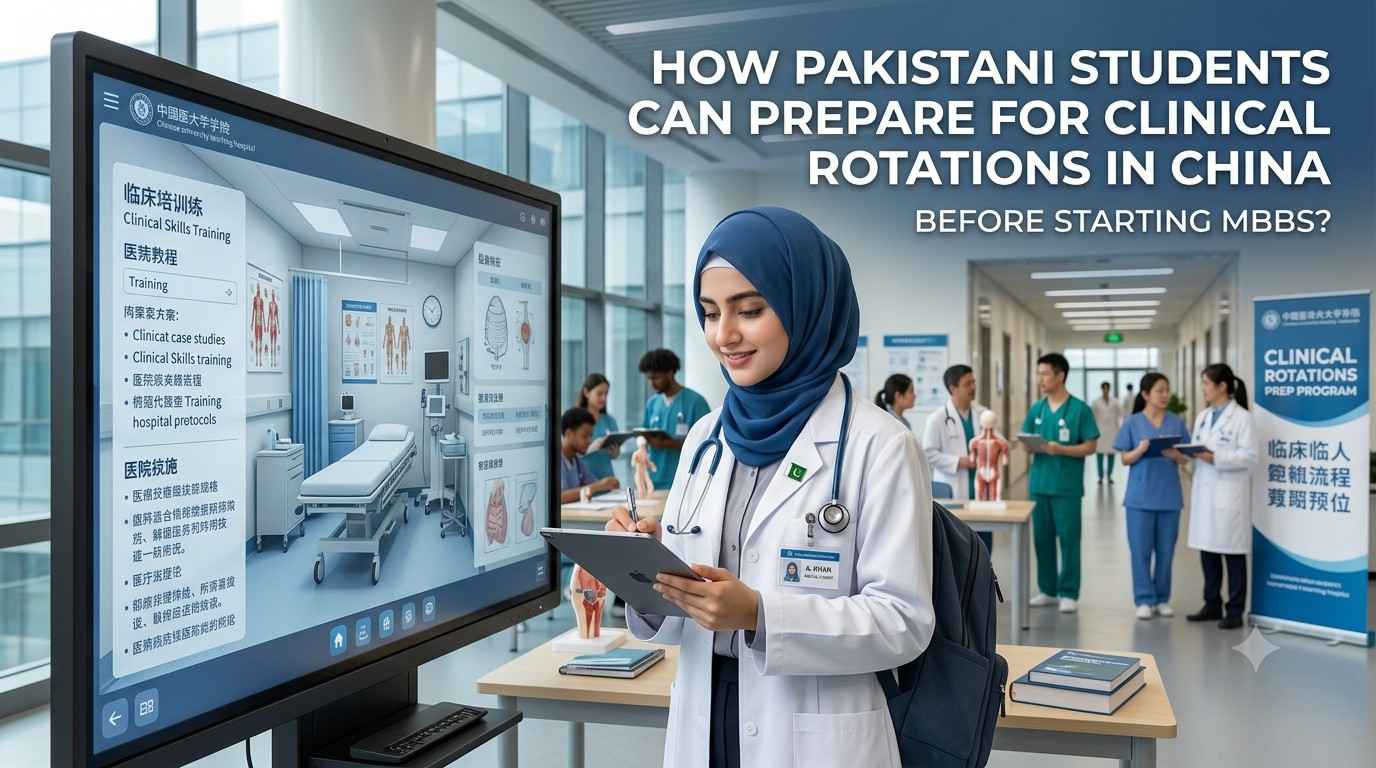
Clinical rotations are where medical students begin turning classroom knowledge into supervised patient-care skills. Pakistani students planning MBBS in China should therefore prepare for clinical training before entering the university, rather than waiting until the internship year. The most useful preparation includes basic clinical terminology, communication skills, anatomy and physiology revision, professional conduct, documentation habits, and an early understanding of how the Chinese teaching-hospital system works.
This preparation matters because English-medium MBBS does not necessarily mean that every patient interaction will happen in English. Chinese medical universities commonly include Chinese-language learning alongside medical education, while clinical training can involve communication with local patients and hospital staff. China’s Ministry of Education also requires English-medium clinical medicine programs to provide standardized clinical skills training and supervised hospital-based clerkship and internship. The internship component is generally structured for at least 48 weeks.
For Pakistani students, there is another important consideration: the clinical training completed during the degree should not be viewed separately from future licensing plans. Pakistan Medical & Dental Council (PM&DC) maintains a system for recognizing foreign undergraduate medical institutions and has specific registration requirements for graduates returning to Pakistan. Students should therefore evaluate clinical exposure, university recognition, internship structure, and future licensing requirements together before enrollment.
Understand What Clinical Rotations Actually Involve
Clinical rotations are more demanding than simply observing doctors. Students gradually learn how to take patient histories, perform examinations, understand diagnostic reasoning, communicate with healthcare teams, and follow clinical procedures under supervision.
China’s Ministry of Education identifies history taking, physical examination, laboratory examination, diagnosis, differential diagnosis, clinical planning, clinical operations, emergency handling, and communication as important clinical abilities in undergraduate medical education.
Clinical preparation areas
| Preparation Area | What Students Should Know Before Rotations | Why It Matters |
|---|---|---|
| Medical terminology | Common terms for symptoms, body systems, investigations and treatment | Helps students follow ward discussions |
| Anatomy | Major structures, organs and anatomical relationships | Supports physical examination and procedures |
| Physiology | Normal body functions and vital signs | Helps interpret abnormal findings |
| Pathology | Basic disease mechanisms | Connects symptoms with diagnosis |
| Pharmacology | Drug classes, common indications and adverse effects | Improves understanding of treatment plans |
| History taking | Chief complaint, history of present illness, medical and medication history | Forms the foundation of patient assessment |
| Physical examination | General examination and basic system examination | Builds clinical confidence |
| Medical ethics | Confidentiality, consent and professional boundaries | Protects patients and students |
| Documentation | Clear clinical notes and structured case presentation | Helps communication with supervisors |
| Infection control | Hand hygiene, PPE and basic aseptic principles | Essential for safe clinical practice |
Build Chinese Language Skills Before Hospital Training
One of the most practical preparations is learning enough Mandarin to function safely around patients and hospital staff.
An English-taught MBBS curriculum does not automatically remove the need for Chinese communication skills. Universities may teach Chinese as part of the international medical curriculum, but students should independently build practical vocabulary before reaching the wards.
The objective is not necessarily fluency. The immediate goal is functional communication that allows a student to understand basic instructions, recognize common symptoms and communicate respectfully with patients.
| Language Skill | Useful Preparation |
|---|---|
| Numbers | Learn numbers used for age, temperature, blood pressure and dosage discussions |
| Symptoms | Learn common words for pain, fever, cough, nausea, dizziness and breathing problems |
| Body parts | Learn Mandarin terms for major body regions and organs |
| Basic questions | Practice asking about pain, duration, previous illness and medication |
| Directions | Understand common instructions from doctors and nurses |
| Hospital vocabulary | Learn terms related to wards, examinations, tests and medicines |
| Polite communication | Practice appropriate greetings and respectful forms of address |
A practical approach is to start learning medical Mandarin before departure and continue building vocabulary during the first academic years. Waiting until the clinical phase can create unnecessary pressure.
Strengthen Core Clinical Skills Before Leaving Pakistan
Students do not need to arrive in China as fully trained clinicians. Clinical rotations are designed for supervised learning. However, students who arrive with strong academic foundations generally adapt more easily to practical teaching.
Before departure, revise the subjects that directly support clinical reasoning.
| Subject | Revision Priority | Preparation Target |
|---|---|---|
| Anatomy | High | Major structures and surface anatomy |
| Physiology | High | Vital signs and normal physiological processes |
| Pathology | High | Common disease mechanisms |
| Pharmacology | High | Major drug classes and safety principles |
| Microbiology | Medium-High | Common infections and transmission |
| Biochemistry | Medium | Clinical relevance of major pathways |
| Medical ethics | High | Consent, confidentiality and professional conduct |
| Basic clinical examination | High | History taking and systematic examination |
A useful exercise is to practise presenting a patient case in a structured sequence: complaint, history, examination findings, possible diagnosis and investigations. This builds a habit of clinical thinking before students enter a hospital.
Know How Chinese Medical Universities Structure the Internship
Students should not assume every university provides exactly the same clinical experience. The program structure, teaching hospitals, rotation schedule and internship arrangements should be checked directly with the university.
The Ministry of Education requires the internship to be properly organized and states that it should last at least 48 weeks. Current university information also demonstrates that six-year English-medium MBBS programs commonly include a one-year internship. Guangzhou Medical University, for example, describes its 2026 Clinical Medicine program as six years including one year of internship, while Southeast University states that its graduation clinical rotation is arranged for 48 weeks.
| Program Element | Typical/Regulated Position | What Students Should Verify |
|---|---|---|
| Degree | Bachelor-level Clinical Medicine/MBBS | Exact degree title |
| Duration | Six years is used by several English-medium programs | University-specific curriculum |
| Internship | At least 48 weeks under the MOE quality-control framework | Exact rotation schedule |
| Clinical location | Teaching hospitals of the institution or approved affiliated arrangements | Hospital names and affiliation |
| Supervision | Clinical training is supervised | Level of student responsibility |
| Graduation | Graduation examination follows completion of internship | Examination requirements |
Compare Clinical Preparation in Pakistan and China
Preparing in Pakistan before departure can give students a strong foundation, but the hospital environment in China may differ in language, workflow and patient interaction.
| Country | Preparation Environment | Main Advantage | Main Adjustment |
|---|---|---|---|
| Pakistan | Familiar academic and clinical terminology | Students can revise clinical foundations in a familiar environment | Less exposure to Chinese-language hospital communication |
| China | University teaching hospitals and supervised clinical education | Direct exposure to the healthcare environment where students study | Mandarin, hospital procedures and communication styles may require adjustment |
The comparison is not about deciding which clinical environment is superior. The more useful question is whether a student is prepared to adapt between the two systems.
Check Recognition and Future Licensing Before Enrollment
Clinical preparation should begin with university selection. A student may complete extensive clinical training but still face difficulties later if the degree or training does not meet the requirements of the intended licensing authority.
PM&DC maintains an official foreign undergraduate institution and qualification framework, including recognized Chinese institutions. Its current regulatory material also states that clinical work or internship completed before the degree, as part of the foreign medical program, does not by itself count toward the one-year house job required for full registration in Pakistan after the relevant licensing requirements.
| Licensing Consideration | What Pakistani Students Should Check |
|---|---|
| University recognition | Confirm the institution appears on the relevant PM&DC recognition list |
| Degree title | Confirm the awarded qualification matches regulatory requirements |
| Clinical training | Review the university’s internship and rotation structure |
| Licensing examination | Check current PM&DC requirements before graduation |
| House job | Understand whether overseas clinical training can satisfy future requirements |
| Documents | Keep transcripts, internship records and official certificates safely |
| Future country | Check the regulator of the country where practice is planned |
This verification should happen before admission, not after graduation.
Prepare the Visa and Academic Documents Early
For a long-term MBBS program, Pakistani students normally require an X1 study visa because China classifies study exceeding 180 days under the X1 category. The Chinese Embassy in Pakistan lists the admission letter and JW201/JW202 documentation among the core requirements and states that X1 holders need to complete the relevant residence-permit process after entry.
| Visa Requirement | Description | Importance |
|---|---|---|
| X1 visa | Long-term study exceeding 180 days | Required for qualifying long-term study |
| Admission Letter | Issued by the Chinese university | Core study-visa document |
| JW201/JW202 | Study-in-China documentation | Used for the student visa application |
| Passport | Valid travel document | Required for application and entry |
| Financial evidence | Evidence requested under current visa instructions | Demonstrates financial capacity |
| Residence permit | Required after entering China for long-term study | Maintains lawful residence |
Students should avoid treating visa preparation as the final step. Missing or inconsistent documents can disrupt arrival and university registration.
What Students Should Assess Before Moving Forward?
The decision to study MBBS in China should be based on more than admission availability. Students should evaluate the complete academic-to-career pathway.
| Decision Factor | Key Question |
|---|---|
| Budget planning | Can the family support the full duration of the program without relying on uncertain future funding? |
| Academic fit | Does the curriculum provide the medical subjects and clinical training expected? |
| University recognition | Is the institution currently recognized by the relevant authorities? |
| Clinical exposure | Which hospitals provide clerkship and internship training? |
| Language | Can the student realistically develop enough Mandarin for clinical communication? |
| Visa compliance | Can all study-visa and residence requirements be maintained throughout the program? |
| Career goals | Does the degree support the student’s intended licensing destination? |
| Post-study plans | Will the student return to Pakistan or pursue another regulated medical pathway? |
How Study Sphere Advisors Supports Students?
University Selection Guidance
Study Sphere Advisors can help students compare Chinese medical universities based on program structure, clinical training arrangements, recognition and long-term academic objectives.
Study Visa Assistance
Support can focus on understanding the documentation required for a Chinese student visa and maintaining consistency between admission documents and the visa application.
Admission Processing Support
Students can receive guidance on organizing academic documents and completing university application requirements in the correct sequence.
Work Visa Consultation
Study Sphere Advisors provides guidance on work visa requirements and the transition from student status to employment in China after graduation.
Questions Students Usually Ask Before Applying
Should students learn Mandarin before starting MBBS in China?
Yes. Even when the MBBS program is taught in English, basic Mandarin can make patient communication and daily hospital interaction easier.
Does clinical rotation mean students can treat patients independently?
No. Clinical education is supervised. Students should follow the authority and scope assigned by their university and teaching hospital. Chinese medical education regulations emphasize supervised clinical practice.
Should PM&DC recognition be checked before admission?
Yes. Recognition should be verified before paying deposits or committing to a six-year medical pathway.
Is the internship automatically accepted as a Pakistani house job?
Students should not assume this. PM&DC regulations distinguish clinical training completed as part of a foreign degree from the post-degree house-job requirements for full registration.
Additional Questions Students Often Have
When should clinical preparation begin?
Ideally, preparation should begin before departure and continue throughout the pre-clinical years.
What should students carry into clinical training?
A student should follow the university’s instructions for permitted equipment, identification, clothing and clinical materials rather than purchasing unnecessary items in advance.
Can students work in China while studying MBBS?
Study status and employment authorization are separate matters. Students should never assume that an X1 study visa automatically permits employment. Any work activity should be checked against current Chinese immigration and university rules. China’s government guidance states that foreigners working in China generally require the appropriate work authorization.
What is the most important university-selection mistake?
Choosing a university based only on admission ease or location while failing to investigate recognition, affiliated hospitals, internship arrangements and future licensing requirements.
Should students plan their post-graduation pathway before starting MBBS?
Yes. Knowing whether the intended destination is Pakistan, China or another country helps students make better choices about university recognition, clinical training and licensing preparation.
Final Words
Preparing for clinical rotations in China starts well before the first hospital posting. Pakistani students should strengthen their basic medical sciences, develop practical Mandarin vocabulary, practise structured patient assessment, understand professional conduct and investigate the clinical training offered by each university.
The most important step is to connect university selection with long-term licensing plans. China’s medical education framework provides structured clinical training, but students remain responsible for checking how their degree and clinical experience fit the requirements of the country where they eventually intend to practise.
A careful decision should therefore consider academic quality, clinical exposure, recognition, language preparation, visa compliance and post-study goals together rather than treating admission as the final objective.
Get Guidance Before Applying
Students evaluating MBBS in China can benefit from informed guidance when comparing universities, clinical training arrangements, admission requirements and student-visa documentation. Study Sphere Advisors provides educational support focused on university selection, admission processing, study-visa requirements and pre-departure preparation. Students seeking individualized guidance can contact the advisory team through the official website for further information.
Leave a Reply