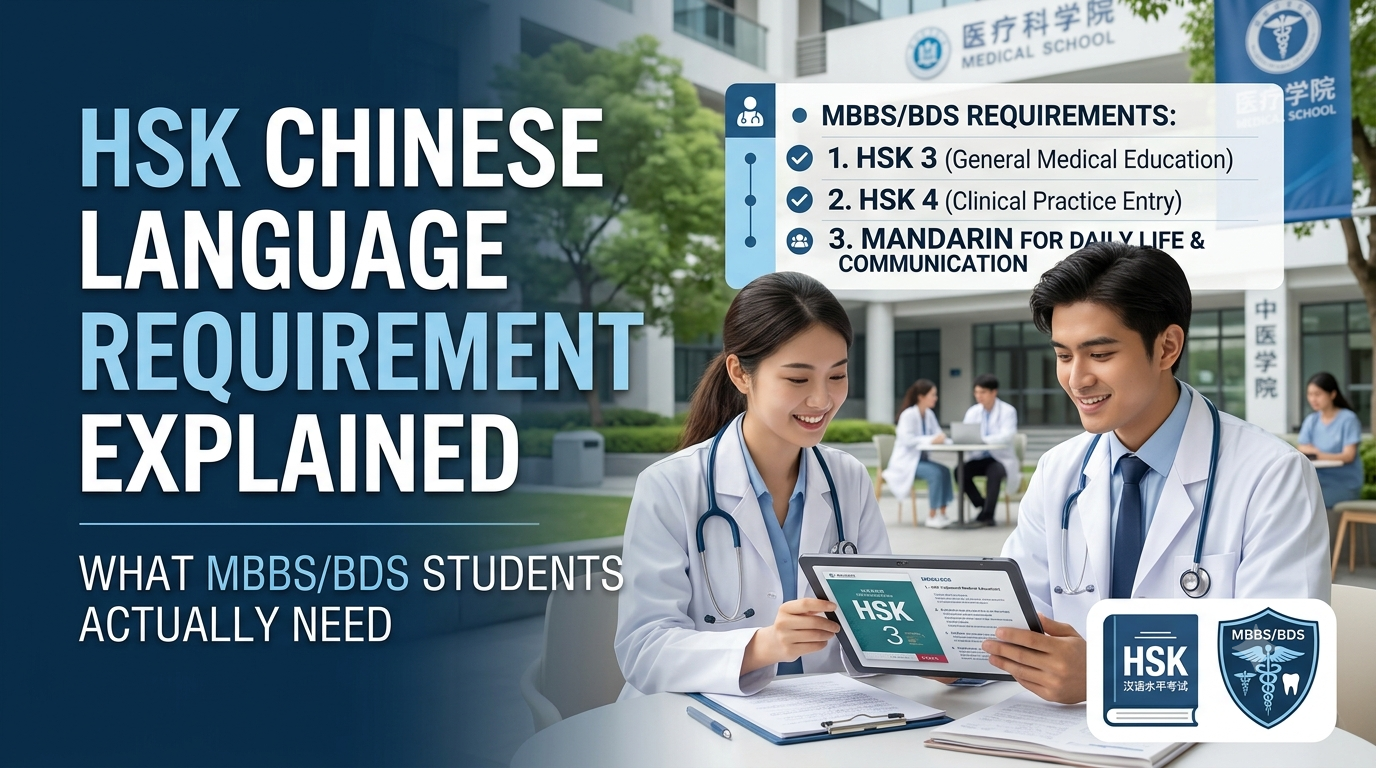
HSK stands for Hanyu Shuiping Kaoshi, China’s standardized Chinese language proficiency test, and HSK Level 4, not a higher or lower level, is the threshold most commonly required for MBBS and BDS students in China, typically before clinical rotations, internship, or graduation rather than at admission.
Unlike IELTS or TOEFL, which most English-medium Chinese medical programs do not require at all, HSK-4 is tied to functional Chinese needed for patient interaction and hospital documentation during clinical training, which is conducted in Mandarin even at universities that teach the academic curriculum in English.
This distinction matters because the timing of the HSK-4 requirement varies meaningfully from one Chinese university to another, and Pakistani students comparing multiple admission offers often assume every university applies the same rule.
Fee structure documents reviewed for several Chinese medical universities illustrate this directly: some require HSK-4 within the first year of study, others explicitly state it is not required in the first year, and others tie it to the point just before internship or graduation instead. Getting this wrong in personal planning, assuming a lenient timeline when a university actually expects early compliance, can create avoidable pressure partway through the program.
Advisory conversations with Pakistani students and families researching MBBS options in China reveal a consistent source of confusion: assuming that because a program is taught in English, no Chinese language requirement applies at all, or assuming that HSK-4 is simply a formality that can be addressed casually alongside medical coursework.
In practice, HSK-4 preparation from a beginner level typically requires 600 to 700 hours of structured study, spread over roughly 12 to 18 months, which is a genuine time commitment that benefits from early planning rather than late-stage cramming.
What the HSK Actually Tests and Why Level 4 Matters?
The HSK is structured across six proficiency levels, with each level representing a distinct stage of practical Chinese ability rather than a simple pass/fail hurdle.
| HSK Level | General Proficiency | Relevance to MBBS/BDS Students |
| HSK 1–2 | Basic communication skills | Not sufficient for university-level requirements; considered a starting point only |
| HSK 3 | Emerging academic readiness | Sometimes used as an interim milestone in structured language programs |
| HSK 4 | Functional classroom and daily-life Chinese, approximately 1,200-word vocabulary | The level most commonly required for MBBS/BDS students before clinical rotations, internship, or graduation |
| HSK 5–6 | Advanced academic and research-level Chinese | Generally required for Chinese-medium postgraduate or research programs, not standard English-medium MBBS/BDS tracks |
HSK-4 is specifically emphasized for medical and dental students because clinical training, patient interaction, ward documentation, and examination protocols, is conducted in Mandarin at Chinese teaching hospitals, even when the academic curriculum itself is delivered in English.
Exam Format and Duration by Level
| HSK Level | Approximate Test Duration | Format |
| HSK 1 | 40 minutes | Listening, reading (basic) |
| HSK 2 | 55 minutes | Listening, reading |
| HSK 3 | 90 minutes | Listening, reading, writing |
| HSK 4 | 105 minutes | Listening, reading, writing |
| HSK 5 | 125 minutes | Listening, reading, writing |
| HSK 6 | 140 minutes | Listening, reading, writing |
Test takers may attempt any level directly without progressing sequentially; a student aiming for HSK-4 is not required to first pass HSK-1 through HSK-3, though building foundational vocabulary in sequence is generally more effective for genuine comprehension.
Why HSK-4 Timing Varies by University?
Reviewing fee structure and admission documents across several Chinese medical universities makes clear that HSK-4 is a widely shared requirement, but its timing is not standardized.
| University | HSK-4 Timing Requirement | Notes |
| Hubei University of Science and Technology | Required within the 1st year, per Ministry of Education regulations | Students should prioritize language preparation early alongside foundational coursework |
| Kunming Medical University | Not required in the 1st year | Provides more flexibility in early-program language planning compared with universities requiring it immediately |
| North Sichuan Medical College | Required before internship or graduation, not within the 1st year | Medical classes begin from the 1st year regardless of HSK-4 status, allowing language preparation to continue alongside coursework |
| Jining Medical University | Bilingual instruction model | Language integration is built into the program structure differently than universities with a distinct HSK-4 milestone |
Because this timing genuinely differs, confirming the specific HSK-4 requirement and deadline directly with each university under consideration, rather than assuming a uniform rule applies, is a necessary step when comparing offers.
Registration, Format Options, and Cost
| Aspect | Detail | Notes |
| Registration platform | Official HSK site (chinesetest.cn) | Requires creating an account and selecting level, format, and test date |
| Test format options | Internet-based test (IBT) or paper-based test (PBT) | IBT registration typically closes about 10 days before the test date; PBT closes earlier, around 27 days before |
| Approximate fee | Increases with level; lower levels (HSK 1–2) generally cost less than higher levels (HSK 5–6), with HSK 3–4 falling in between | Fees vary by country and test center, so confirming the current local fee before registering is advisable |
| Certificate validity | Commonly cited as valid for two years for university and application purposes | Universities may set their own acceptance windows, so confirming this directly with the specific institution is recommended |
| Multiple attempts | Permitted | Universities generally accept a student’s best score across attempts |
What Happens If HSK-4 Is Not Met on Time
| Scenario | Consequence | Notes |
| HSK-4 not achieved by the university’s required stage (year 1, pre-internship, or pre-graduation, depending on the institution) | A provisional degree may be issued, with the final degree withheld until the requirement is met | This can extend the program beyond its standard duration |
| Delayed clinical progression | Some universities restrict advancement into clinical rotations without HSK-4 | Directly affects a student’s ability to complete internship on the standard timeline |
| Late-stage cramming attempts | Given the 600–700 hour study commitment typically needed, last-minute preparation is a common and largely avoidable source of stress | Early, consistent preparation from year one reduces this risk regardless of a university’s specific deadline |
How China’s Language Requirement Compares to Other Study Destinations
| Country | Language Proficiency Test Commonly Required | Relevance to Clinical/Medical Training |
| China | HSK-4 (for MBBS/BDS clinical training), separate from any English proficiency requirement | Required due to Mandarin-language clinical environments, even in English-medium academic programs |
| United Kingdom | IELTS/TOEFL for English proficiency | No additional local-language clinical requirement, since instruction and clinical training are both in English |
| Canada | IELTS/TOEFL for English proficiency (or French-language equivalents for French-medium programs) | No additional local-language clinical requirement in English-medium programs |
| Australia | IELTS/TOEFL for English proficiency | No additional local-language clinical requirement in English-medium programs |
This is one of the more distinctive planning differences between studying medicine in China versus English-speaking destinations, and it deserves attention alongside cost and recognition factors. Visa and enrollment trends across these destinations have shifted in recent years as well.
According to ICEF Monitor’s 2026 analysis of student mobility trends, study visa rejection rates for Pakistani applicants have risen sharply across several Big Four destinations, with more than 70% of Pakistanis refused an F-1 visa in the US in 2026, and Pakistani applicants to the UK seeing sponsored study visa rejection rates spike from 5.6% to 41% year-over-year.
Against this backdrop, China’s inbound international enrollment reached roughly 380,000 foreign students from nearly 200 countries during the 2024/25 academic year, according to Chinese Ministry of Education figures reported via China Daily, a trend that keeps HSK-4 planning a relevant, recurring topic for the large number of Pakistani students choosing China despite the added language requirement.
Factors That Deserve Careful Evaluation
- Academic fit: Assessing personal comfort with language learning alongside a demanding medical curriculum, since HSK-4 preparation runs in parallel with coursework rather than replacing it.
- Budget planning: Accounting for HSK exam registration fees and any language preparation courses as a small but real addition to overall program costs.
- Career goals: Recognizing that HSK-4 affects graduation and clinical progression timelines but does not, by itself, affect PMDC recognition status, which should be verified separately.
- Visa compliance: Understanding that HSK-4 timing is set by the specific university rather than by visa regulations, so this requirement should be tracked alongside, not confused with, residence permit or visa deadlines.
- Language requirements: Confirming the exact HSK-4 deadline (year one, pre-internship, or pre-graduation) directly with the university before enrollment, since this varies significantly.
- Post-study opportunities: Planning language preparation early enough that HSK-4 does not become an obstacle to completing internship and graduation on schedule.
How Study Sphere Advisors Supports Students?
University Selection Guidance: Comparing program structures, including HSK-4 timing requirements, across Chinese medical universities to help students identify options aligned with their language preparation timeline.
Study Visa Assistance: Guidance on preparing and submitting the documentation required for a Chinese student visa application, helping students avoid unnecessary delays and ensuring compliance with official requirements.
Work Visa Support: Assistance for graduates and professionals seeking employment opportunities abroad by providing guidance on work permit requirements, application procedures, and supporting documentation.
Pre-Departure Support Orientation on practical academic requirements, including language preparation expectations, ahead of arrival in China.
Questions Students Usually Ask Before Applying
Is HSK-4 required even for English-medium MBBS programs? Yes, at most universities, though the specific timing (year one, pre-internship, or pre-graduation) varies by institution.
Is HSK the same as IELTS or TOEFL? No. HSK tests Chinese language proficiency and is separate from English proficiency tests, which most Chinese MBBS/BDS programs do not require at all.
How long does it typically take to reach HSK-4 from a beginner level? Approximately 600 to 700 hours of structured study, often spread over 12 to 18 months.
What happens if a student does not meet the HSK-4 deadline set by their university? Consequences vary by institution but commonly include a provisional degree, delayed clinical progression, or an extended program timeline until the requirement is met.
Additional Questions Students Often Have
Can a student attempt HSK-4 directly without passing HSK 1 through 3 first? Yes. Students can register for any HSK level directly, though building foundational vocabulary in sequence is generally more effective for genuine comprehension.
Does passing HSK-4 affect PMDC recognition of the degree? No. HSK-4 is a university-level academic and clinical-readiness requirement, separate from PMDC’s recognition and licensing process, which should be verified independently.
How long is an HSK certificate valid for university purposes? Commonly cited as two years for application and university requirements, though the specific acceptance window should be confirmed with the individual institution.
Can HSK-4 be retaken if a student doesn’t pass on the first attempt? Yes. Multiple attempts are permitted, and universities generally accept a student’s best score.
Does every Chinese medical university require the same HSK level? No. While HSK-4 is the most commonly cited level for MBBS/BDS students, some programs may have different requirements or timing, making direct confirmation with each university important.
Conclusion
The HSK Chinese language requirement for MBBS and BDS students centers on HSK Level 4, tied to functional Chinese needed for clinical training rather than a general academic hurdle, but the exact timing, year one, pre-internship, or pre-graduation, differs meaningfully across Chinese universities. Understanding this variation, budgeting realistic preparation time of 600 to 700 study hours, and confirming each university’s specific deadline before enrollment gives Pakistani students a clearer, more manageable path through this often-overlooked part of studying medicine in China.
Making the Decision
Students evaluating their study abroad options often benefit from expert guidance when comparing universities, scholarships, visa requirements, and long-term career opportunities. Study Sphere Advisors assists students in understanding admission requirements, documentation processes, and language preparation considerations relevant to Chinese medical and dental universities. Students seeking personalized guidance on their specific academic profile can reach out to the advisory team for further information.
Leave a Reply