
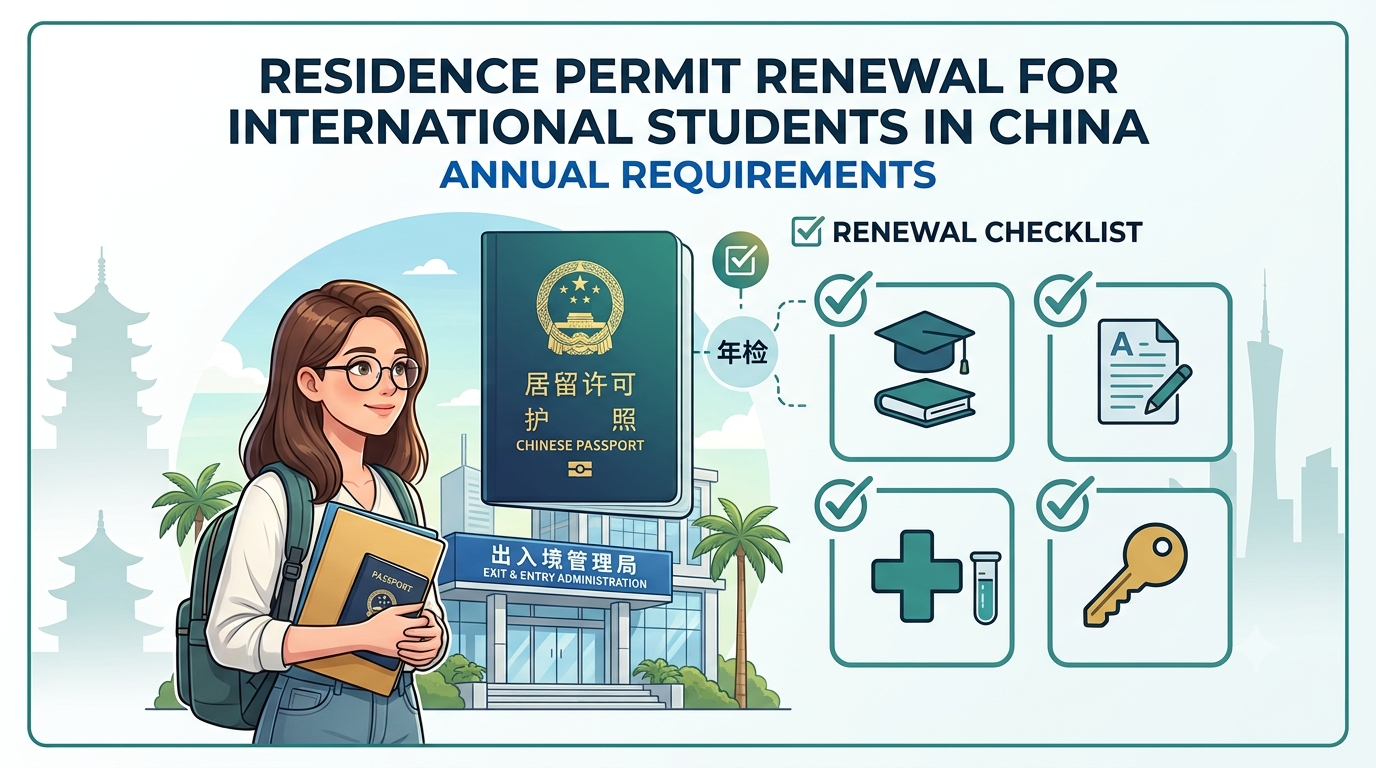
Residence permit renewal for international students in China must be filed at the local Public Security Bureau’s Exit-Entry Administration office at least 30 days before the current permit expires, using an updated enrollment certificate, current accommodation registration, valid health insurance, and the student’s passport.
Missing this window, even briefly, places a student in a status Chinese authorities treat as illegal residence, carrying fines of up to CNY 500 per day (capped at CNY 10,000) and, in more serious cases, the risk of detention.
This process matters to every Pakistani student enrolled in an MBBS, BDS, or other multi-year program in China, because a residence permit is typically issued for a limited duration, often matching a single academic year, meaning renewal is not a one-time task but a recurring annual obligation throughout the program.
Parents supporting a child through a five- or six-year Chinese medical degree, and students managing coursework alongside administrative deadlines, both need a clear picture of this cycle, since a lapsed permit can affect a student’s legal status regardless of how well their academic progress is going.
Advisory conversations with Pakistani students already studying in China reveal a consistent pattern: many treat the residence permit as a formality handled entirely by the university’s international office, only to discover that specific documents, an updated accommodation registration in particular, require the student’s own timely action.
Common mistakes include waiting until the final week before expiry to begin renewal, assuming a physical examination completed abroad will automatically be accepted, and not registering accommodation changes promptly when moving between dormitories or off-campus housing.
From Visa to Residence Permit: The Initial Conversion
Most Pakistani students arrive in China on an X1 visa, issued for programs longer than 180 days. This visa itself is not the long-term authorization to stay; it must be converted into a residence permit within 30 days of arrival, at the local Entry-Exit Administration Bureau, a division of the Public Security Bureau (PSB).
| Requirement | Details | Notes |
| Conversion deadline | Within 30 days of the date stamped in the passport at the border | This window begins on arrival, not on the start of classes |
| JW201 or JW202 form | Issued by the Chinese university as part of the admission process | Referenced in many university fee structures as prepared once tuition and management charges are confirmed |
| Admission notice | Issued by the university | Confirms enrollment status |
| Physical examination record | Conducted at an authorized facility | Examinations completed abroad are sometimes not accepted by local quarantine bureaus, requiring a repeat exam in China |
| Proof of financial support | Bank statements or equivalent documentation | Should reflect both tuition and living expenses |
Annual Renewal Requirements
Once converted, a student’s residence permit is generally valid for a set period, often aligned with the academic year, and must be renewed before it expires for the duration of the program.
| Requirement | Details | Notes |
| Renewal deadline | At least 30 days before the current permit’s expiry date | Filing later increases the risk of processing delays pushing past the expiry date |
| Updated enrollment certificate | Issued by the university confirming continued student status | Should be requested from the university’s international student office ahead of the renewal window |
| Current accommodation registration | Dormitory registration (for on-campus students) or a temporary residence registration form from the local police station (for off-campus students) | Off-campus students must complete this with their landlord present, typically within 24 hours of any address change |
| Valid health insurance | Proof of continued coverage | Often tied to the insurance fee already included in a university’s annual fee package |
| Passport and biometric data | Fingerprints and biometric information may be collected as part of the application | Standard procedure at most PSB Exit-Entry offices |
Fees and Processing Details
| Item | Approximate Cost/Detail | Notes |
| Residence permit fee (valid under 1 year) | Approximately 400 RMB | Typical for standard student permit renewals |
| Residence permit fee (valid up to 3 years) | Approximately 800 RMB | Less common for standard student permits, which are usually issued annually |
| International travel during processing | Generally restricted | Students should avoid planning international travel while an application is under review |
| Processing time | Varies by city and current workload of the local Exit-Entry Administration Bureau | Confirming current estimated processing times with the local PSB office or university is advisable, since timelines are not fixed nationally |
Common Renewal Mistakes and Their Consequences
| Mistake | Consequence | Better Approach |
| Starting the renewal process in the final week before expiry | Risk of the permit lapsing before processing completes, resulting in illegal residence status | Begin the process at least 30 days before expiry, as required, and ideally earlier during a stable point in the academic term |
| Assuming a physical exam completed abroad is automatically accepted | Local quarantine bureaus sometimes reject exams conducted outside China, requiring a repeat exam (typically CNY 400–700) | Complete or confirm the physical examination requirement within the first weeks after arrival in China |
| Not registering off-campus accommodation promptly | Landlords are legally required to register foreign tenants; failure to do so can complicate the student’s own renewal application | Complete accommodation registration with the landlord at the local police station immediately after any address change |
| Attempting renewal during university holiday periods | Processing may be less accessible or take longer when administrative support is reduced | Where possible, initiate renewal during the regular semester, as several universities specifically advise |
| Overlooking permit expiry while focused on academic deadlines | Illegal residence status carries fines of up to CNY 500 per day, capped at CNY 10,000, with detention possible in severe cases | Set a personal reminder well ahead of the official 30-day window, rather than relying solely on university notifications |
Transferring Cities or Losing a Passport
| Scenario | Required Action | Timeline |
| Transferring to a university in a different Chinese city | Complete move-out formalities with the original city’s Entry-Exit Administration, then move-in formalities with the new city’s office | Generally required within 10 days of arrival in the new city |
| Loss of passport | Report immediately to the university’s international office and the local Entry-Exit Administration; obtain a loss certificate; apply for a replacement passport through the relevant embassy or consulate; then apply for a new residence permit | Should be initiated without delay, since the student has no valid travel or residence document until this process is completed |
How Residence Requirements Compare Across Study Destinations?
| Country | Residence/Registration Requirement for International Students | Renewal Frequency | Notes |
| China | Residence permit via PSB Exit-Entry Administration, converted from X1 visa within 30 days of arrival | Typically annual, aligned with the academic year | Off-campus students face an additional accommodation registration requirement |
| United Kingdom | Biometric Residence Permit or eVisa linked to the study visa | Tied to visa validity, often covering the full course duration | Fewer recurring annual renewal cycles compared with China’s typical structure |
| Canada | Study permit, generally valid for the program duration | Renewal required if the program extends beyond the permit’s validity | Different administrative process from China’s PSB-based system |
| Australia | Student visa with associated conditions | Tied to visa validity, often covering the full course duration | Fewer recurring annual renewal cycles compared with China’s typical structure |
China’s requirement for more frequent, typically annual, residence permit renewal is one administrative difference Pakistani students should factor in when comparing study destinations, alongside cost and recognition considerations. Visa and enrollment trends have shifted meaningfully across these destinations in recent years.
According to ICEF Monitor’s 2026 analysis of student mobility trends, study visa rejection rates for Pakistani applicants have risen sharply across several Big Four destinations, with more than 70% of Pakistanis refused an F-1 visa in the US in 2026, and Pakistani applicants to the UK seeing sponsored study visa rejection rates spike from 5.6% to 41% year-over-year.
Against this backdrop, China’s inbound international enrollment reached roughly 380,000 foreign students from nearly 200 countries during the 2024/25 academic year, according to Chinese Ministry of Education figures reported via China Daily, reflecting a large population of students who manage this annual renewal process successfully as a routine part of their studies.
This Requirement Applies Regardless of University Choice
| University | Program Duration | Residence Permit Renewal Applies |
| Hubei University of Science and Technology | 1+5 years (incl. internship) | Yes, annually, as with all Chinese universities |
| Jining Medical University | 5+1 years (incl. internship) | Yes, annually, as with all Chinese universities |
| Kunming Medical University | 5+1 years (incl. internship) | Yes, annually, as with all Chinese universities |
Residence permit renewal is a national administrative requirement rather than a university-specific policy, meaning it applies consistently regardless of which PMDC-recognized Chinese university a student attends; what varies is the level of administrative support each university’s international office provides during the process.
Factors That Deserve Careful Evaluation
- Academic fit: Planning renewal timing around the academic calendar, avoiding periods when university administrative support may be reduced.
- Budget planning: Accounting for the renewal fee (typically around 400 RMB annually) and potential repeat physical examination costs as small but recurring expenses throughout the program.
- Career goals: Maintaining continuous, compliant residence status throughout the program, since gaps in legal status can complicate later administrative processes, including PMDC-related documentation.
- Visa compliance: Treating the 30-day renewal window as a firm deadline, not a flexible guideline, given the financial and legal consequences of lapsing.
- Language requirements: Preparing for interactions with PSB offices where English support may be limited, particularly in smaller cities; university international offices often assist with this.
- Post-study opportunities: Understanding that residence permit compliance throughout the program is a separate matter from post-graduation licensing requirements, though both require careful administrative follow-through.
How Study Sphere Advisors Supports Students?
Study Visa Assistance Guidance on preparing the documentation required for a Chinese student visa application, including the initial JW202 process that precedes residence permit conversion.
Work Visa Assistance: Step-by-step support for Chinese work visas (Z Visa), from obtaining the Work Permit Notification Letter to post-arrival permit conversion.
Pre-Departure Support Orientation on practical post-arrival requirements, including the physical examination and residence permit conversion timeline.
Questions Students Usually Ask Before Applying
Is the residence permit the same as the student visa? No. The X1 visa allows entry into China, but it must be converted into a residence permit within 30 days of arrival, which then serves as the student’s ongoing legal authorization to stay.
How often does the residence permit need to be renewed? Typically annually, aligned with the academic year, though the exact validity period can vary by city and case.
What happens if the renewal deadline is missed? The student is considered to be in illegal residence status, which carries fines of up to CNY 500 per day (capped at CNY 10,000) and, in serious cases, the risk of detention.
Can international travel happen while a renewal application is being processed? Generally, international travel should be avoided during this period, since the passport may be required at the PSB office throughout processing.
Additional Questions Students Often Have
Does the residence permit renewal process differ between on-campus and off-campus students? Yes. Off-campus students must complete an additional accommodation registration step with the local police station, alongside their landlord, which on-campus students typically do not need to arrange independently.
What should be done if a passport is lost during the program? Report the loss immediately to the university’s international office and the local Entry-Exit Administration, obtain a loss certificate, apply for a replacement passport through the relevant embassy, and then apply for a new residence permit.
Does transferring to a different city in China affect residence permit status? Yes. Students transferring cities must complete move-out formalities with the original city’s Entry-Exit Administration and move-in formalities with the new city’s office, generally within 10 days of arrival.
Is the physical examination required only once, at the start of the program? The initial examination is required for the first residence permit conversion; specific renewal requirements regarding subsequent exams can vary and should be confirmed with the local PSB office.
Who typically assists students with the renewal process? University international student offices commonly provide guidance and document preparation support, though certain steps, particularly off-campus accommodation registration, remain the student’s own responsibility.
Conclusion
Residence permit renewal in China follows a defined annual cycle: converting the initial X1 visa within 30 days of arrival, then renewing at least 30 days before each subsequent expiry, supported by an updated enrollment certificate, accommodation registration, and valid health insurance. Understanding this as a recurring administrative responsibility throughout a multi-year MBBS or BDS program, rather than a single post-arrival task, helps Pakistani students avoid the fines and legal complications associated with lapsed residence status.
Making the Decision
Students evaluating their study abroad options often benefit from expert guidance when comparing universities, scholarships, visa requirements, and long-term career opportunities. Study Sphere Advisors assists students in understanding admission requirements, documentation processes, and post-arrival compliance considerations relevant to studying in China. Students seeking personalized guidance on their specific academic profile can reach out to the advisory team for further information.
Leave a Reply