
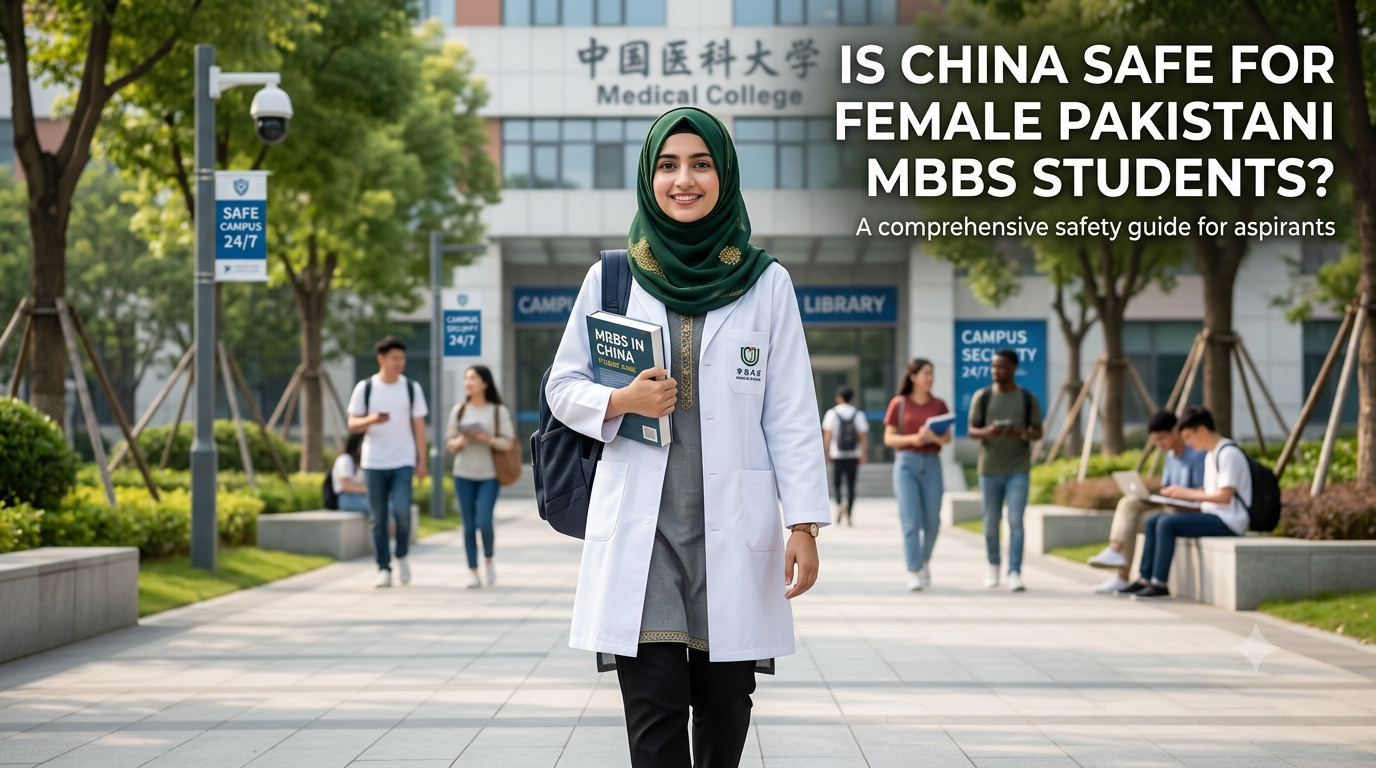
Based on available government travel advisories and consistent reporting from students and universities, China is generally regarded as a safe destination for female Pakistani students pursuing MBBS, with low rates of violent crime, strong campus security infrastructure, and, at most universities with an established international student population, dedicated arrangements such as female-only hostel floors and halal dining options. This general picture should not replace verifying the specific arrangements at an individual university, since safety features, hostel policies, and food availability can vary meaningfully from one institution to another.
This question deserves a direct and honest answer because it affects a real decision many Pakistani families weigh carefully: whether to send a daughter to study medicine several thousand kilometers from home, in a country with a different language, legal system, and set of social norms. Female applicants themselves, and parents evaluating multiple destinations, both need factual information rather than reassurance alone, since decisions made on incomplete information can lead to mismatched expectations after arrival.
Advisory conversations with Pakistani families considering MBBS programs in China reveal that concerns generally fall into three consistent categories: physical safety and campus security, availability of halal food and religiously appropriate living arrangements, and cultural or legal adjustment, particularly around unfamiliar restrictions such as limits on political expression. Common gaps in initial research include assuming every Chinese university offers identical hostel security arrangements, and not distinguishing between general country-level safety data and the specific, verifiable policies of the university a student is actually considering.
What Government Travel Advisories Indicate?
Government travel advisories offer one of the more objective, non-promotional sources of safety information available to families researching a study destination.
| Advisory Source | General Rating for China | Notes Relevant to Female Travelers |
|---|---|---|
| US State Department | Level 2 (“Exercise Increased Caution”) as of 2026 | Notes that women travelers are generally treated with respect and experience a high level of safety, alongside broader guidance on arbitrary detention risk and restricted regions |
| General international safety data | Violent crime against foreign nationals is comparatively low in major Chinese cities | Petty crime and scams targeting tourists exist but are distinct from personal safety concerns raised by families |
Advisory levels are updated periodically and can shift with regional or political developments, so checking the current advisory closer to departure, rather than relying on information from a previous year, remains good practice.
Campus and Hostel Safety Considerations for Female Students
Across many Chinese universities hosting international medical students, a consistent pattern of campus security measures has been reported, though the specific implementation varies by institution.
| Safety Feature | Commonly Reported at Chinese Universities | Notes |
|---|---|---|
| Gated hostel entry with restricted access | Frequently reported | Entry is often controlled through ID card, biometric, or front-desk verification |
| Female-only hostel floors or buildings | Frequently reported, particularly at universities with larger international cohorts | Should be confirmed directly with the specific university rather than assumed |
| 24-hour CCTV monitoring | Frequently reported | Common across both male and female hostel areas |
| Female warden or dedicated staff support | Reported at some universities | Availability and role can vary; confirm directly with the university’s international student office |
| Restrictions on visitors, including male students, in female hostel areas | Frequently reported | Reduces unsupervised access to female living spaces |
Since these features are not uniformly documented across every Chinese medical university’s own admission material, requesting written confirmation of hostel arrangements — including room-sharing structure, entry policy, and whether the floor or building is designated for female students only — from the specific university under consideration is a more reliable approach than relying on general claims.
Halal Food and Religious Accommodation
Availability of halal food and accommodation for religious practice is a recurring and legitimate concern for Pakistani families, distinct from general safety.
| Consideration | General Pattern Across Chinese Universities | Notes |
|---|---|---|
| Halal campus canteens | Common at universities with established international or Muslim student populations | Availability should be confirmed for the specific university, since it is not universal at every institution |
| Halal restaurants near campus | Common in cities with a Hui (Chinese Muslim) community or a history of hosting international medical students | City choice affects this more than university choice alone |
| Space or accommodation for daily prayer | Varies by university | Not consistently documented in admission material; worth a direct query before enrollment |
| Pakistani or South Asian student associations on campus | Present at many universities with a longstanding history of Pakistani enrollment | Can provide informal support and orientation for new arrivals, including guidance on halal food sourcing |
Fee structure documents reviewed for several Chinese medical universities, including Jining Medical University and Jiamusi University, specifically confirm halal food availability inside or near campus, which suggests this is a genuine and checkable feature rather than a generic marketing claim, though it should still be confirmed directly for any university not already verified.
Cultural and Legal Adjustment Considerations
Beyond physical safety, cultural and legal adjustment is a separate dimension families should weigh honestly.
| Consideration | What to Expect | Practical Implication |
|---|---|---|
| Restrictions on political expression | International students are generally expected to avoid discussing political topics publicly or on social media | A significant adjustment for students accustomed to more open political discourse; awareness reduces the risk of unintended issues |
| Strict law enforcement | Chinese authorities are known for consistent enforcement of local laws, including around residence permits and registration | Compliance with visa, registration, and residence rules should be treated as non-negotiable |
| Cultural norms around dress and social interaction | Generally not highly restrictive in university settings, though norms vary by region | Adjusting expectations to local context, without assuming Pakistani or Western norms apply uniformly, eases the transition |
| Language barrier in daily life | Significant outside the classroom, particularly for tasks like banking or medical visits | Universities with larger international cohorts often provide more translation support and peer assistance |
How China Compares to Other Study Destinations on These Dimensions?
| Country | General Safety Perception for Female International Students | Halal Food Availability | Cultural Adjustment Considerations |
|---|---|---|---|
| China | Generally regarded as safe, with strong campus security infrastructure at many universities | Available at many universities and cities with Muslim communities, though not universal | Political expression restrictions and strict law enforcement are notable adjustments |
| United Kingdom | Generally regarded as safe, though urban crime concerns vary by city | Widely available in most major cities | Fewer restrictions on political expression; different cultural and social norms to adjust to |
| Canada | Generally regarded as safe | Widely available in most major cities | Fewer restrictions on political expression; distinct cultural adjustment around climate and lifestyle |
| Australia | Generally regarded as safe | Available in most major cities | Fewer restrictions on political expression; distinct cultural adjustment around lifestyle and distance from home |
Visa and enrollment trends have shifted meaningfully across these destinations in recent years, which affects how many Pakistani families weigh these considerations together with safety and cultural comfort. According to ICEF Monitor’s 2026 analysis of student mobility trends, study visa rejection rates for Pakistani applicants have risen sharply across several Big Four destinations, with more than 70% of Pakistanis refused an F-1 visa in the US in 2026, and Pakistani applicants to the UK seeing sponsored study visa rejection rates spike from 5.6% to 41% year-over-year.
Against this backdrop, China’s inbound international enrollment reached roughly 380,000 foreign students from nearly 200 countries during the 2024/25 academic year, according to Chinese Ministry of Education figures reported via China Daily, reflecting a large and established international student population, including many female Pakistani students who have completed MBBS programs there over an extended period.
Factors That Deserve Careful Evaluation
- Academic fit: Weighing safety and cultural comfort alongside academic and recognition factors, rather than treating them as entirely separate decisions.
- Budget planning: Confirming whether female hostel arrangements involve any additional cost, since some universities charge differently for single, double, or shared rooms.
- Career goals: Recognizing that safety and cultural comfort do not affect a program’s PMDC recognition status or long-term licensing pathway, which should be verified independently.
- Visa compliance: Understanding residence permit and registration requirements clearly, since strict enforcement means compliance is expected without exception.
- Language requirements: Considering how comfortable a student is navigating daily life with limited English outside the classroom, alongside the academic language of instruction.
- Post-study opportunities: Factoring in that safety and support networks (Pakistani student associations, for example) tend to be stronger at universities with a longer history of hosting Pakistani students.
How Study Sphere Advisors Supports Students?
Study Visa Assistance: Guidance on preparing the documentation required for a Chinese student visa application, reducing the risk of delays caused by incomplete paperwork.
Pre-Departure Support: Orientation on practical arrival-stage considerations, including hostel arrangements and day-to-day adjustment factors relevant to female students.
Work Visa Assistance: Support and guidance for students seeking post-graduation employment opportunities, including help with understanding work permit requirements, preparing documentation, and navigating the work visa application process where applicable.
Questions Students Usually Ask Before Applying
Is China generally considered safe for female international students? Based on government travel advisories and consistent reporting, China is generally regarded as safe, with low rates of violent crime in major cities, though specific hostel and campus arrangements should be confirmed for each university.
Do Chinese universities offer female-only hostel arrangements? Many do, particularly those with established international student populations, but this should be confirmed directly with the specific university rather than assumed universally.
Is halal food reliably available for Pakistani students? Availability varies by city and university; it is confirmed in admission material for some universities (such as Jining Medical University and Jiamusi University) and should be verified directly for others.
What cultural adjustments should be expected beyond physical safety? Restrictions on public political expression and strict enforcement of local laws are among the most significant adjustments for students accustomed to different norms.
Additional Questions Students Often Have
Are safety features the same at every Chinese medical university? No. While many universities report similar patterns (gated hostels, CCTV, female floors), specific policies vary, making direct verification with each university important.
Does a university’s overall academic reputation indicate anything about its safety arrangements? Not directly. Academic recognition and campus safety features are separate considerations and should each be evaluated independently.
How can families verify safety and hostel arrangements before enrolling? Requesting written confirmation from the university’s international admissions office, and where possible, connecting with current students through a Pakistani Students Association, offers more reliable information than general marketing claims.
Do government travel advisories change over time? Yes. Advisory levels are reviewed periodically and can shift with regional developments, so checking the current advisory closer to departure is advisable.
Is cultural adjustment typically harder for female students specifically? Adjustment challenges are generally similar for male and female students in terms of language and daily life, though specific considerations around hostel arrangements and religious accommodation are more commonly raised by and for female students and their families.
Conclusion
Available evidence, including government travel advisories and consistent reporting on campus security, halal food availability, and hostel arrangements, generally supports the view that China is a manageable and comparatively safe destination for female Pakistani students pursuing MBBS. That said, general safety data should not substitute for confirming the specific policies, hostel structure, and support networks of the particular university under consideration. Reviewing these details directly, alongside academic and recognition factors already covered elsewhere, gives Pakistani families a fuller and more honest basis for this decision.
Making the Decision
Students evaluating their study abroad options often benefit from expert guidance when comparing universities, scholarships, visa requirements, and long-term career opportunities. Study Sphere Advisors assists students in understanding admission requirements, documentation processes, and practical considerations relevant to studying medicine in China. Students seeking personalized guidance on their specific academic profile can reach out to the advisory team for further information.
Leave a Reply