
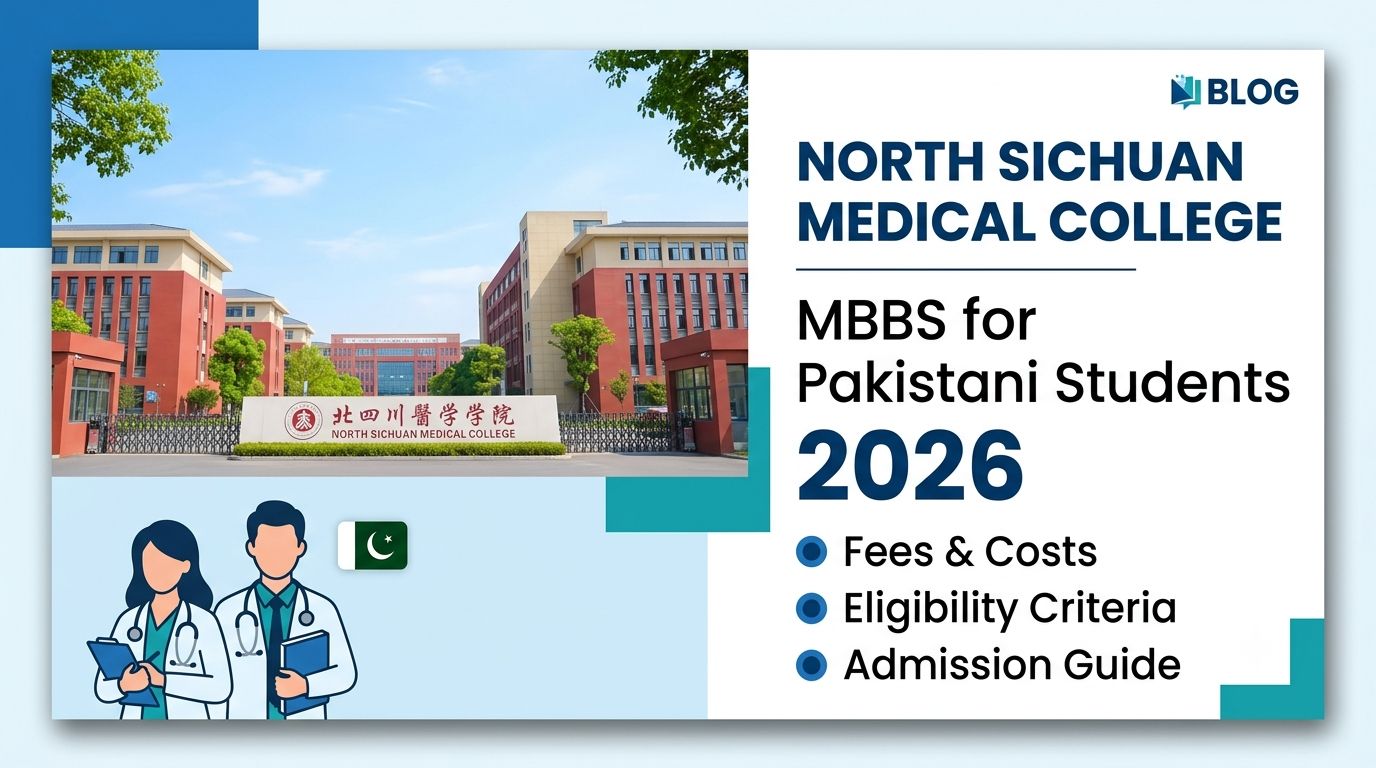
North Sichuan Medical College (NSMC) charges Pakistani students an approximate 1st-year package of 43,500 RMB (around 6,000 USD) for its Clinical Medicine (MBBS) program, covering tuition, hostel, visa extension, insurance, a medical checkup fee, and a one-time management charge.
From the 2nd through 5th years, the annual cost drops to 29,200 RMB (roughly 4,000 USD) each year, since the management and medical checkup fees are not repeated. In the 6th and final year, which covers the internship period, the cost falls further to 12,000 RMB, covering tuition only. A separate 250 USD application fee is paid with the initial documents and becomes non-refundable once the admission letter is issued.
For Pakistani HSSC graduates comparing MBBS options in China, NSMC’s year-by-year fee breakdown across all six years, rather than a simple first-year-versus-later-years structure, makes full-program budgeting more straightforward but also requires closer reading.
Understanding which costs recur annually, which apply only once, and what happens during the internship year all affect whether a six-year financial commitment is realistic for a given family. This matters particularly for students weighing NSMC against universities with a 5+1 year structure, since the cost profile across the six years differs meaningfully from a flat annual fee.
Advisory conversations with Pakistani families comparing Chinese medical universities consistently raise similar concerns: whether the fee stays consistent across the full program or changes significantly by year, whether HSK-4 is required before starting classes or later in the program, and what happens to the security deposit paid after the admission letter is issued.
Common oversights include assuming a lower first-year figure applies uniformly across all six years, and not accounting for the fact that hostel fees listed are based on 4-sharing accommodation rather than private or double-sharing options.
North Sichuan Medical College Fee Structure (Full 6-Year Breakdown)
| Fee Component | 1st Year | 2nd Year | 3rd Year | 4th Year | 5th Year | 6th Year |
| Tuition Fee | 25,000 RMB | 25,000 RMB | 25,000 RMB | 25,000 RMB | 25,000 RMB | 12,000 RMB |
| Hostel Fee (4-sharing) | 3,000 RMB | 3,000 RMB | 3,000 RMB | 3,000 RMB | 3,000 RMB | , |
| Visa Extension | 400 RMB | 400 RMB | 400 RMB | 400 RMB | 400 RMB | , |
| Insurance Fee | 800 RMB | 800 RMB | 800 RMB | 800 RMB | 800 RMB | , |
| Medical Checkup Fee | 350 RMB | , | , | , | , | , |
| Management Charge | 14,000 RMB | , | , | , | , | , |
| Total Fee | 43,500 RMB (approx. 6,000 USD) | 29,200 RMB (approx. 4,000 USD) | 29,200 RMB (approx. 4,000 USD) | 29,200 RMB (approx. 4,000 USD) | 29,200 RMB (approx. 4,000 USD) | 12,000 RMB |
Application fee: 250 USD, paid with the initial application documents and non-refundable after the admission letter is issued. The 6th year corresponds to the internship period, when only tuition applies according to the fee structure provided.
Payment Routing and Conditions Students Should Understand
- A security deposit of 2,000 RMB is paid after the admission letter is issued and is later deducted from the 1st-year fee package upon arrival.
- The remaining 1st-year balance , covering tuition, hostel, visa extension, medical checkup, airport pickup, management fee, service fee, courier charges, and insurance , is paid upon arrival at the university, before registration.
- Admission processing, airport pickup, and settling-in support at the university are handled by the company responsible for the admission process.
- The hostel fee listed applies to 4-sharing accommodation; students requiring single or double sharing can arrange this at an additional cost.
- Medical classes begin from the 1st year, and HSK-4 certification is required before internship or graduation rather than within the first year.
- Air ticket, stationery, and food expenses are not included in the fee package.
- All fees paid are non-refundable and non-transferable.
- Students are expected to follow the rules and academic regulations of the university, China’s Ministry of Education, and PMDC throughout the program.
University Snapshot: Eligibility Requirements
| Requirement | Details | Notes |
| Age Limit | 18–29 years | Broader age range than several comparable Chinese medical universities |
| Academic Requirement | Minimum 60% marks overall in HSSC (12th grade) | Required for the Clinical Medicine (MBBS) program |
| Language Milestone | HSK-4 certificate required before internship or graduation | Not required within the 1st year |
| Instruction Mode | English medium | Program structured as a full 6-year MBBS, including internship |
Admission Document Checklist
| Document | Mandatory | Additional Notes |
| Matric (SSC) result card | Yes | Original or attested copy typically required |
| F.Sc (HSSC) result card | Yes | Used to verify the 60% eligibility threshold |
| Passport | Yes | Valid for the intended study duration |
| Passport-size photo | Yes | As per university format |
| Police clearance certificate | Yes | Issued in Pakistan |
| Medical fitness form | Yes | Completed as per university format |
Scholarship Availability for This Intake
Current admission material for North Sichuan Medical College’s MBBS program does not specify a dedicated scholarship program for international students. Students for whom scholarship access is a deciding factor are advised to confirm directly with the university’s international admissions office whether merit-based or need-based funding is available for their intended intake, rather than assuming a scholarship structure exists by default.
University Profile
North Sichuan Medical College is located in Nanchong City, Sichuan Province, and was founded in 1951. The university operates two campuses , Shunqing District (West Campus) and Gaoping District (East Campus) , spanning a combined area of over 820,000 square meters.
According to admission material, NSMC holds a world ranking of 5,597 and a national ranking of 821, and the university began enrolling international students in 2005. NSMC is recognized by PMDC and approved by WHO. As with any ranking figure supplied by admission material, students are advised to independently verify current standing through the relevant ranking body’s own published data before treating it as a deciding factor.
North Sichuan Medical College Compared with Other Chinese Medical Universities
| University | Approx. Ranking Context | Program Duration | Language | International Recognition |
| North Sichuan Medical College | World Rank 5,597, National Rank 821 (per admission material) | 6 years, full program (incl. internship) | English medium | PMDC-recognized, WHO-approved |
| Kunming Medical University | National Rank #211, World Rank #1611 (per admission material) | 5+1 years (incl. internship) | English medium | WHO-, PMDC-, MOE-, and ECFMG-recognized |
| Jining Medical University | Established medical institution in Shandong Province | 5+1 years (incl. internship) | Bilingual | WHO- and ECFMG-listed |
Recognition depends on continuous listing across multiple registers rather than a single ranking figure: a foreign medical university must be listed in the World Directory of Medical Schools, accredited by the World Federation for Medical Education, and included in PMDC’s official list of recognized foreign institutions. Since PMDC updates this list periodically, verifying a university’s current status directly on the PMDC website before finalizing admission remains a necessary step, not a formality.
China as a Study Destination: Country Comparison
| Country | Approx. Annual Medical Tuition | Student Visa Processing Time | Work Rights (During Study) | Scholarship Availability | Post-Study Path Relevance for Pakistani Doctors |
| China | 12,000–25,000 RMB per year (varies by year and institution) | Typically a few weeks | Limited; primarily clinical/internship exposure | Varies significantly by university; not universal | Requires PMDC NLE for practice in Pakistan |
| United Kingdom | Substantially higher tuition for medicine | Weeks to months, with fluctuating approval rates | Restricted for medical students | Limited for undergraduate medicine | Requires separate UK/PLAB or PMDC pathway |
| Canada | High tuition; limited direct-entry MBBS-equivalent seats | Processing times have lengthened, with lower approval rates in recent cycles | Restricted for most programs | Limited scholarship access for international undergraduates | Requires MCCQE or PMDC pathway |
| Australia | High tuition for medical programs | Variable, with rising rejection rates reported for South Asian applicants | Part-time work rights outside clinical placements | Limited | Requires AMC or PMDC pathway |
Visa and enrollment conditions across major destinations have shifted noticeably in recent admission cycles. According to ICEF Monitor’s 2026 analysis of student mobility trends, study visa rejection rates for Pakistani applicants have risen sharply across several Big Four destinations, with more than 70% of Pakistanis refused an F-1 visa in the US in 2026, and Pakistani applicants to the UK seeing sponsored study visa rejection rates spike from 5.6% to 41% year-over-year.
Against this backdrop, China’s inbound international enrollment has moved in the opposite direction: roughly 380,000 foreign students from nearly 200 countries were in China during the 2024/25 academic year, a substantial increase from the pandemic-era low, with top source markets including Pakistan, according to Chinese Ministry of Education figures reported via China Daily.
Factors That Deserve Careful Evaluation
Before finalizing an admission decision, Pakistani students and their families are generally advised to assess the following:
- Budget planning: Whether the full six-year cost , not just the first-year figure , fits within available funds, given that years 2 through 5 carry a consistent annual cost before dropping in the internship year.
- Academic fit: Whether current HSSC marks meet the 60% overall threshold and whether the broader 18–29 age range changes eligibility compared with other universities.
- Recognition verification: Whether the specific program is currently listed on PMDC’s foreign institutions register, independent of the university’s stated world or national ranking.
- Career goals: Whether the student intends to practice in Pakistan (requiring the PMDC National Licensing Exam), pursue licensure elsewhere, or keep both pathways open.
- Language requirements: Whether the HSK-4 certification timeline , required before internship or graduation rather than in the first year , fits the student’s language learning pace.
- Post-study opportunities: What licensing exams or registration steps apply after the internship year, based on the destination where the graduate intends to practice.
How Study Sphere Advisors Support Students?
Study Visa Assistance Guidance on preparing the documentation required for a Chinese student visa application, reducing the risk of delays caused by incomplete paperwork.
Work Visa Consultation Orientation on the requirements and pathway for a work visa for graduates considering employment or internship opportunities in China after completing their program.
Questions Students Usually Ask Before Applying
Is the 43,500 RMB package the total cost for the first year? It covers tuition, hostel, visa extension, insurance, medical checkup, and management charges. Air ticket, stationery, and food expenses are separate.
Does the fee stay the same for all six years? No. Years 2 through 5 cost approximately 29,200 RMB each, since the first-year management and medical checkup fees do not recur, and the 6th year (internship) drops to 12,000 RMB, covering tuition only.
Is the application fee refundable if a student changes their mind? No. It becomes non-refundable once the admission letter has been issued.
Is HSK-4 required before starting classes? No. Medical classes begin from the 1st year, and HSK-4 certification is required before internship or graduation rather than at the start of the program.
Additional Questions Students Often Have
Does completing an MBBS at NSMC guarantee a license to practice in Pakistan? No. Graduates must still pass the PMDC National Licensing Exam and complete PMDC registration; WHO approval of the university does not substitute for this step.
What happens to the 2,000 RMB security deposit paid after the admission letter? It is deducted from the 1st-year fee package upon arrival, rather than treated as a separate charge.
Is the hostel fee the same for all room-sharing options? No. The listed hostel fee applies to 4-sharing accommodation; single or double sharing is available at an additional cost.
Are scholarships available for this program? Current admission material does not specify a scholarship program; students should confirm scholarship availability directly with the university.
What costs apply specifically in the internship year? Based on the fee structure provided, only tuition (12,000 RMB) applies in the 6th year, with hostel, visa extension, and insurance fees not listed for that year.
Conclusion
North Sichuan Medical College’s fee structure differs from several other Chinese medical universities by breaking costs down across the full six-year program rather than a simple first-year-versus-later-years format.
What determines whether this program fits a Pakistani student’s plans is less the first-year figure alone and more the consistency of costs across years two through five, the reduced internship-year expense, and confirmed PMDC recognition status. Reviewing the complete fee table, required documents, and eligibility criteria against personal academic standing and long-term career goals gives a clearer basis for deciding whether this program, or a comparable one, is the right fit.
Making the Decision
Students evaluating their study abroad options often benefit from expert guidance when comparing universities, scholarships, visa requirements, and long-term career pathways. Study Sphere Advisors assists students in understanding admission requirements, documentation processes, and recognition criteria relevant to Chinese medical universities. Students seeking personalized guidance on their specific academic profile can reach out to the advisory team for further information.
Leave a Reply