
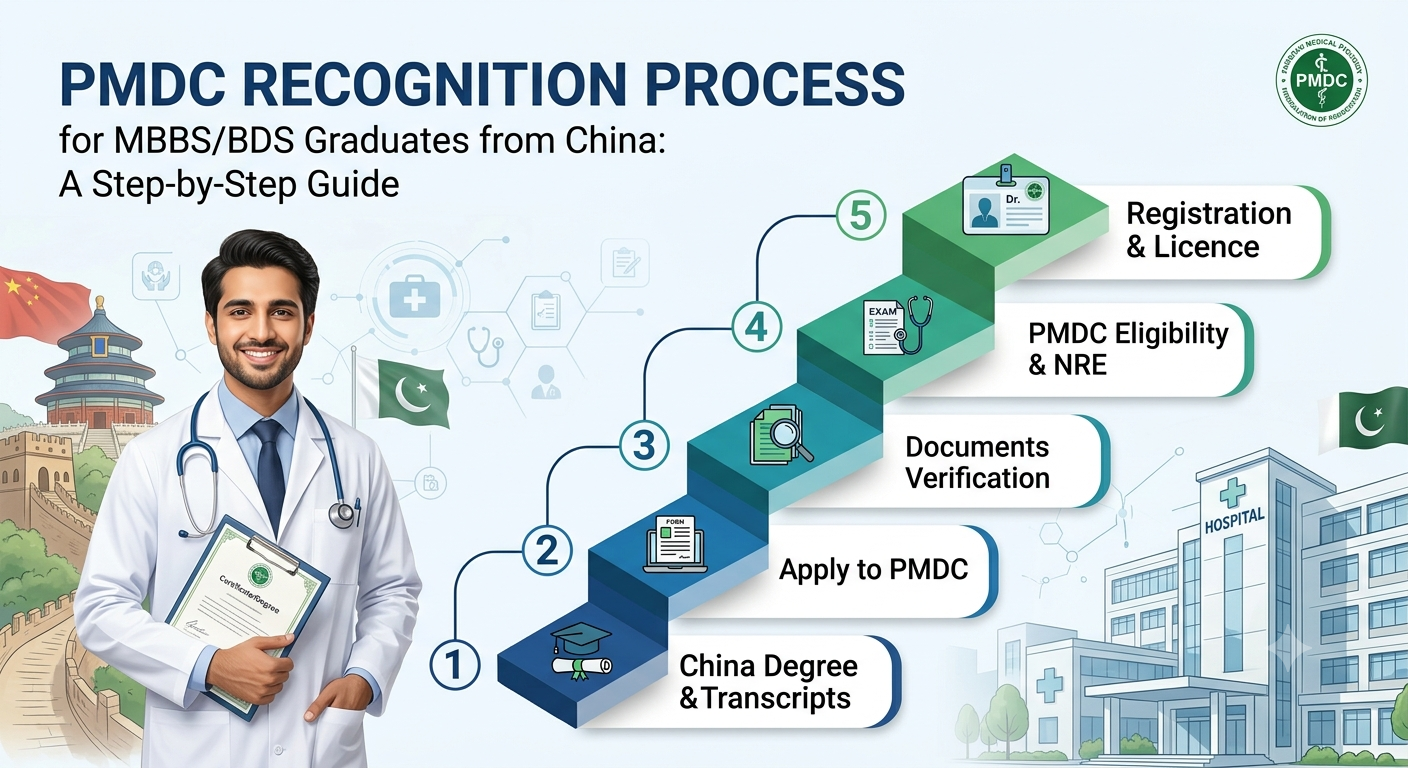
PMDC recognition for MBBS or BDS graduates from China follows a defined sequence: verifying the university’s international accreditation before admission, completing the degree abroad, clearing the National Equivalence Board (NEB) exam, passing the National Registration Examination (NRE) in two stages, completing a house job in Pakistan under provisional registration, and finally receiving full PMDC registration. Skipping or misunderstanding any step in this sequence is one of the most common reasons graduates face delays after returning to Pakistan.
This process matters to every Pakistani student pursuing MBBS or BDS in China, not just those nearing graduation, because eligibility depends on decisions made at the admission stage — specifically, whether the chosen university carries the accreditation status PMDC requires. Parents researching study options for their children, and students already partway through a Chinese medical or dental program, both need clarity on this sequence to avoid a scenario where years of study abroad do not translate into the right to practice in Pakistan.
Advisory conversations with Pakistani families pursuing MBBS and BDS in China consistently reveal the same pattern of confusion: assuming that graduation alone confers the right to practice, treating “WHO recognized” and “PMDC recognized” as interchangeable, and discovering only close to graduation that a registration exam stands between the degree and a license. Common admission-stage mistakes include enrolling in a university without confirming its current PMDC listing status and assuming an older cohort’s experience with the process still applies, since PMDC’s registration framework has been restructured under the PMDC Act 2022.
Why PMDC Recognition Cannot Be Assumed From Graduation Alone?
A Chinese medical or dental degree, however well-regarded internationally, does not by itself grant the right to practice in Pakistan. The Pakistan Medical and Dental Council (PMDC), the statutory body succeeding the Pakistan Medical Commission (PMC), requires foreign-qualified graduates to complete a separate verification and licensing pathway. This distinction matters because recognition by other bodies, the World Health Organization’s listing, or a university’s own claim of international accreditation, addresses academic standing, not the specific legal right to register and practice medicine or dentistry within Pakistan.
Step 1: Verifying University Accreditation Before Admission
Before enrolling, PMDC guidance indicates that a foreign medical or dental university should be accredited by the World Federation for Medical Education (WFME) and listed in the World Directory of Medical Schools (WDOMS), in addition to appearing on PMDC’s own list of recognized foreign institutions.
| Accreditation Body | What It Verifies | Why It Matters for Pakistani Students |
|---|---|---|
| World Directory of Medical Schools (WDOMS) | Whether the institution is formally listed as a recognized medical school globally | A prerequisite many licensing bodies, including PMDC, reference when assessing foreign degrees |
| World Federation for Medical Education (WFME) | Whether the university’s medical education program meets international quality standards | Accreditation status can change over time; continuous listing matters, not a one-time historical approval |
| PMDC Recognized Foreign Institutions List | Whether the specific university is currently accepted for registration purposes in Pakistan | This list is updated periodically and is the most direct indicator relevant to Pakistani graduates |
Since these lists are reviewed periodically, verifying a university’s current status directly on PMDC’s official website before finalizing admission remains a necessary step rather than a formality — a university listed in one admission cycle is not guaranteed to remain listed indefinitely.
Step 2: Documentation to Maintain Throughout the Program
Foreign medical graduates seeking PMDC registration are generally required to submit a defined set of documents once their degree is complete.
| Document | Mandatory | Additional Notes |
|---|---|---|
| Certified copy of medical/dental degree | Yes | Should be obtained directly from the university upon graduation |
| Academic transcripts | Yes | Covering the full duration of the program |
| Proof of internship/house job completion | Yes | Documentation from the affiliated teaching hospital where clinical training occurred |
| Passport and CNIC | Yes | Used for identity verification on PMDC’s registration portal |
| English or Urdu proficiency confirmation | Yes | Assessed as part of the registration eligibility criteria |
Maintaining organized copies of these documents throughout the program, rather than assembling them only after returning to Pakistan, reduces delays at the registration stage.
Step 3: The National Equivalence Board (NEB) Examination
Graduates whose primary medical or dental qualification was obtained outside Pakistan are generally required to clear the National Equivalence Board (NEB) examination before their foreign degree can be considered for further registration steps. The NEB assesses whether the graduate’s academic training aligns with PMDC’s competency benchmarks for Pakistan. According to PMDC’s published 2026 examination calendar, the NEB has been scheduled through Rawalpindi Medical University, though exact dates and cycles are set annually and should be confirmed directly on PMDC’s portal closer to the graduate’s expected completion date.
Step 4: The National Registration Examination (NRE), Formerly Known as NLE
Once NEB requirements are satisfied, foreign medical and dental graduates proceed to the National Registration Examination (NRE) — the licensing pathway previously referred to as the National Licensing Examination (NLE) under the Pakistan Medical Commission. The NRE is conducted in two components.
| NRE Stage | Format | Purpose |
|---|---|---|
| NRE Step-I (Theory) | Written assessment | Evaluates foundational medical or dental knowledge against Pakistan’s competency standards |
| NRE Step-II (Clinical Skills) | Practical/clinical assessment | Evaluates clinical judgment and patient-care competence, typically conducted in multiple annual cycles |
PMDC’s published 2026 schedule listed multiple NRE-I and NRE-II sessions across the year, reflecting a shift toward more frequent examination cycles compared with earlier years. Since these schedules are released annually, graduates should confirm the current cycle dates directly through PMDC’s official registration portal rather than relying on a previous year’s calendar.
Step 5: Provisional Registration and House Job Requirements
Passing NRE Step-I generally allows a foreign graduate to obtain provisional registration, a temporary status permitting supervised clinical training or a house job in Pakistan rather than independent practice. Under PMDC’s revised framework, provisional registration is no longer granted automatically to every foreign graduate; it is now tied more directly to the recognition status of the graduate’s originating institution at the time of application. Completing a house job at a PMDC-recognized institution in Pakistan remains a required step before full registration is issued.
Step 6: Full PMDC Registration
After completing the house job and passing the required NRE components, graduates submit their documentation for full PMDC registration and pay the applicable registration fee. Once approved, PMDC issues a registration certificate confirming the graduate’s legal right to practice medicine or dentistry in Pakistan.
How This Process Compares Across Study Destinations?
| Country | Recognition Body Relevant to Pakistani Graduates | Additional Licensing Step After Graduation | Typical Complexity for Pakistani Students |
|---|---|---|---|
| China | PMDC (via NEB and NRE) | NEB equivalence exam, then NRE Step-I and Step-II | Moderate; process is standardized but requires early verification of university’s PMDC status |
| United Kingdom | PMDC or UK’s GMC/GDC, depending on practice location | PLAB (for UK practice) or PMDC’s NEB/NRE pathway (for Pakistan) | Higher cost and longer visa processing; dual-pathway decision needed early |
| Canada | PMDC or Canada’s MCCQE, depending on practice location | MCCQE (for Canada) or PMDC’s NEB/NRE pathway (for Pakistan) | Complex; limited direct-entry medical seats for international students |
| Australia | PMDC or Australia’s AMC, depending on practice location | AMC exams (for Australia) or PMDC’s NEB/NRE pathway (for Pakistan) | Requires early decision on intended country of practice |
Visa and study-destination trends have shifted in recent years, which indirectly affects how many students pursue the PMDC-recognition pathway through China specifically. According to ICEF Monitor’s 2026 analysis of student mobility trends, study visa rejection rates for Pakistani applicants have risen sharply across several Big Four destinations, with more than 70% of Pakistanis refused an F-1 visa in the US in 2026, and Pakistani applicants to the UK seeing sponsored study visa rejection rates spike from 5.6% to 41% year-over-year.
Against this backdrop, China’s inbound international enrollment has moved in the opposite direction, with roughly 380,000 foreign students from nearly 200 countries in China during the 2024/25 academic year, according to Chinese Ministry of Education figures reported via China Daily — a trend that has kept PMDC-recognized Chinese universities firmly on Pakistani students’ shortlists.
Recognition Status Across Selected Chinese Medical Universities
| University | WHO Recognition | PMDC Status (Verify Currently) | ECFMG/MOE Listing |
|---|---|---|---|
| Hubei University of Science and Technology | Yes | Historically PMDC-approved | ECFMG-listed |
| Jining Medical University | Yes | Historically PMDC-approved | ECFMG-listed |
| Kunming Medical University | Yes | Historically PMDC-approved | MOE-listed, ECFMG-listed |
This table reflects recognition status as commonly cited in admission material; because PMDC’s list is reviewed periodically, students should independently confirm each university’s current standing on PMDC’s official website rather than relying on historical status alone.
Factors That Deserve Careful Evaluation
- Academic fit and admission timing: Confirming a university’s PMDC status before, not after, accepting an admission offer.
- Budget planning: Accounting for NEB and NRE examination fees as part of the total cost of studying medicine or dentistry abroad, alongside university tuition.
- Career goals: Deciding early whether the intended country of future practice is Pakistan, the country of study, or another destination, since each carries a different post-graduation licensing pathway.
- Visa compliance: Maintaining valid documentation throughout the study period, since incomplete records can delay both graduation formalities and later PMDC submissions.
- Language requirements: Meeting the English or Urdu proficiency expectations built into PMDC’s registration criteria.
- Post-study opportunities: Understanding that provisional registration and the house job requirement apply regardless of how strong the university’s international reputation is.
How Study Sphere Advisors Supports Students
Study Visa Assistance Guidance on preparing the documentation required for a Chinese student visa application, reducing the risk of delays caused by incomplete paperwork.
Work Visa Consultation Orientation on the requirements and pathway for a work visa for graduates considering employment or internship opportunities in China after completing their program.
Questions Students Usually Ask Before Applying
Does a WHO-recognized Chinese university automatically mean PMDC recognition? No. WHO recognition and PMDC recognition are separate processes, and students should verify PMDC status independently before enrolling.
Is the NRE the same exam that was previously called the NLE? Yes, in practical terms. The National Licensing Examination (NLE) administered under the Pakistan Medical Commission has been carried forward as the National Registration Examination (NRE) under PMDC’s current framework.
Can a student begin the house job in Pakistan without passing any exam first? Generally, provisional registration, required before a house job, depends on passing NRE Step-I and confirming the originating institution’s recognition status.
Is the NEB exam required for every foreign graduate? It applies to graduates whose primary medical or dental qualification was obtained outside Pakistan, which includes most Pakistani students completing MBBS or BDS in China.
Additional Questions Students Often Have
What happens if a university loses its PMDC recognition after a student has already enrolled? This scenario underscores why ongoing verification, not just a one-time check at admission, is advisable; students in this situation should contact PMDC directly regarding their specific standing.
Are NEB and NRE fees included in a university’s advertised tuition package? No. These are separate examination fees paid directly to PMDC and are not part of a Chinese university’s fee structure.
How long does the full process typically take after graduation? Timelines vary depending on exam cycle availability and house job placement, so graduates should plan for a multi-step process rather than expecting immediate registration after finishing their degree.
Does completing a house job abroad count toward Pakistan’s requirement? The house job requirement is generally expected to be completed at a PMDC-recognized institution in Pakistan, rather than substituted with clinical training completed abroad.
Where can students verify the most current PMDC exam dates and recognized university list? Directly through PMDC’s official website and registration portal, since both the examination calendar and the recognized institutions list are updated periodically.
Final Words
PMDC recognition for MBBS and BDS graduates from China follows a defined but multi-step pathway: confirming university accreditation before admission, maintaining complete documentation throughout the program, clearing the NEB equivalence exam, passing both stages of the NRE, completing a house job under provisional registration, and receiving full registration.
Understanding this sequence early, rather than assuming graduation alone secures the right to practice, gives Pakistani students and their families a clearer basis for evaluating both university choice and long-term career planning.
Making the Decision
Students evaluating their study abroad options often benefit from expert guidance when comparing universities, scholarships, visa requirements, and long-term career opportunities. Study Sphere Advisors assists students in understanding admission requirements, documentation processes, and recognition criteria relevant to Chinese medical and dental universities. Students seeking personalized guidance on their specific academic profile can reach out to the advisory team for further information.
Leave a Reply