
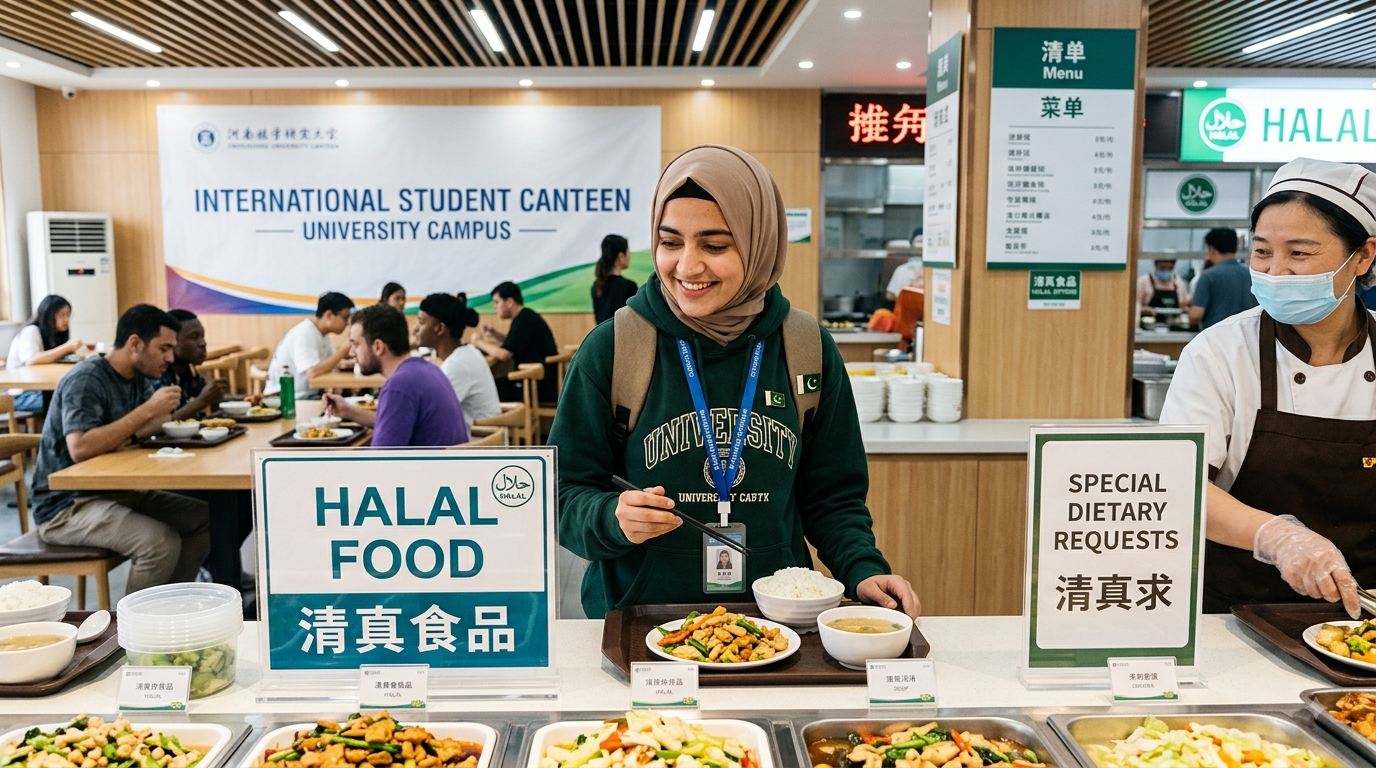
Moving to China for university does not mean giving up familiar food habits, but students need to plan for dietary differences before arrival. Pakistani students, particularly those following a halal diet, should check campus dining facilities, understand common Chinese food ingredients, identify nearby halal restaurants, and learn a few useful Chinese food terms. Many Chinese universities provide Muslim or halal dining options, but availability varies by campus and city. For example, Tsinghua University lists Muslim food among its campus dining options, while Xiamen University has a dedicated halal canteen.
Food planning matters because diet affects daily comfort, health, study routines, and monthly budgeting. Students with halal, vegetarian, vegan, allergy-related, or medically restricted diets should investigate their university’s food arrangements before accepting an admission offer. A university can have strong academic credentials but still be inconvenient if suitable food is difficult to access.
From an education-advisory perspective, food is often overlooked during university selection. Students tend to compare tuition, rankings, accommodation, and scholarships first, then discover after arrival that a particular campus has limited dietary choices. Checking dining halls, accommodation rules, local restaurants, grocery access, and food preparation facilities in advance can prevent this problem.
What Pakistani Students Should Expect From Food in China?
Chinese cuisine is extremely diverse, so food experiences differ considerably between provinces and cities. Rice, noodles, dumplings, vegetables, tofu, eggs, chicken, beef, and seafood are common, but preparation methods and ingredients can be unfamiliar.
For Muslim students, the key term to recognize is 清真 (Qingzhen), commonly used for halal food. Several universities officially provide Muslim or halal dining areas. Xiamen University, for example, states that its Siyuan Dining Hall has a dedicated halal canteen.
| Dietary Need | What Students Should Check | Practical Approach |
|---|---|---|
| Halal | Dedicated Qingzhen or Muslim dining areas | Confirm whether the university has a certified or designated halal facility |
| Vegetarian | Ingredients, sauces and cooking methods | Ask whether meat stock or animal-based ingredients are used |
| Vegan | Oils, sauces, dairy and eggs | Confirm preparation ingredients rather than relying only on the dish name |
| Food allergies | Ingredient lists and cross-contact | Carry translated allergy information and communicate clearly |
| Pakistani-style food | Availability of familiar spices and dishes | Identify nearby Pakistani, Indian or South Asian restaurants |
| Medical diet | Ingredients and preparation methods | Discuss requirements with the university before arrival |
How to Find Halal Food on Campus
The easiest starting point is the university’s international student office. Do not rely solely on general university advertisements. Check the specific campus where the program will be taught because large universities can operate several campuses with different dining facilities.
Some universities provide particularly clear information. University of Science and Technology Beijing states that Muslim meals are available on the third floor of Hongbo Canteen. University of Science and Technology of China also identifies canteens offering halal food and explains that students generally use campus cards to purchase meals.
| University Dining Check | Why It Matters | What to Confirm |
|---|---|---|
| Halal canteen | Determines whether daily meals are convenient | Location, operating hours and meal availability |
| Separate halal counter | May provide additional choices | Whether preparation is specifically designated halal |
| Campus card | Often required for canteen purchases | How international students obtain and recharge it |
| Dining hours | Canteens may close between meals | Breakfast, lunch and dinner timings |
| Vacation arrangements | Some facilities operate reduced schedules | Whether halal food remains available during holidays |
| Off-campus options | Useful when campus choices are limited | Restaurants and supermarkets near accommodation |
Nankai University is another example where the official international student information lists a dedicated halal restaurant on campus.
Learn the Food Terms Before You Arrive
A small amount of Chinese vocabulary can make daily meals much easier. Students do not need advanced Mandarin to manage food, but knowing dietary terms can reduce misunderstandings.
| Chinese Term | Meaning | When It Helps |
|---|---|---|
| 清真 (Qingzhen) | Halal | Finding Muslim or halal food |
| 穆斯林 (Mùsīlín) | Muslim | Explaining dietary requirements |
| 素菜 (Sùcài) | Vegetarian dishes | Identifying vegetable-based meals |
| 不要肉 (Bù yào ròu) | No meat | Requesting food without meat |
| 牛肉 (Niúròu) | Beef | Identifying beef |
| 鸡肉 (Jīròu) | Chicken | Identifying chicken |
| 猪肉 (Zhūròu) | Pork | Checking for pork |
| 海鲜 (Hǎixiān) | Seafood | Identifying seafood ingredients |
| 鸡蛋 (Jīdàn) | Egg | Checking whether eggs are included |
| 牛奶 (Niúnǎi) | Milk | Identifying dairy |
However, simply saying “no meat” may not be enough for strict dietary requirements. NYU Shanghai specifically advises vegetarian students to use sucai because seafood may not necessarily be understood as “meat” in the same context. The university also notes that sauces, oils and broths can make ingredient identification difficult for vegan students.
Managing Food When Campus Options Are Limited
Students should have more than one food strategy. Depending entirely on a single campus restaurant can become difficult during weekends, holidays, examinations, or changes to dining schedules.
A practical system is to combine three sources: campus dining, nearby restaurants and groceries.
Campus Dining
University canteens are usually the most convenient option because they are close to classrooms and accommodation. Some institutions have multiple dining halls with different cuisines.
Tsinghua University, for instance, reports more than 10 student dining halls, including Muslim and Western food options.
Local Restaurants
Students can search for Qingzhen restaurants, Xinjiang-style restaurants, Pakistani restaurants and other Muslim-friendly establishments. Before ordering, confirm whether the restaurant’s halal claim meets the student’s personal requirements.
Grocery Shopping
Keeping basic ingredients in accommodation can provide a backup when suitable prepared food is unavailable. Rice, oats, lentils, spices, tea, eggs, vegetables and packaged foods can help students maintain familiar eating patterns.
However, students should first check accommodation rules before planning to cook. Some university dormitories restrict cooking or the use of heating appliances.
Food Safety and Dietary Health
Students should avoid assuming that every unfamiliar dish is unsafe, but they should also avoid taking unnecessary risks. China has a formal food safety and inspection framework for imported food, with the General Administration of Customs responsible for inspection and quarantine requirements. China also revised its imported-food oversight rules in 2026.
| Food Safety Consideration | Recommended Action |
|---|---|
| Unfamiliar ingredients | Ask before ordering |
| Street food | Choose busy, hygienic vendors and observe food handling |
| Food allergies | Carry written allergy information in Chinese |
| Packaged food | Check labels and expiry dates |
| Refrigerated products | Check storage conditions |
| Sudden dietary changes | Introduce unfamiliar foods gradually |
| Persistent illness | Seek medical attention rather than self-treating |
Students with serious allergies or medically prescribed diets should discuss their needs with the university before travelling. Dietary restrictions requiring medication or emergency treatment should also be documented appropriately.
Build Food Planning Into the University Selection Process
Food should not normally determine the entire university decision, but it deserves consideration alongside academic and practical factors.
China’s higher education system is extensive. China’s Ministry of Education reported 271,064 international students enrolled in higher education institutions in 2024, showing the substantial international student population within the country’s university system.
This does not mean every university provides the same level of international support. Students should compare the actual campus environment rather than assuming facilities are identical.
| Factor | What to Evaluate | Why It Matters |
|---|---|---|
| Academic fit | Course content and teaching language | Determines educational suitability |
| Food access | Halal, vegetarian or other dietary facilities | Affects daily living |
| Accommodation | Cooking and food-storage rules | Determines backup food options |
| Location | Nearby restaurants and supermarkets | Provides alternatives to campus dining |
| Language | Ability to communicate dietary needs | Reduces ordering mistakes |
| Budget planning | Food, groceries and occasional eating out | Helps manage monthly expenses |
| Career goals | Degree recognition and professional pathway | Connects study choice to long-term plans |
What Students Should Assess Before Moving Forward?
Before selecting a Chinese university, students should consider food as part of the wider living and study environment.
The most important questions are whether halal food is available consistently, how far the dining facilities are from accommodation, whether cooking is permitted, and whether nearby grocery stores and restaurants provide alternatives.
Budget planning should also account for occasional off-campus meals. Students should avoid building their entire financial plan around the assumption that every meal will be available from the cheapest campus dining option.
Language preparation is equally important. A student who can identify basic ingredients and communicate dietary restrictions is better prepared to manage everyday situations independently.
Finally, food convenience should be evaluated alongside academic recognition, admission requirements, scholarship conditions, visa compliance and long-term career plans. A comfortable food environment is valuable, but it should support rather than replace careful university selection.
How Study Sphere Advisors Supports Students?
University Selection Guidance
Study Sphere Advisors can help students compare university options using practical criteria beyond academic programs, including campus facilities and suitability for international students.
Admission Processing Support
Admission planning includes reviewing university-specific requirements and helping students organize documentation according to the institution’s stated process.
Pre-Departure Support
Students can receive practical preparation guidance before travelling, including considerations that affect everyday life after arrival in China.
Student Visa Guidance
Study Sphere Advisors can assist students in understanding the documentation and procedural requirements connected with their student visa application.
Questions Students Usually Ask Before Applying
Should Pakistani students only choose universities with halal canteens?
No. A dedicated halal canteen can make daily life easier, but students can also consider universities with reliable Qingzhen restaurants and suitable food options nearby. The important point is to verify the actual arrangements before enrolment.
Is Pakistani food easily available in China?
It depends heavily on the city and university location. Larger and more internationally connected cities generally provide more restaurant choices, but students should investigate their specific campus area rather than assume availability.
Can students cook Pakistani food in their dormitories?
Not necessarily. Dormitory rules differ, and some residences restrict cooking or electrical heating appliances. Students should confirm the rules with the university before planning to cook regularly.
Should food availability affect university selection?
Yes, but as one factor among several. Academic quality, degree recognition, admission requirements, finances and career objectives should remain central to the decision.
Additional Questions Students Often Have
What is Qingzhen food?
Qingzhen is the Chinese term commonly associated with halal food and Muslim dietary practices. Students can look for 清真 signage when searching for suitable restaurants.
Do Chinese universities provide international food?
Many universities offer multiple cuisines, but the range varies significantly. Some have Muslim, Western, vegetarian or international dining facilities, while others rely more heavily on traditional Chinese canteens.
Can students use food delivery services?
Food delivery is widely used in major Chinese cities, and some universities specifically mention delivery as an option. However, students should still verify restaurant ingredients and halal status rather than relying only on restaurant names or photographs.
What should students do during university holidays?
Students should check whether campus dining halls remain open during vacations. Some universities reduce or temporarily suspend dining services during academic breaks, making nearby restaurants and groceries particularly important.
What if a student has a serious food allergy?
The student should communicate the allergy clearly before arrival, carry translated information, understand emergency procedures, and identify appropriate medical support near the university.
Conclusion
Managing food and dietary needs as a Pakistani student in China is mainly a matter of preparation. Halal food is available at many Chinese universities, but facilities differ by institution, campus and city. Students should verify dining arrangements directly, learn basic Chinese food terminology, identify backup restaurants and grocery options, and understand accommodation rules before departure.
Food should also be considered within the larger university decision. Academic fit, degree recognition, admission requirements, scholarship conditions, visa compliance, living arrangements and career plans should all be evaluated together. A university that works well academically and provides a manageable daily environment is more likely to support a positive study experience.
A Practical Next Step for Students
Students evaluating study options can benefit from checking university dining facilities alongside admission, scholarship and visa requirements. Study Sphere Advisors supports students with university selection, admission processing, pre-departure preparation and student visa guidance. Students seeking personalized guidance can contact the advisory team through the official Study Sphere Advisors website for information about studying in China.
Leave a Reply