
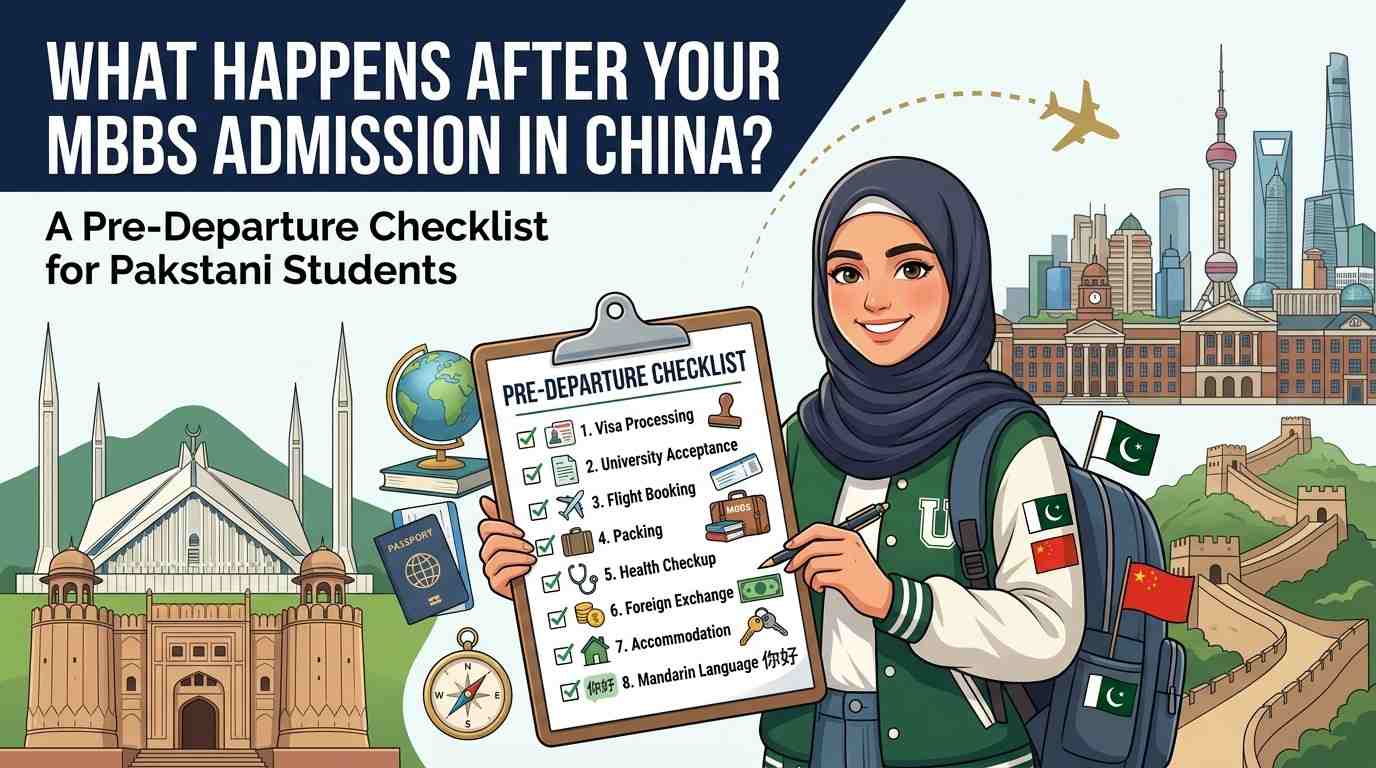
Getting an MBBS admission offer from a Chinese university is an important milestone, but it is not the final step. After admission, Pakistani students still need to verify the offer, complete university formalities, prepare documents, apply for the correct Chinese study visa, arrange travel, and understand what must be completed after arrival.
The post-admission stage matters because mistakes with documents, visa paperwork, deadlines, accommodation, or university requirements can create avoidable delays. The process can also differ between English-taught and Chinese-taught medical programs. For example, some 2026 MBBS programs require CSCA results, while Chinese-medium clinical medicine programs may additionally require HSK certification.
Based on common admission and visa processing patterns, students should treat the admission letter as the starting point for pre-departure preparation, not simply as confirmation that everything is finished.
[Image: Pakistani student reviewing a Chinese university MBBS admission letter and pre-departure documents]
1. Verify Your MBBS Admission Documents First
Before booking a flight or submitting a visa application, carefully check the documents issued by the university. The university’s requirements should always take priority because admission procedures vary between institutions.
| Document | Mandatory | What to Check |
|---|---|---|
| Admission Letter | Yes | Student name, passport number, program, intake and study duration |
| JW201/JW202 or Confirmation Form for Study in China | Usually required for X1 visa | Ensure the information matches the admission documents |
| Passport | Yes | Name and passport details must match university records |
| Academic documents | Yes | Original certificates and transcripts should be available for verification |
| Physical examination documents | University/visa dependent | Check validity period and required format |
| Scholarship confirmation | If applicable | Confirm exactly what expenses are covered |
| University registration instructions | Yes | Note reporting date, campus and registration procedure |
The Chinese Embassy in Pakistan lists the admission letter and JW201/JW202 among the key documents for an X1 student visa application.
A practical mistake seen in international admissions is assuming that a provisional or pre-admission letter is equivalent to the final admission package. Students should confirm whether the university has issued the final documents required for visa processing.
2. Complete the Final University Requirements
An admission offer does not necessarily mean that every university condition has been completed.
| Requirement | What the Student Should Do | Why It Matters |
|---|---|---|
| Final academic certificate | Submit after graduation if a provisional document was used | University may require final verification |
| CSCA result | Confirm whether the program requires it | Requirements vary by university and intake |
| English proficiency | Submit required evidence if applicable | Some English-taught MBBS programs require proof |
| HSK | Check if applying to a Chinese-medium program | Chinese-taught programs can have specific HSK requirements |
| Medical examination | Complete according to university instructions | May be needed for registration or residence formalities |
| Deposit/registration payment | Meet the stated deadline | Missing the deadline can affect admission status |
| Original documents | Prepare physical copies | Universities may verify originals at enrollment |
For example, the 2026 English-taught MBBS program at Shanghai Jiao Tong University School of Medicine requires a six-year program structure and CSCA results, while Xiamen University’s 2026 MBBS guidance states that its English-taught program does not require HSK for admission.
This illustrates why students should not assume that one university’s requirements apply to another.
3. Apply for the Correct Chinese Student Visa
For a Pakistani student enrolling in a long-term MBBS program, the relevant visa is generally the X1 visa, because it is intended for study in China exceeding 180 days.
| Visa Requirement | Description | Importance |
|---|---|---|
| X1 visa | For study exceeding 180 days | Essential for long-term MBBS study |
| Admission Letter | Issued by the Chinese university | Confirms admission |
| JW201/JW202 or Confirmation Form | Study-related visa document | Required for the relevant X1 application |
| Academic documents | Degree/certificate and marksheet as applicable | Supports educational background |
| Financial evidence | May be required under current visa instructions | Demonstrates financial capacity where applicable |
| Passport | Valid travel document | Required for visa processing |
| Visa application form | Completed according to current procedure | Required for submission |
The Chinese Embassy in Pakistan currently states that X1 applicants need the Confirmation Form for Study in China, a copy of the admission letter, and evidence of scholarship issuance or financial resources. Its current instructions mention financial resources of US$2,500 per academic year or equivalent Pakistani rupees, subject to the stated conditions.
Students should therefore check the latest embassy requirements immediately before submitting the application rather than relying on an older checklist.
4. Understand What Happens After Entering China
Obtaining the X1 visa does not mean the immigration process is completely finished.
| After Arrival | Requirement | Timeframe |
|---|---|---|
| University registration | Report according to the university’s instructions | As stated by university |
| Residence permit application | Apply through the relevant local exit-entry authority | Within 30 days of entry for X1 holders |
| Medical verification | Complete if required by local authorities/university | Follow local instructions |
| Residence registration | Complete required registration procedures | As instructed after arrival |
| Student ID/university formalities | Complete institutional registration | During enrollment |
China’s National Immigration Administration states that foreigners whose visa requires a residence permit must apply within 30 days after entry. For X1 holders, the student-type residence permit is linked to the period of study specified by the university.
This 30-day requirement is one of the most important items on the pre-departure checklist because missing it can create an immigration compliance problem.
5. Prepare a Complete Document Folder
Carrying only the documents submitted online can cause problems when a university asks to inspect originals.
| Document | Original | Copies | Recommended Preparation |
|---|---|---|---|
| Passport | Yes | 2-3 | Keep securely accessible |
| Admission Letter | Yes | 2-3 | Carry in hand luggage |
| JW201/JW202 or study confirmation | Yes | 2-3 | Keep with visa documents |
| Academic certificates | Yes | 2-3 | Carry originals and copies |
| Academic transcripts | Yes | 2-3 | Organize chronologically |
| Medical documents | If required | 1-2 | Keep recent versions |
| Scholarship letter | If applicable | 2-3 | Keep with financial documents |
| Passport photographs | Recommended | Several | Useful for university paperwork |
| Emergency contacts | Yes | Several | Include university and family contacts |
Students should also keep secure digital scans of important documents. Cloud storage and an offline copy on a phone or laptop can be useful if an original document is misplaced.
6. Plan Your Budget Before Leaving Pakistan
The admission letter may show tuition information, but students should calculate the actual first-year financial requirement before departure.
| Budget Area | What to Consider |
|---|---|
| Tuition | Amount stated by the university |
| Accommodation | University dormitory or approved alternative |
| Food | Daily living expenses |
| Insurance | University or scholarship requirements |
| Visa expenses | Application-related costs |
| Travel | Flight and local transportation |
| Study materials | Books, equipment and academic supplies |
| Emergency funds | Unexpected personal or academic expenses |
Scholarship coverage also needs careful reading. The Chinese Government Scholarship framework can provide full or partial support, and full scholarship packages may include tuition, accommodation, medical insurance and a living allowance. Coverage depends on the specific scholarship and program.
| Scholarship Type | Possible Coverage | Important Point |
|---|---|---|
| Chinese Government Scholarship | Tuition, accommodation, medical insurance and stipend under applicable full-scholarship schemes | Eligibility and participating programs vary |
| University Scholarship | May cover tuition or other selected expenses | Check the university’s specific award |
| Partial Scholarship | One or more covered components | Student remains responsible for uncovered costs |
| Self-funded Admission | Student bears applicable study and living costs | Follow university payment schedule |
Do not assume that receiving a scholarship means every personal expense is covered.
Factors Students Should Assess Before Moving Forward
The decision after admission should not be based solely on receiving an offer.
| Factor | Questions to Ask |
|---|---|
| Academic fit | Does the curriculum match your long-term medical goals? |
| University status | Is the institution appropriate for your intended licensing pathway? |
| Clinical training | Where does clinical training and internship take place? |
| Recognition | Have the relevant Pakistani and international recognition requirements been checked? |
| Language | Is the program genuinely English-taught, and what Chinese language requirements apply during clinical training? |
| Budget | Can the family manage tuition and living expenses throughout the program? |
| Visa compliance | Are all current X1 visa and residence requirements understood? |
| Career plans | Do you intend to return to Pakistan or pursue another country’s licensing pathway? |
For Pakistani students, recognition deserves particular attention. The Pakistan Medical and Dental Council maintains official information on recognized institutions and related medical education matters, so students should verify the current recognition status and applicable requirements before committing to a medical program rather than relying on an agent’s list or an old social-media post.
How Study Sphere Advisors Supports Students
University Selection Guidance
Study Sphere Advisors can help students compare university requirements, program structures, recognition considerations and admission conditions before the student finalizes an institution.
Admission Processing Support
Support can focus on organizing admission documentation, checking application requirements and helping students understand additional university conditions after receiving an offer.
Study Visa Assistance
Study Sphere Advisors can assist students in understanding the documentation required for the Chinese study visa and preparing the application file according to current requirements.
Pre-Departure Support
Students can receive guidance on document preparation, university registration expectations and practical preparations before travelling to China.
Work Visa Consultation
Students planning to pursue employment after completing their MBBS can receive guidance on understanding potential work visa pathways, documentation requirements and eligibility considerations in their intended destination.
Questions Students Usually Ask Before Applying
Does an admission letter guarantee a student visa?
No. Admission and visa decisions are separate. The applicant must satisfy the current visa requirements and provide the required supporting documents.
Can a student travel to China immediately after receiving admission?
Not necessarily. The student should first complete the university’s required formalities and obtain the appropriate visa documents before making final travel arrangements.
Is HSK required for every MBBS program in China?
No. Requirements depend on the language of instruction and university. Some Chinese-medium programs require HSK, while some English-taught MBBS programs do not.
Should students buy a flight before receiving the visa?
It is generally safer to wait until the visa and university reporting arrangements are confirmed, unless the university or visa center provides specific instructions requiring otherwise.
Additional Questions Students Often Have
What should students do if their passport expires soon?
Renew it before completing major university and visa formalities if the university or visa authority requires longer validity. Passport information should remain consistent across the admission and visa documents.
Can an X1 visa be used throughout the entire MBBS degree?
The X1 visa is for entry for long-term study. After entering China, X1 holders must complete the required residence-permit process within 30 days.
Can international MBBS students work part-time in China?
Students should not assume that a student residence permit automatically authorizes off-campus employment. China’s National Immigration Administration states that approved students must have the relevant work-study or internship information recorded on the residence permit before undertaking permitted off-campus activities.
What if the university changes the reporting date?
Students should obtain updated instructions directly from the university and ensure that travel plans, accommodation and immigration arrangements remain consistent with the revised schedule.
Should students carry original academic documents to China?
Yes. Universities can require original documents for verification during enrollment, so keeping originals securely in hand luggage is a sensible precaution.
Final Words
After receiving an MBBS admission in China, the next priority is not simply booking a flight. Students need to move through a sequence of checks: verify the admission package, complete outstanding university requirements, prepare the X1 visa file, organize finances and documents, and understand the residence-permit procedure after arrival.
For Pakistani students, university recognition, clinical training, language requirements and future licensing plans deserve the same attention as admission itself. A university may offer an attractive program, but the right choice should ultimately fit the student’s academic background, financial capacity, visa situation and long-term medical career plans.
Student Guidance and Support
Students evaluating their study abroad options often benefit from structured guidance when comparing universities, admission requirements, scholarships, visa documentation and long-term career considerations. Study Sphere Advisors assists students with educational pathway planning, admission processing, study visa guidance and pre-departure preparation. Students seeking personalized guidance can contact the advisory team through the official website for further information.
Leave a Reply