
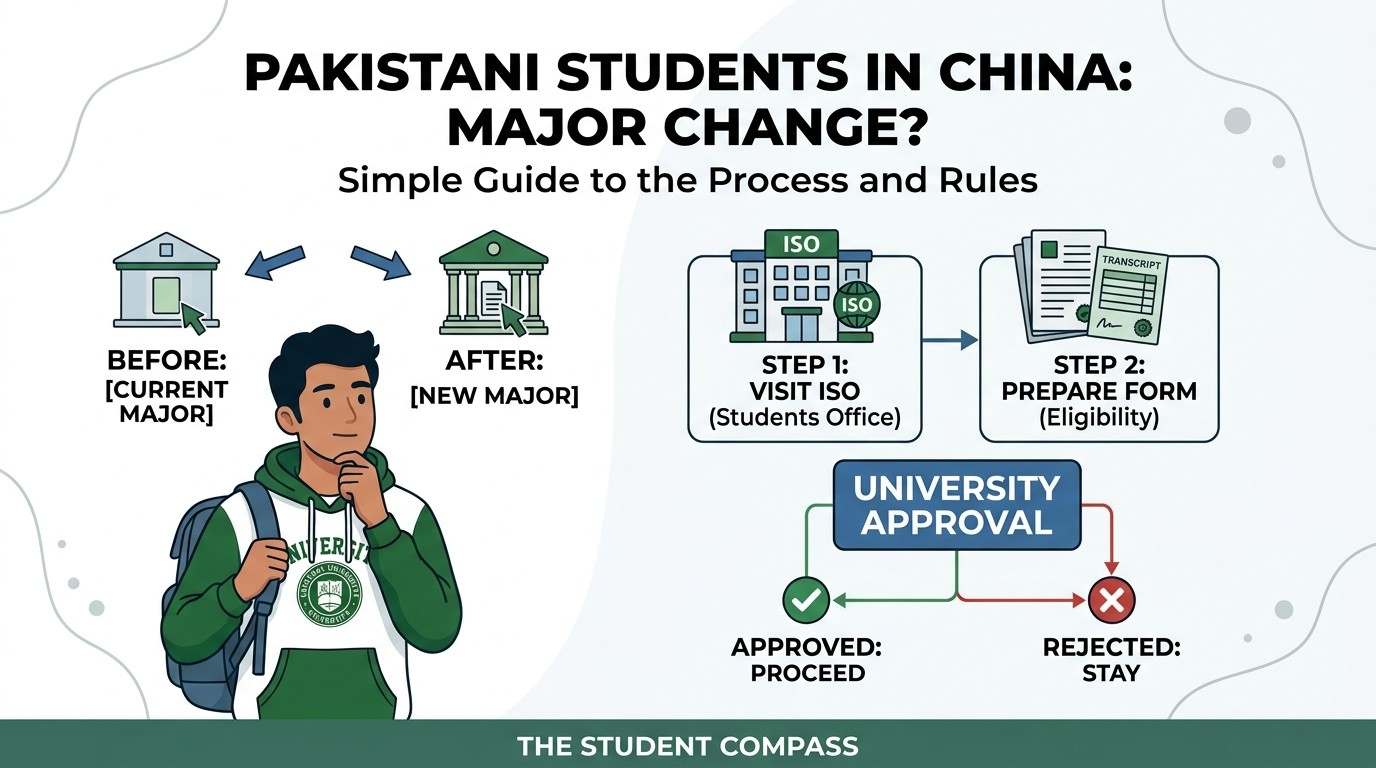
Yes, Pakistani students can sometimes change their degree program after arriving in China, but it is not an automatic right. Approval usually depends on the university’s internal rules, the student’s academic record, available places in the new program, language ability, and whether the change affects the student’s admission and residence status. Students should receive formal approval before stopping their current course or starting a new one.
This decision can affect more than academics. A change from MBBS to another degree, from an English-taught program to a Chinese-taught program, or from one university to another may require new admission documentation and updates to immigration records. Students also need to consider lost credits, scholarship conditions, professional licensing and future career plans.
From an advisory perspective, one of the most common mistakes is treating a degree change as an informal academic decision. In practice, students should first confirm whether the receiving department will accept them and then check how the university’s international student office and local exit-entry administration require the change to be documented. China’s Ministry of Education reported 271,064 international students enrolled in higher education institutions in its latest published national statistics, showing the scale of the international student system students must navigate.
When Can a Student Request a Program Change?
Universities set their own procedures, so there is no single rule that guarantees every Pakistani student the right to switch programs. Some institutions may allow changes within the same academic field more easily than a move into a restricted or highly specialised program.
| Situation | Possibility of Program Change | Key Consideration |
|---|---|---|
| Change within the same university | May be possible | Requires approval from the relevant academic departments |
| Change to a related subject | May be easier | Previous coursework may be partially relevant |
| Change to a highly regulated program | More restricted | Entry standards and professional requirements may apply |
| Change from English to Chinese medium | Possible in some cases | Chinese-language proficiency may be required |
| Change from one university to another | Usually treated separately | New admission and immigration procedures may apply |
| Change after significant academic progression | More complex | Credit loss and graduation delays may occur |
Students should not assume that passing one program automatically qualifies them for another. For example, a student leaving an engineering course for clinical medicine may need to meet the full entry requirements for medicine rather than simply transfer existing credits.
University Approval Comes First
The first step should be obtaining written confirmation from the current university and, where relevant, the department offering the new program. Universities may review academic performance, attendance, disciplinary records and the student’s reason for requesting the change.
| Requirement | Details | Notes |
|---|---|---|
| Formal application | Written request to change the program | Internal procedure varies by university |
| Academic record | Current transcripts or grades | Strong performance may support the request |
| Department approval | Approval from the receiving department | Subject to available capacity |
| Eligibility review | Confirmation that entry requirements are met | Previous admission does not guarantee eligibility |
| Language evidence | HSK or other required proof | Particularly relevant for Chinese-taught programs |
| Updated admission documents | May be required | Depends on the nature of the change |
Students should request written confirmation rather than relying only on verbal advice from classmates or informal university conversations.
How a Degree Change Can Affect the Student Visa?
For programs longer than 180 days, international students generally enter China on an X1 visa and then apply for a residence permit after arrival. The National Immigration Administration states that applicants requiring a residence permit should complete the required procedures, and changes to relevant registered information or the purpose of residence may require alteration formalities.
| Visa or Immigration Issue | Possible Requirement | Why It Matters |
|---|---|---|
| Change in study details | Updated supporting documents | Immigration records must remain accurate |
| Change of university | New admission documentation may be needed | The original sponsoring institution may change |
| Change of residence permit information | Application for alteration may be required | Changes should not be ignored |
| Residence permit expiry | Extension application where required | Delays can create immigration problems |
| New study purpose or arrangement | Supporting evidence from the institution | Authorities may assess the basis for continued residence |
The National Immigration Administration states that where registered information on a foreigner’s residence permit changes, the holder should apply for alteration formalities within the required period and provide supporting documentation.
Because local implementation and university procedures can differ, students should confirm the exact process with the international student office and the relevant exit-entry administration before making the academic switch.
Bonus Tip: Do not withdraw from the current program before receiving written confirmation that the new academic arrangement and immigration documentation can proceed.
What Happens to Completed Credits?
Credit transfer is often one of the biggest practical concerns. A student may not receive full credit for completed courses, especially when moving between unrelated disciplines.
| Type of Program Change | Likelihood of Credit Recognition | Potential Academic Impact |
|---|---|---|
| Same subject, same university | Higher | Limited interruption may be possible |
| Related subject | Moderate | Some courses may transfer |
| Unrelated subject | Lower | Student may repeat foundation courses |
| Change to medicine or another regulated field | Case-specific | Full entry requirements may apply |
| Change to a new university | Depends on both institutions | Transcript evaluation is usually required |
A student who changes programs primarily to solve an academic difficulty should also assess whether the new course genuinely matches their strengths. Changing programs without reviewing the curriculum can simply move the problem to a different subject.
Scholarships May Not Transfer Automatically
Scholarship conditions are usually linked to a specific university, program, academic year or performance requirement. A program change can therefore affect existing financial support.
| Scholarship Factor | What Students Should Check | Risk |
|---|---|---|
| Program eligibility | Whether the new degree qualifies | Funding may end |
| University approval | Whether the scholarship provider permits the change | Award may require reassessment |
| Academic performance | Minimum grades or progression standards | Failure to meet conditions may affect renewal |
| Language requirements | Required proficiency for the new program | Additional preparation may be necessary |
| Duration of study | Whether the new course extends graduation | Extra study periods may not be funded |
Some universities listed on Study Sphere Advisors’ China pages attach scholarship continuation or academic progression to specific conditions, including language requirements. Students should therefore review the written scholarship terms before changing programs.
Bonus Tip: Ask for the scholarship decision in writing. An academic department may approve a program change without having authority to guarantee that existing funding will continue.
Special Considerations for Pakistani Medical Students
Students considering a move into or out of MBBS should take additional care. Medical education involves professional and licensing implications that may not apply to general degree programs.
For Pakistani students planning to return and practise medicine in Pakistan, the suitability and recognition status of the chosen institution and qualification should be checked against the applicable requirements of the relevant authorities. A change to a different university or program should therefore be evaluated for its long-term licensing consequences, not only its immediate admission outcome.
Study Sphere Advisors’ current university guidance also highlights that language and program structures can differ significantly between institutions. Some programs require students to meet specific HSK milestones before progressing or graduating.
| Consideration | Why It Matters |
|---|---|
| University and program status | Recognition requirements may affect future plans |
| Language progression | Clinical or academic progression may depend on HSK requirements |
| Program duration | A change may extend the total study period |
| Licensing pathway | Graduation alone may not establish the right to practise |
| Clinical training | The new curriculum may have different internship requirements |
Factors That Deserve Careful Evaluation
Before submitting a change request, students should compare the academic and long-term consequences.
| Decision Factor | Questions to Ask |
|---|---|
| Budget planning | Can the student manage additional semesters if credits are not transferred? |
| Academic fit | Does the new subject match the student’s strengths and interests? |
| Career goals | Does the qualification support the intended profession or postgraduate pathway? |
| Visa compliance | What documents must be updated before the change takes effect? |
| Language requirements | Is the student’s Chinese or English proficiency sufficient? |
| Scholarship position | Will existing funding continue, change or end? |
| Post-study opportunities | Does the new qualification support the student’s intended country or career pathway? |
Bonus Tip: Students who change programs early often have more flexibility than those who wait until several years of study have been completed. However, an early change should still follow the university’s formal process.
Common Questions Before Taking Action
Should a student change programs because the current course is difficult?
Difficulty alone should not be the only reason. Students should identify whether the issue is the subject, teaching language, adjustment to China or temporary academic pressure.
Is it better to change programs within the same university?
It may reduce some administrative complexity, but approval, eligibility and credit recognition still depend on university rules.
Can a student start attending the new program before approval?
Students should not assume that informal permission is sufficient. Formal confirmation is important for academic records and immigration compliance.
What should parents check before supporting a program change?
Parents should ask about the revised graduation date, credit loss, scholarship consequences, immigration documentation and future career implications.
How Study Sphere Advisors Supports Students?
- University Selection Guidance
- Study Sphere Advisors can help students compare program structures, language requirements and academic pathways before deciding whether a change is appropriate.
- Admission Processing Support
- Students can receive guidance on preparing academic documents and understanding the admission requirements of a proposed new program.
- Study Visa Guidance
- Guidance can help students understand the importance of maintaining accurate study and immigration documentation during approved academic changes.
-
Work Visa Guidance
- Study Sphere Advisors can provide guidance on understanding work visa requirements and documentation for students planning to explore employment opportunities after completing their studies.
- Visa Documentation Assistance
- Students can receive support in organising relevant documentation required for their next academic or visa-related step.
Additional Questions Students Often Have
Can Pakistani students change their major during the first year in China?
Possibly. The university’s academic regulations, the receiving department’s approval and the student’s eligibility will determine the outcome.
Will changing a degree automatically cancel a scholarship?
Not necessarily, but students should not assume that funding transfers. The scholarship provider or university must confirm the position.
Can credits from the old program be used in the new degree?
Some credits may be recognised when subjects are academically equivalent. Unrelated programs may require substantial coursework to be repeated.
Does a program change affect the residence permit?
It can. Changes involving the student’s institution or registered study arrangements may require updated documentation or alteration procedures.
Can a student change from an English-taught course to a Chinese-taught course?
Potentially, but the student may need to meet the university’s Chinese-language requirements before entering the new program.
Conclusion
Changing a degree program after arriving in China is possible in some situations, but it should be treated as an academic, financial and immigration decision rather than a simple change of preference. University approval, eligibility, credit recognition, scholarship conditions, language requirements and residence documentation all deserve careful review.
Pakistani students should first clarify their academic goals, obtain written confirmation from the relevant university offices and understand how the change could affect their visa status and graduation timeline. The strongest decision is usually the one based on documented requirements and long-term career planning rather than a quick response to temporary academic difficulties.
Discussing the Next Academic Step
Students evaluating a program change or a new study pathway often benefit from structured guidance when comparing university requirements, admission options and visa documentation. Study Sphere Advisors supports students with relevant university selection, admission processing, study visa guidance and documentation assistance.
For further information, students can contact the advisory team at +92 3193371281 or studysphereadvisor@gmail.com.
Leave a Reply